Showing posts with label korea. Show all posts

Saturday, February 28, 2015

Planning on a Hospital Stay in South Korea? Don't Forget Your Extended Family

"I want to use the restroom," I said in my best Korean. The nurse stopped in her tracks and tilted her head as she considered what I had said.

"Where are your friends?" she asked.

Confused, I cast a glance at the clock hanging above my bed. "Working," I said in bewilderment.

The nurse sighed and hurried out of the room with one last glance in my direction. She returned after a moment with a wheelchair from the hallway and helped me navigate myself into it, taking special care of my wires and recently operated leg. I got the distinct impression that the nurse really didn't want to help me into that restroom, despite the task being what I had thought was part of her job. 

Later,  I would learn that the responsibilities of nurses in South Korea are, in fact, vastly different from those in the USA.

In America, nurses do a variety of small jobs. They hook up monitors, make note of the patient's fluid intake and output, check to see if the patient has been getting adequate rest, relay information given to them by the doctors, and ensure that the patient is following a prescribed diet if one exists. In many hospitals in South Korea, the story is quite different...

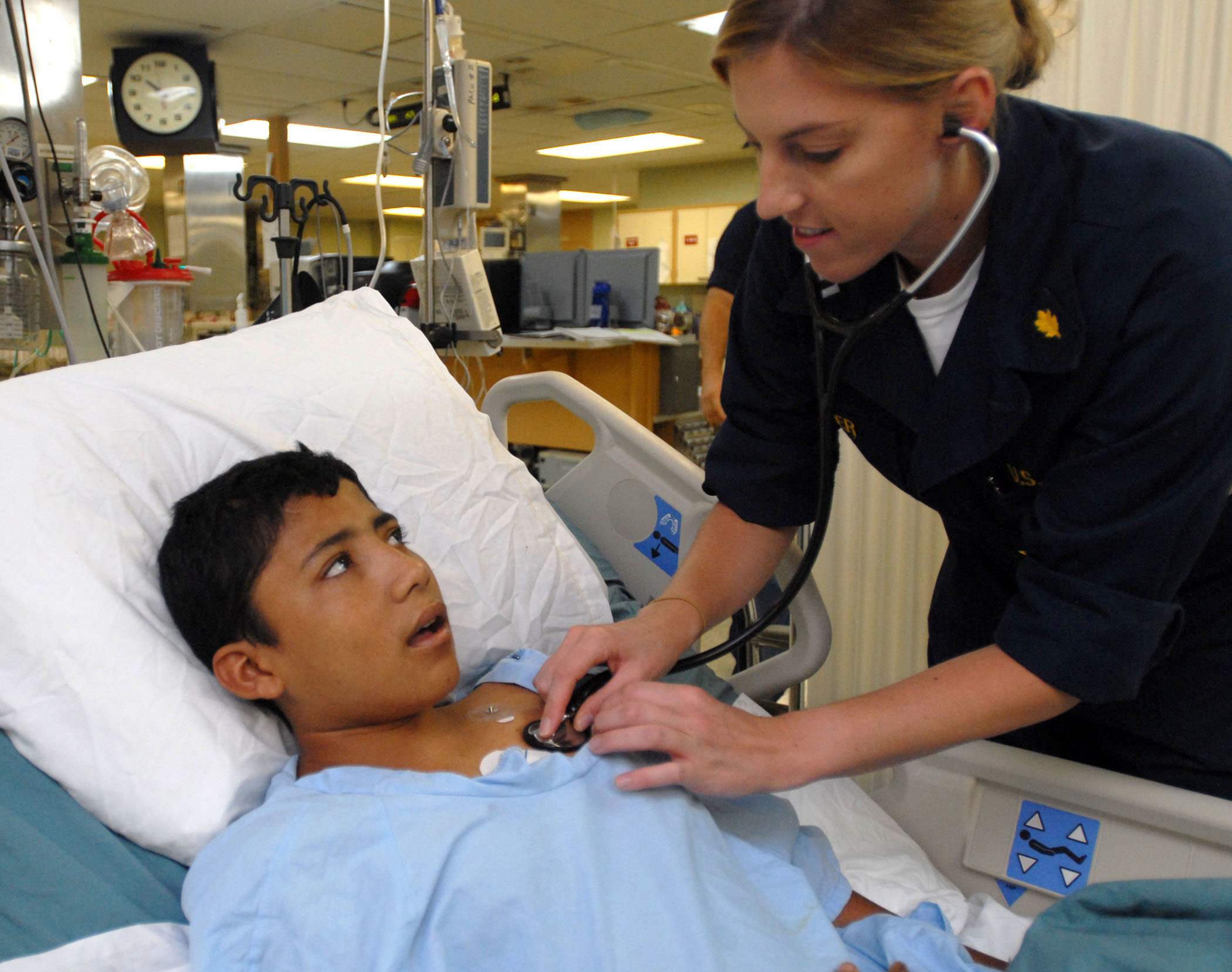
[caption id="attachment_3603" align="alignnone" width="2100"]Approved for release by USNS Comfort PAO LT Susan Henson (pao@comfort.navy.mil or sdhenson@comfort.navy.mil). An American nurse checks a boy's vital signs after surgery.[/caption]

I was asleep, finally. It was probably around 9 or 10 A.M. I remember having already been woken up around 5:30 A.M. for my morning butt injections. I hated those. I was victim to the nurses' needles at least three times per day. I switched sides on the nurses because each butt cheek would become so sore that sitting on it became uncomfortable. Later, someone would tell me that injections are cheaper than pills. Maybe that's why I was getting so many? I didn't know.

Anyway, it was around mid-morning, and I was finally asleep, when I suddenly heard the crinkling of cellophane. I opened my heavy eyes slowly, seeing only a wall of black fabric at first. It backed away from me, and surprised, I looked up and realized what I was seeing. A man in a suit was standing at my bedside and placing something beneath the pillow, where my face had just been a second before.

Why was a man sticking things under my head, and why was he waking me up when I was finally, finally asleep, I asked myself. By the time I opened my mouth, the man had moved on to give one of his bags to another patient. I propped myself up on my elbow and pulled the package out to look at it. It had several hard fruit candies inside with a religious leaflet. Ah. Advertising for a church, I realized.

I looked around the room. There were seven other patients and some of their family members. At the other end of the room, an older patient talked with a person I didn't recognize. They had Bibles in their hands.

In the United States, I have the impression that the nurse is like a knight standing guard between you, the patient, and the outside world. If a visitor comes into the hospital and brings forty friends, the nurse and/or nurses will not let the stress of forty visitors (plus one) into the room where the patient is fighting a battle to regain or maintain newly-won good health. It wasn't long ago that men weren't allowed into birthing rooms. It wasn't long ago that children weren't allowed into hospitals. If it brings too much stress, or too many germs, the nurse forms a human barrier against it and keeps that riff-raff out of her kingdom.

And yet here I was, trying so hard to finally get some sleep, and a strange old man in a pinstriped suit was sticking candies under my pillow. He didn't even ask if I was diabetic! On a few occasions, a woman would come with huge trash bags full of things like panties, slippers, socks, and pajamas, which she would drape across our beds and start hawking right there in our room. Other patients would come in from other rooms while dragging their IV carts behind them. Then, people would actually buy this woman's underwear.

The American parts of me thought, "What the hell is going on here!?" How could people expect to get any sleep in these conditions, and did nobody care at all about the germs from outside? Seriously? The nurses weren't monitoring the things that were happening in that room at all. By this point, I had contacted my friends and coworkers and told them that the nurses made it clear to me that I would need help from someone other than them.

It is thus impossible for me to write this without making some mention of the gratitude I owe to so many people from outside the hospital. There were people who helped me take a shower, despite how awkward it is to help your friend undress and get in and out of a wheelchair while naked. There were friends who helped me repeatedly get into a bathroom that really wasn't meant for handicapped people. There were people who brought me home-made chili, fruit trays, chocolates, chips, candies, books to read, extra blankets, and pillows. One person even painted my nails. My boss came to make sure I used the restroom and got fresh water to drink at least every morning and every night. She held a cup and straw to my mouth and stayed with me for eight hours post-operation when I was told I wasn't allowed to lift my head from my bed. I never knew how loved I was until I needed to be loved in this way. Thank you.

[caption id="attachment_3604" align="aligncenter" width="758"]10339665_10154171431865427_5693786999891649622_n My boss's lovely daughter and my coworker's brand-new son during a wonderful visit that lifted my spirits.[/caption]

But the bottom line is, we had people barging into our rooms day and night, and the nurses were doing nothing. They didn't help us get our lunches, they didn't help us into the bathroom, they didn't even help me get down to the basement when I started physical therapy and learning to walk again. I began to think about what that meant for the hospital environment. It meant that we patients had to rely on other people to fight for our right to sleep and regular bathroom visits.

Because of this initially uncomfortable situation, I realized that the hospital is a much more cheerful and welcoming place when you rely on the help of your loved ones than on a stranger to care for you.

In thinking about it, I realized that if I had to choose between my own mother helping me get my pants down for a shower or having some stranger do it, I'd rather it be my own mother. On top of your own family members caring for you, the fact that my bed had no privacy curtain coupled with the fact that I was stuck in a room with seven other people meant that those seven other people were in the same plight as I was. Though some of them could walk, they understood what it meant to be there in that moment and to be stuck in it. One of the walkers would get our lunch trays and put them on or next to our beds, and the woman who did this for me always slammed mine down and yelled "EAT YOUR RICE!!" in Korean. It was like I had my very own angry Korean grandmother, and even though I really, really did not want to eat my rice, the fact that she wanted me to eat it made me very happy---and it even made me try a little bit.

Perhaps even worse than not monitoring who was coming or going, the nurses didn't seem to care whether we left---which we did. Every couple of days, one of the walkers would simply leave the hospital altogether (still wearing her gown and still pulling her IV behind her on a wheeled stand), and return with treats for us, having walked herself all the way to the supermarket and back. Why even stay in the hospital?

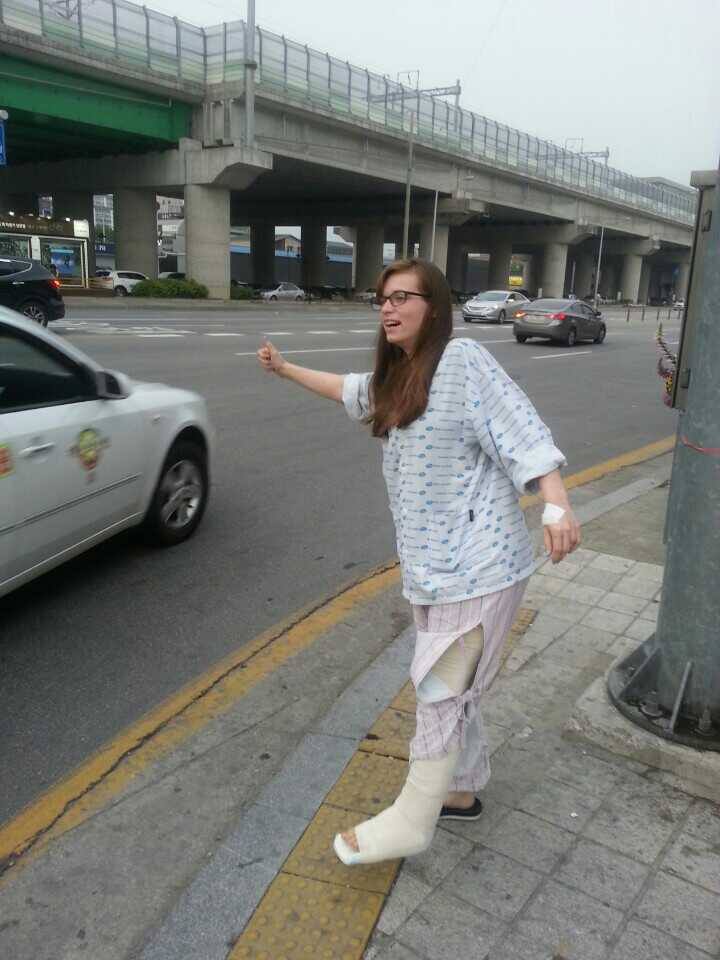
The surgery I had, while I don't recommend just going in and doing it for fun, is actually an out-patient procedure in the United States. However, in Korea, I had to beg them every day to let me leave. Finally, twelve days after my operation, they let me go...but they didn't know that I had actually left before. With the help of two friends, I decided to go outside and get some fresh air, and even go to a café just behind the hospital. We had a really good time taking pictures of me pretending to walk, but really just balancing on my good leg with the wheelchair out of view.

[caption id="attachment_3605" align="aligncenter" width="720"]10288803_10154185712995427_2972673619153327745_n I would have gotten away with it, if it weren't for that meddling conscience! People probably would've worried if I disappeared.[/caption]


[caption id="attachment_3606" align="aligncenter" width="720"]983681_10154185712845427_2643229393373262939_n It was about as soft as my bed. Top-notch spot for a nap.[/caption]

I thought very seriously about going home, but since I lived two floors up on slick granite floors and was completely unable to bend my leg, I decided to stay until they released me. So why do nurses not care if their patients come and go, why do they fill such minimalistic roles, and why do they not care who visits the patients?

I found an interesting blog written by a Canadian woman who talks about her child's stay in a Korean hospital, and she recounts many of the same things I've mentioned, though it seems that her hospital was furnished with more equipment than mine. It's important to remember that my story might stray from the norm.

Originally, my thought was that patients in Korea have long hospital stays because Koreans work hard and have stressful lives, so staying in a hospital grants them a reprieve from their responsibilities. I recall someone telling me that a hospital stay can be a bit like a vacation for people there, and I remember being a little horrified by the notion, because I would have much preferred to have been at work than confined to a bed. I did some digging around on the Internet and learned that there are incentives to having patients stay longer. Apparently, South Korea ranks #2 behind Japan in average length of hospital stays in the OECD.

In my reading, I also read that there are fewer nurses per patient in South Korea than there are in the US and in most other OECD nations. Perhaps this helps to explain why nurses seem to do so little for patients in Korea. Perhaps they're stretched thin. I came across an article advocating better treatment and conditions for nurses in South Korea, and it said:
“Nursing in the two countries also differs in many respects, too. For example, in addition to the much higher patient load in South Korea, nurses there are expected to fulfill many of the duties support personnel here in the United States would normally handle. Sung Hee Kwon, an operating room RN at Korea University Hospital, was impressed that OR nurses here never leave their patients’ bedsides. Back home, she is expected to also manage all the OR equipment, supplies, cleaning, set up, ordering, and inventory."

It appears that while I thought my Korean nurses simply didn't care much for me or that culturally they weren't expected to, what may have been happening is that they were simply too busy to devote to me and my fellow patients the kind of time and attention that I expected due to my American background. I am quite impressed by the number of tasks that nurses accomplish which have so little to do with direct patient care, like the management of inventory.

Another interesting excerpt from the article is this paragraph:
“We are still thinking about what number to propose in Korea,” said Yoo Ji Hyun, RN and secretary general of KMHU. “To start, we’re looking at a range from 1:5 to 1:10. But the hospital industry is attacking that, saying that 1:10 in Korea is about the same as 1:5 in the United States. That’s why we’ve come to compare actual nursing tasks to refute their argument.”

Why would the hospital industry attest that one nurse for ten patients in Korea is the same as one nurse for five patients in the US? I think it is making a reference to the apparent fact that much of the care patients receive in hospitals comes from patient family members and friends than from nurses. Given what I've learned about nurses' responsibilities, I'm inclined to disagree with this ratio.

Korean nurses don't do less; they do different things. Perhaps if Korean hospitals hired support staff to take care of some of their responsibilities, the nurses could devote more time to patients---but is it really better that way? When I think of my very own ajumma yelling at me to eat my rice, it honestly makes me think fondly of my time there somehow.

Perhaps they're already doing things in the best way possible.

Sunday, February 1, 2015

Whitewater Kayaking in South Korea

Greetings! Today, I will take you on another splendid journey through time. You have the honor of accompanying me as I recount my personal quest to go whitewater kayaking in South Korea. Is it possible? Is it popular? How can it be done? Not only will these questions be answered, but they will also be placed in a cultural context. Do you think you know everything there is to know about Korea? Have you thought about how recent Korean history may have shaped whitewater activity in the country? If you find yourself unable to answer these questions, continue reading.

Kayaking Becomes a Part of My Life


In my home state of Tennessee, whitewater activity generates millions of dollars in economic growth each year as a result of local tour businesses, the sale of locally-made equipment, and profits generated by the Tennessee Valley Authority (TVA). The TVA releases water from dams periodically in controlled amounts in order to provide whitewater for sport while conserving the state's resources. Arguably the most popular of such rivers, the Ocoee river generated over 40 million dollars in the space of a single year due to guided rafting trips alone. Two geographic features make this sport possible: mountains and moving water.

[caption id="attachment_3526" align="aligncenter" width="1452"]IMG_6207 resized I promise there's a raft in there somewhere.[/caption]

I had gone whitewater rafting on the Ocoee every Spring and Summer for a couple of years. One day, I brought my father along and my family was forever changed. Suddenly, my dear old dad put down his xbox controller and each member of my family had a kayak of his or her own. I like to joke that he hit his mid-life crisis, and instead of finding a younger woman and buying a sports car, he decided to throw us all in the river.

With our new kayaks (liquidlogic xp9's and an xp10 for my dad), we set out to learn everything we could. I had just gotten into the sport, having paddled a couple of small whitewater rivers in the area, when I surprised everyone and graduated from my university. Ready to step out into the great big world, I found myself in contact with a recruiter for teachers to go teach English as a foreign language in South Korea.

[caption id="attachment_3528" align="aligncenter" width="1304"]1557598_10154155800180427_8147608077929357128_n Apparently, this is what aging looks like.[/caption]

Moving to South Korea


When asked where in Korea I'd like to live, I said it didn't matter much to me- but that I liked the outdoors. I signed a contract with a school in the city of Chuncheon. “Chuncheon” means “spring river,” and is described as being one of Korea's best cities for nature and the outdoors. It's also called the city of three rivers, because of the three rivers that wind through it. Nestled in a mountain range in a mountainous country, it seemed like I would find whitewater there.

I lived in Korea for a total of 25 months. I am not sure if I ever saw a single kayak while there.

The Quest Begins: River Rafting and Sea Kayaking


I tried finding whitewater. I found dams, rivers, and waterfalls, but never heard of anyone actually kayaking whitewater. I learned that in the city of Inje, one can sign up for a rafting trip. Curious about how “big” the water would be, I did a search to see how the river was classed. Whitewater ranges in levels from class I-VI. Class I is very easy water to paddle. Class VI is something people rarely attempt, as rescue may be impossible and death likely. I wasn't able to find out what class the river rafting trip in Inje would be, so I decided to go and find out for myself.

[caption id="attachment_3532" align="aligncenter" width="1320"]Niagara Falls Do you recognize this class VI river? [The answer is at the end of the article].[/caption]River rafting in Inje would probably have been very enjoyable if I had not already been paddling larger water. If I had to make a guess, I'd say that Inje was a class I-II river. I was not satisfied, and I set out to find something bigger. Unfortunately, my Google searches were yielding nothing. I learned about a trip to a place called “Pirate's Island,” in Namhae. It was about as far away as possible from my home in the province of Gangwon-do, but among the other activities, the trip listed sea kayaking. I signed up to go on the trip and promptly fell ill. I had to cancel.

The next year, the same travel company advertised the same trip. I signed up and went. After travelling two hours by train to meet the travel company in Seoul, we drove overnight in a bus for five hours toward our destination. At this point, I had travelled seven hours. We started the morning by hiking up a mountain to the most beautiful temple I have ever seen in South Korea: Boriam Temple. We watched the sun rise over the sea. Its brightness spread across the sky and cleared away the twinkling lights of the ships at sea near the coastline along the stars perched in the sky above them. It was breathtakingly beautiful but I was distraced by my excitement for sea kayaking later in the day.

We left the temple and boarded the bus. After another hour of driving through winding mountain roads, while I coped with my fatigue and car sickness, we arrived at a beach. A tour guide left the bus, said he'd return, and after a few minutes he came back. He explained to everyone on the bus that due to choppy seas, we would not be kayaking.

Making a Greater Effort


The rest of the trip was enjoyable and I am glad I saw the temple, but after having travelled all night long and all morning, I was tired and disappointed. Upon returning home, I again searched for a place to go kayaking and came up with nothing. During a conversation with my dad, he told me that one of his friends working for Jackson Kayak, a company which designs and builds kayaks and equipment based in Tennessee, was a customer service representative. Apparently, he worked with a Korean business that sells kayaking gear and equipment. It became my new goal to track them down.

With all of the mountains, rivers, and people dressed in outdoor equipment, I knew that real whitewater had to be somewhere. Finally, it was winter. In Tennessee, kayaking can be considered a winter sport. There is more water in the rivers during winter, so people gear up in special winter equipment and throw themselves down water-filled ravines, often with snow on the rocks beside them. I appealed to my Korean friends on Facebook, asking if anyone knew of a place where I could go whitewater kayaking in Korea. A very, very helpful friend told me about Inje. I explained that I'd already been there and was looking for something bigger, and not rafting. He told me it sounded strange that I wanted to go kayaking in the dead of winter, so I explained that I was used to the idea of paddling in the snow. Finally, he found me a link to a kayaking school. If I remember correctly, they were affiliated with the same company that my dad's friend worked with.

When I went to their website, I learned that they would take people on kayaking trips through their school, but in order to paddle with them on Class III water (which was my goal at the time), I would first have to paddle with them on flat water, Class I, and Class II water. At each level, I would have to be certified by them before advancing to the next level. The classes were very, very expensive.

I gave up and threw myself into a new sport, which I had fallen in love with in Korea: cycling. I've biked in the US, France, and in the Netherlands. It is my very strong opinion that no country so far rivals Korea in cycling infrastructure. It is by far my favorite activity in South Korea. I hope to write about its merits one day.

Asking Why I Failed


I am living in France now, and I've learned that kayaking competitions are sometimes held in a town nearby. It should be easy for me to find a place to kayak here. So, in Tennessee, the eastern half of which is mountainous, I can go kayaking. In Normandy, which is not mountainous but does have rolling hills, I can go kayaking. But in Gangwon-do, South Korea, a region of mountains, valleys, and rushing water, it took me two years of searching for a place to go kayaking and I never truly found what I was looking for.

Why?

Why have whitewater sports taken such deep roots in Appalachia and in Normandy, but have not done so in South Korea? One of the first things that outsiders will often notice when they visit Korea for the first time is the droves of people dressed fashionably in outdoor clothing: hiking boots, sturdy hiking pants, windbreakers, and waterproof hats with wide brims. Hiking into the mountains is an extremely popular activity in Korea, and the trails are generally well-maintained and beautiful. Personally, I am impressed with them. Hundreds of miles of beautiful running, walking, and cycling paths stretch across the country from east to west, north to south, and along the eastern coastline. Along these paths, one will often discover people exercising on equipment installed there for public use.

Tennis courts, driving ranges, soccer fields, swimming pools, gyms, and public parks are found everywhere. It has always appeared to me that healthy eating and exercise are large considerations in Korean society. So, why have whitewater sports not caught on in a country which, geographically, seems to be made for it? Why especially have they not caught on in a country which seems to enjoy outdoor sports to a vast degree?

IMG_1566_bike path_resized

Maybe It's Cultural


One of the jobs of an expatriot ought to be discovering not only how other cultures differ, but also ask himself or herself the question of why it is different. I remember a conversation I had with another American in Korea; we were discussing the idea that “Koreans can't swim.” It's not a good idea to make broad generalizations, but this statement danced around inside my head like a carrot in front of a horse for a long time. If I were to accept the idea that Koreans swim less often or less well than their American counterparts do, this might help explain the curious lack of interest in Korean whitewater.

The first thing I began doing was questioning what I knew about Korean swimming habits. Contrary to what my friend said, I knew that many of my students attended swimming classes, and I knew of a few swimming pools in my city. I suggested to my friend that he might be mistaken, and he countered with the idea that Korean children are now learning to swim perhaps because their parents could not. He suggested that maybe their parents wanted to make sure that their children had the opportunity to learn a skill they were not able to learn in their youth.

He told me a story about the time when Park Geun-Hye's father was a dictator in the newly-recreated nation. He claimed that he read about the Han River in Seoul being surrounded by fences and access to it forbidden. My friend said that since the time of the Korean War, people were discouraged from swimming and from visiting beaches because of the opportunity it might present to defect to either side. Given that the country is so mountainous and the border so heavily guarded, the beach might present a much safer passage across the border. In addition, crossing the border sometimes means crossing a river. Crossing a river means that the defector may have to swim.

Are the Rumors True?


Even now, at night on certain beaches, you'll find that they are sometimes lit up like the top of a birthday cake before the candles are blown out. I was born in Florida and attended middle school there. I had a particularly vocal biology teacher who lamented the city lights on our coasts because they encouraged hatchling sea turtles to move toward the lights and cross into the road instead of following the reflection of the moon into the sea, as is their instinct. So, when I visited a certain beach at night in Korea, and I saw the flood lights stretched as far as I could see in either direction, I wondered about the effect it might have on the nearby wildlife. What would drive a city to install floodlights on a beach that isn't used at night?

It made me wonder if the stories about using the beaches to defect were true and it made me wonder if stories about older Koreans not knowing how to swim might actually have some merit. The next day, I went swimming in a very small area of the beach that was roped off and guarded vigilantly by two very fit lifeguards. Most people simply bobbed around where they could still stand up if they needed to, and nobody was trying to do laps. When my friend and I ventured further out to the edge of the barrier, the lifeguards immediately came near to us. Did they think we were in danger of drowning? I'll never know without asking.

[caption id="attachment_3531" align="aligncenter" width="1414"]Haeundae_Busan Haeundae Beach at night.[/caption]

What Do You Think?


I urge the readers of this article to tell me about their experiences with Korean beaches at night. I also ask that you share with me your thoughts on Korean swimming habits and culture. I do not think that a simple, “general inability to swim” can explain the lack of whitewater activity in South Korea. As I said before, geographically, Korea is as perfect for whitewater as a hand is to a glove.

The image of the Class VI waterfall is Niagara Falls.

Friday, December 5, 2014

Glocalization: Taking the edge off Globalization


- Do you know what they call a Quarter Pounder with cheese in France?
- They don't call it a quarter pounder with cheese?
- Hell no, they got the metric system. They don't know what the fuck a quarter pound is. They call it a royale with cheese.


The term globalization is becoming increasingly common around the world. For some it represents the future and how the world may change to become more equal, with merging cultures, ethnicities, economic systems, social justices and political ideals. For others, it is a pernicious force that poses a danger to local markets, domestic culture and unique customs. Either way, no matter what you think, it is happening.

Sometimes, foreign customs may seep into a culture naturally. When something is practical, it makes sense to follow suit. For example, using knives and forks began somewhere and spread throughout the Western world and eventually spread overseas and across distant continents. Actually it is thought that forks were developed in ancient Egypt and knives were a product of France, yet this perfect couple met somewhere along the lines of history and we take their practical use for granted.

On the other hand, global trends may barge in on a culture regardless of their ultimate use. Think of the McDonalds and Starbucks around the world. We see them everywhere whether we want to or not. Franchises are not always welcome and small Italian city showed this when locals opted to continue eating local goods back in 2002. After opening in 2001, the McDonalds restaurant in Altamura shut its doors in only 2002 (1).  In light of the various attitudes regarding embracing globalization or protecting traditional heritage, there is one thing that helps bridge that divide: ‘glocalization.’

Glocalization is, as the name suggests, the mix of both globalization and localization. This process involves localizing a foreign ‘product’ to keep local elements intact. Glocalization takes the edge off the product and makes it more palatable for native mouths, eyes, ears and minds. The most common place we see this is in food. Let’s go back to McDonalds and Starbucks, two experts in glocalization. South Korea is home to the Bulgogi Burger, the Kimchi Burger and the Shanghai Spicy Chicken Burger (2). In Thailand, Ronald McDonald is seen bowing down to local customers, as is local custom (3). Going one step further, McDonalds in France got rid of poor Ronald and replaced him with Asterix, the well-known French kids cartoon character (4).

[caption id="" align="aligncenter" width="500" class=" "] Glocal goodies await inside![/caption]

Similarly, Starbucks is another fox when it comes to entering foreign farms. Living in Korea, I have noticed that Insadong in Seoul is a major tourist zone, bustling with traditional arts, crafts and food. When Starbucks tried to set up shop here, local residents and store keepers were greatly annoyed, as referenced in this. In order to succeed, the store name Starbucks has been written in the Korean script hangeul. The interior also matches the local mood, with Korean rice cakes (deok) and lemon teas on sale inside.

On its latest expedition, Starbucks also made a foray into the Muslim world but angered locals in Saudi Arabia with its smiling mermaid logo. As local residents have strict views on the role and place of women in soceity, the logo has now been edited with the mermaid removed (5).

Starbucks has even managed to set up a store right in the Forbidden City, Beijing, China. Starbucks attempted to adjust smoothly by making things appear somewhat local, however this particular example shows how glocalization doesn't always succeed; Starbucks eventually shut up shop after intense protests from Chinese locals.

[caption id="" align="aligncenter" width="420" class=" "] Fobidden City. Forbidden Cafe? Nope[/caption]


Glocalization is not only limited to food. In the music world, South Korea, which for me is majorly over-globalized, is another expert at localizing foreign products. The success of Korean pop, or K-pop as it is better known, has spread to other Asian nations like Vietnam, China and Taiwan. The spread of K-pop brings economic and cultural advantages for South Korea but undermines local talent elsewhere.  In fact, due to K-pop, which is supposedly Korean, is being limited in China as it is bringing in Western fashion styles, music and consumerism with it. However, clever marketers in Korea saw a perfect chance to seize upon; EXO - the Chinese/Korean boy group (6).

Moving onto the film world, Hollywood also smartly conceals localized content in its films to boost worldwide sales. For example, it may be hire a Korean actor in a Hollywood blockbuster to shore up sales in Asia. The actor may not be the best for the position, but it will guarantee big cinema attendances in Korea (7).

Even if you have watched the same movie, drunk the same cup of Starbucks’ coffee or had the same Mcburger in two countries, perhaps you could see that not every aspect of your experience was identical in both. Glocalization may seem like something sneaky that is used to make more money, and yes it may be. But like the knife and the fork, new things can be practical for us and we need to embrace them. As globalization increases, I think we should enjoy watching how a product or service adapts to local needs.

Thursday, November 20, 2014

Pop Culture: Enjoy... But Be Cautious

Stuck in Stereotypes

I once read that the majority of Americans don’t have a passport. As a European, I thought this was an incredibly shocking, if not dismaying, piece of trivia. On the other hand, presumably even those without passports know that Italians eat pizza and pasta and the typical French person cycles around with a baguette, wearing a black beret. An Irish citizen wears green and stumbles drunk down the street. Australians throw boomerangs at kangaroos. All the classic stereotypes.

These examples seem perhaps quite harmless at first glance, but what about the others---all Arabs are Muslim, all Blacks are poor, all Jews are greedy.

Stereotypes influence our decision making and are difficult to unlearn. Where do we form these ideas? How do we come to know---or think we know---so much about countries and cultures we have never experienced firsthand? The answer is through popular culture – the media of film, books, magazines, music and videos.

Mass Media: The Importance of Popular Culture

We cannot underestimate the power of mass media and pop culture in shaping our perceptions, ideals or prejudices of another culture. When it comes to ‘exporting culture’, there is both “High Culture" and "Low Culture" (a.k.a. Pop Culture). High Culture includes opera and ballet but reaches a smaller audience. Pop culture is much more ubiquitous and as a result arguably more influential. Let’s look at the most popular example---violence on our screens.

It is well documented that watching violence in film and on television could negatively influence the viewer. There is evidence to suggest this is true. Recently, a young man in the USA killed and dismembered his girlfriend after being inspired by a popular show about a serial killer, Dexter. On the other hand, Norway is regarded as a very peaceful country with low internal conflict. Is it a coincidence that the same country attempts to control, avoid and limit negative influences from its media? Crime is not sensationalized, television has little violence, boxing is banned from television. Even E.T. was rated too violent for viewers under 12.

Violence on television is a widely debated topic in the public eye. Why then, is less thought put into monitoring and researching the power of pop culture? Most people would look down at the importance of studying pop culture, believing it to be insignificant. Pop culture can be fun and educating but at the same time, it is a major factor in building prejudices and creating stereotypes. When original content is made by one culture and exported to another, we need to examine it carefully and make an educated decision on whether or not it is accurately portraying a culture’s image.

[caption id="" align="aligncenter" width="329"] How are Asians usually represented in film? The men traditionally played the role of the villain such as Ming in Flash Gordon. On the hand, women tend to be painted as soft, feminine and desirable.[/caption]

Film: Learning about Cultures without Personal Experience

While I have yet to visit most of the countries in the world, it seems that I already know so much about them. You probably feel the same. Those who have yet to visit Paris, New York or London all have wonderful images and notions of their streets and alleys. Bustling Asian markets, piranhas in the Amazon and tribes in Africa. We are all constantly learning about cultures without firsthand personal experience. This increases the risk of misshaping our attitudes.

Through mass media, I know that India, for example, is a colorful place with a rich history, delicious food and with wonderful landscapes and locals. I do however, also know that a series of high-profile rape cases have tarnished the country’s image over the past few years. This has lead to a decrease in tourism. I know this from reading the news or watching a documentary but often it is film that is the most widespread channel in delivering gateways into other cultures. Looking at India again, the film Slumdog Millionaire was criticized by Indians for showing the country in such a dim light. Yet friends who have visited there can’t speak highly enough of such a beautiful place. Who to trust more, media sources or those who have been there and done that?

[caption id="" align="aligncenter" width="556" class=" "] Slumdog Millionaire presented the slums of Mumbai in a brutal but honest light. Still, it would most likely turn viewers away from India.[/caption]

Taken, the Hollywood blockbuster about human trafficking in Paris, apparently led to a decline in annual tourism in France. Parents told the movie’s leading front man Liam Neeson, “I’ll never send my kids to Europe.” To Asia, after the movie The Beach was released showing Leonardo Di Caprio’s adventures in Thailand, tourism soared there. People saw what an interesting culture Thailand had to offer with friendly locals, crazy parties and pristine beaches. They also expected shots of snake blood, shark infested-waters and drugs growing out of thin air on their arrival.

Heading north, to eastern Asia and Korea, a French actress Brigitte Bardot highlighted that Koreans eat dog in the French media prior to the 2002 FIFA World Cup. This spread across the global media and painted Koreans in a barbaric way, despite their huge advances in modern technology and innovation. The eating of dog, although a separate topic, is a custom that has lasted centuries and is ingrained in local culture here. We shouldn't compare cultures as being right or wrong, simply different. On a better note, Korean dramas have recently become huge in Cuba, of all places.

[caption id="" align="aligncenter" width="488"] Phi Phi island in Thailand. Since the Beach, the area has received an incredible boost to tourism but local culture and the surrounding environment have taken a battering.[/caption]
Media: Objective or Subjective?

In general, we often believe that the media---whether a newspaper, a television show or a documentary---is objective and reflect their subjects much like a mirror would do. However, in fact the media is more like a window. It is mostly subjective and only offers us one viewpoint. Another window from the same building may cast a different light. This is to say that when we consume foreign pop culture we must do so with an open mind. What we are seeing, reading and hearing may not represent the true culture of a nation. The media is usually affected by local constraints that we are not aware of such as religious, political, historical or gender differences.

Korean director Kim Ki-Duk has had great success at international film festivals but his movies have never been widely appreciated in his homeland. If someone was to watch just one of his films, they would have a misrepresentation of Korea. Traditionally African-American women were portrayed as domestic stereotypes like in Tom and Jerry (which now carries a racial warning to viewers). Often media that is ‘factual’ or ‘based on a true story’ is only telling one side of a tale. Others rewrite history altogether; Disney’s Pocahontas, for example, all but overhauled the tragic history between natives and European adventurers.

[caption id="attachment_3259" align="aligncenter" width="250" class=" "]Media framing - what we see may not be a true reflection Media framing - what we see may not be a true reflection[/caption]

Keep an Open Mind

As technology improves, culture is spreading more and more. However, there is also a major global imbalance. Individuals from less populous cultural groups tend to import huge amounts of foreign content as it isn't plausible to consume only their own. Societies that watch too much foreign media may lose touch with their own. On the other hand, major nations like America, tend to view or consume little or no foreign content.

Finally, for many of us, some cultures and some nations exist only through popular culture. Mass media and pop culture are major powers in building our perceptions of other cultures and can often be only somewhat correct and educational. Those who do use media as their primary source of learning about other cultures thus need to consume as much as possible with an open mind in order to see a wider, probably more accurate picture of a nation, group or culture. Still, the best way to learn is still to get out there and mingle with real people.

Which is more popular? TV vs. Internet in Korea and America

The mid-20th century gave us television. The late 20th century gave us the Internet. Now in the 21st century, a battle rages between the two, as they try to conquer the market of countless viewers. Who will come out the victor? Well, that depends on the part of the world in which you happen to be residing. Let the fight begin!


Korea


TV
Before everything went online, Korea, along with the rest of the world, had simple broadcast television. What’s broadcast television, you ask? It simply means your TV picks up signals sent out by broadcasting stations like your local news station or big corporate stations like MBC (Munwha Broadcasting Corporation) or SBS (Seoul Broadcasting System).
When it comes to Korean TV, Korean dramas have teenage girls (and some men) swooning, jumping, screaming, and whatever other overemotional reaction, over their favorite K-stars.

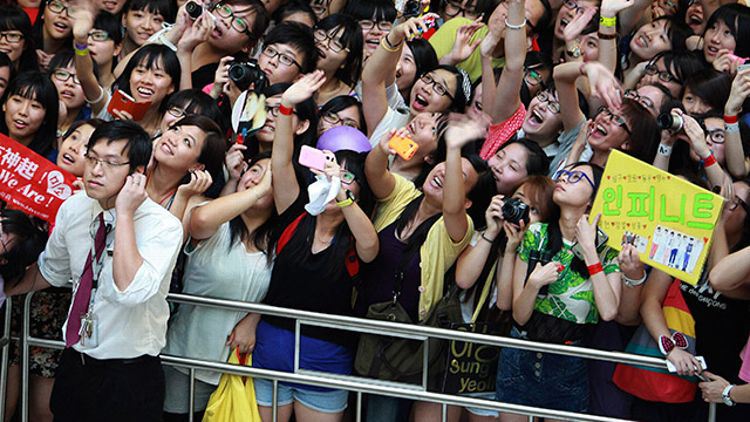
[caption id="attachment_3247" align="aligncenter" width="382"]Fans look up as their saviors come down upon them from Heaven Fans look up as their saviors come down upon them from Heaven[/caption]

The Korean wave, or Hallyu, began in the mid 1990s, but it took most of Asia by storm at the beginning of the 21st century. As it spread around Asia, Korean dramas and boy/girl bands picked up popularity in Europe and America as well. These dramas are what make Korean TV essential to its audience.

Want to watch “Modern Farmer”? Tune in to SBS on the weekends. Have an itch for the latest “Music Bank”? Flip over to KBS Friday night. TV still plays a gargantuan role in being a platform for viewers to catch up on their favorite Korean shows. According to a survey by Quartz, a whopping 78 percent of Koreans watch television every day, compared to the 26 percent that watch online videos.

The news is also a big part of any home television set. Folks that have yet to catch onto this new "Internet fad" still rely on good old fashioned television for information. The biggest broadcasting stations in Korea like MBC , SBS, or KBS produce great drama series and other family-fun programs like "Running Man (러닝맨)" or "Infinite Challenge (무한도전)." However, they are also the biggest news media outlets in Korea as well. These stations hold the most viewership rating in Korea. Though it's true they may be biased towards their political views when it comes to reporting the news, the majority of Koreans watch their shows for the latest news. However, with Internet, a lot of Koreans can find other news sources online.

Exactly  how much Internet do the Korean people use in this IT era?

[caption id="attachment_3248" align="aligncenter" width="392"]Grow your own Hallyu star! Grow your own Hallyu star![/caption]


Internet
Everyone knows South Korea provides many of the fastest Internet networks in the world. But do they use the Internet to its full advantage? After all, there are more Internet users (33 million) than there are people with television sets (15 million). With such a fast connection, watching videos or simply surfing the Internet is quite convenient. Korean television provides original shows, but even TV programs can be found on the Internet. Sites like wwitv.com air major Korean and other countries’ broadcasts online.

[caption id="attachment_3249" align="aligncenter" width="389"]Pictured: Social gathering Pictured: Social gathering[/caption]

But the Internet is more than just watching shows. It’s a vast cyberworld where information and other forms of entertainment collide---not to mention the online games. There are thousands of Internet cafes and PC rooms scattered throughout Korea that bring in people of all ages. Also, let's not forget  the smartphones. Oh God, are they everywhere in Korea. According to Mashable, 73 percent of Koreans have a smartphone, and with free messaging apps like Kakaotalk, it’s quite difficult for people to get along in society without one. Hell, some people can’t go an entire day without their smartphones (my personal record is six hours).


Winner: Internet

Yes, Korean dramas are quite popular throughout all of Asia and in some Western countries, too. However, Gangnam Style spread like wildfire throughout the world, and that would not have been possible without the Internet. A lot of Koreans rely on the Internet to watch, read, and listen to news as well as talk to their friends and associates. And when many of the college students in Korea don’t own a television, it’s much easier for this age group to be content with having the Internet. Koreans are more dependent on the Internet than they are on TV. With mobile technology such as smartphones, almost everyone has a connection to the Internet. This connection to their phones and tablets seems like an addiction in Korean. Though TV is still popular when it comes to shows and other mainstream media, the people of Korea would still prefer their Internet connection.


USA


TV
Let’s start with the stats. According to Tubefilter, the average American watches 5.3 times more TV than YouTube. Roughly speaking, Americans watch about four hours of TV per day. It’s hard to imagine being able to sit on the couch everyday and watch TV for that long. Perhaps the shows are that much entertaining. After all, American TV shows like the never-ending NCIS have penetrated many countries, including Korea. It’s not only popular shows that keep Americans stuck to their televisions.

[caption id="attachment_3250" align="aligncenter" width="383"]11 years in the running. Seriously, we get it. You guys are awesome. Now just stop. Please. 11 years in the running. Seriously, we get it. You guys are awesome. Now just stop. Please.[/caption]

Sports broadcasts are televised year-long. The biggest sporting event is the Super Bowl. Companies spend millions of dollars for 30 seconds of advertisements. The 2014 Super Bowl set the record for the highest viewed show in U.S. history with 111.5 million views. These sporting events along with other shows are great at bringing people together.
Many people flock to someone’s house to watch the latest NFL game or NBA match. And even those who like similar shows like Glee, have a party dedicated to eating unhealthy junk food and watching their favorite shows.
However, the amount of time spent watching television is beginning to fade due to the Internet.
[youtube http://www.youtube.com/watch?v=2d-dZlxqs7g]


Internet
With apps like Hulu and Netflix, Americans can watch their favorite TV shows anywhere and anytime. The Internet gives them the flexibility to catch up on their latest shows at the viewer’s convenience. It’s also a gateway for people to comment and express their thoughts and opinions about the TV shows they have come to adore. I don’t think there has been a single episode of Game of Thrones after which viewers would go online and praise or spout angry comments. Pretty soon, viewers won’t have to watch TV. They can just simply watch what they want online.

Americans between the ages of 18 and 49, which is the target for most major networks, are watching less television than the previous year, according to a Nielsen survey. After all, it makes more sense to pay 10 dollars a month rather than spend nearly 100 dollars on broadcast television. Let’s not forget that smartphones and tablet computers are also having a major impact on increased internet usage.

Viewers would need a TV set to watch shows and other programs, but with mobile phones and tablets providing the freedom to log onto the Internet, viewers have access almost anywhere.

[caption id="attachment_3251" align="aligncenter" width="364"]Words of wisdom from Ron Burgundy himself Words of wisdom from Ron Burgundy himself[/caption]


Winner: TV

Surprised? It’s true broadcast TV is dying down while Internet streaming is gaining more popularity. However, TV is still the biggest media outlet in America at the moment. True, you can watch almost anything online, but the television is still the biggest medium when it comes to shows and other TV programs. Ever since the invention of the television, TV has been one of the forefronts in bringing people together. Though that may soon change with the rise of the Internet, the modern television has yet to lose its popularity in America.

Tuesday, October 28, 2014

Curb your enthusiasm: Korean internet is not all it's cracked up to be.

IMG_0744

Roughly two years ago I moved from a country where net neutrality is implemented by law (the Netherlands) to a country where the freedom of the Internet is under pressure (South Korea). It has been a world of difference using the Internet in both of these countries. To give a feel for how bad the situation really is in South Korea, I will first describe the situation in the Netherlands as a contrast.

The history of how net neutrality in the Netherlands came to be is a fairly recent one. I vividly remember the time when the news leaked that one of the Netherlands' biggest Internet providers had admitted to its investors it was using a technique called Deep Packet Inspection (DPI), with which they could differentiate what the customer was doing on their network. Basically it meant the company was spying on its customers. The plan was to charge extra for certain VoIP and message services because the company was losing money due to decreasing use of SMS and regular calls. The indication that they soon had to pay extra for their WhatsApp use was too much to handle for the Dutch, being the frugal people that they are, and caused such an outrage that the telecom company had to cancel its plan to use the technique. In addition, the Dutch society is also an open one where everybody has the right to express themselves and press freedom is being held in high regard. Therefore, the more informed people worried that the Internet would be controlled by several companies. With these two main arguments, the people urged the Dutch political parties to take action. On 22 June 2011 the Dutch parliament decided to include net neutrality in the new telecom law, and by ratification by the Dutch Senate on 8 May 2012, the Netherlands became one of only two countries in the world (the other being Chile) where net neutrality is guaranteed by the legal system. Thus mirroring the democratic principles of Dutch society in cyberspace.

The benefits of the Dutch net neutrality law for the consumer are many: Internet providers can't limit or charge extra for certain services, the contents of your Internet traffic can be accessed by your Internet provider only in certain extreme cases, your Internet connection can be disconnected only if you don’t pay your bills or you commit fraud, and you have to give explicit permission to let tracking cookies be installed on your computer, which in turn makes it difficult for advertisers to track your behavior on the Internet. All in all it was and is a huge victory for freedom on the Internet. Although at the time I realized to some extent that this was a big deal, since roughly two years I really know by experience how fortunate the Dutch are.

When, in August 2012, I moved to South Korea, which has a reputation of being the Internet capital of the world, I thought I was going to live in the Valhalla of the Internet. Due to several news stories, I thought positively about the South Korean Internet, which seemed to dazzle the world with not only the fastest download and upload speeds around but also nearly universal LTE and WiFi accessibility. Unfortunately, there are some aspects of the South Korean Internet that don't get the attention that they deserve in the news, because of the focus of Western media on the speed of the Internet here. I quickly found out that a new 5G network isn't the most important thing about Internet usage.

A fast Internet connection doesn't get you anywhere if you're not able to access everything you want. Sadly, like in the Netherlands, South Korean cyberspace mirrors its society as well. Internet censorship is common: blocking everything from North Korean sites and materials harmful to minors to pornography and even simple nudity. If the government deems it inappropriate, you won't be able to see it without using a workaround. Unfortunately, blocking some sites is not all the government does; commenting on the Internet isn't anonymous anymore, since you need to register with your social security number to be able to comment on any Korean Internet portal. That makes it easier to extensively monitor the Internet on anti-government comments. Sometimes action is being taken to cut of the perpetrator's Internet or even making arrests in some cases. For example Chung Bong-ju, one of the four hosts of the popular South Korean podcast "Naneun Ggomsuda" (나는 꼼수다) and national lawmaker at the time, was found guilty in 2011 of spreading false rumors, accusing then-presidential candidate Lee Myung-bak in 2007 of being affiliated with a company that forged stock prices. Critics have claimed that it was a political motivated sentence, because of its timing just before the presidential elections. The podcast was a very influential channel of anti-government views. All of this is very serious, but the by far most annoying thing on the Korean Internet ever is Active-X.

The country that has the reputation to be years ahead in technology relative to the rest of the globe relies on this archaic 90's program for its entire e-commerce economy. Forget buying something on your iMac if you're not willing to partition and install Windows as well. Not only that, Active-X is Internet Explorer only, hence the biggest market share of Internet Explorer in the world. Being the Apple fan boy that I am, this frustrates me immensely. I refuse to install Windows on my iMac and if I would, I don't want to have anything to do with Internet Explorer. Fortunately, I have a workaround: if I spot something I want, I'll ask my wife to buy it at her office where she uses a Windows machine. Also I found a bank that has Internet banking for OS X. Well, had Internet banking for OS X.

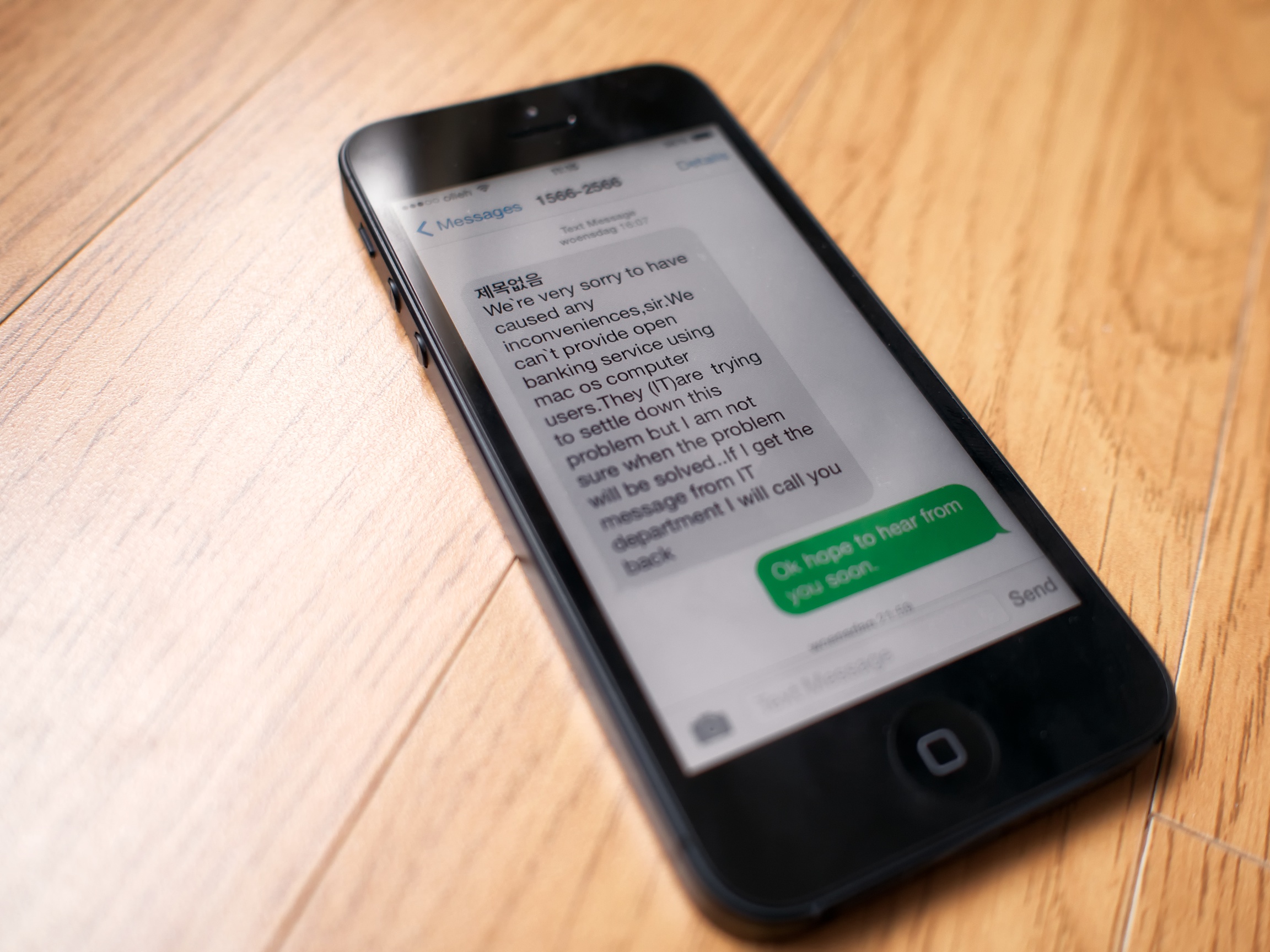
As a Mac user, you're such a rarity in this country that you're met with a lot of misunderstanding and disbelief. When my bank updated their security protocol they somehow forgot that they used to support OS X as well. As a result the site stopped working on an Apple computer and I had to contact the bank's service center. Their solution was to take over my computer to take a look by sending me an .exe file. When that didn’t work they were genuinely surprised and apparently had no alternative way to access my computer. Not much later after the service center employee promised me she would get back to me and hung up the phone, I got a message that they were unable to solve the problem. So now I have to use my workaround for my Internet banking as well.

iPhone bank message

Having lived here for two years, I now know that not South Korea, but the Netherlands is the real champion of the Internet. Although the overall Internet speed isn't as fast as that of South Korea, it's close enough. There is no monitoring, no blocking (although there was one issue with Pirate Bay being blocked), and no Active-X. All government websites have to be accessible by all major browsers and all purchases can be done with any operating system. You can criticize the government without being afraid of being cut off from the Internet. While Dutch cyberspace is a free and open world, South Korean citizens have no access to unfiltered Internet. I have not been homesick often in the two years that I lived in South Korea, but when I stumble on news of Internet censorship being used or when I get confronted by the limitations when browsing the web on my iMac, I long for the possibilities of net neutrality in my own country. I secretly wish South Korea would implement it too. Unfortunately, with democracy more and more under strain, I don’t see that happening in the near future.

Monday, October 27, 2014

Korean Memes vs. American Memes

Meme – n. a cultural item in the form of an image, video, phrase, etc., that is spread via the Internet and often altered in a creative or humorous way. (dictionary.com)

Memes are designed to make us laugh. But depending on where you’re from, some memes will have you gasping for air, and some will simply not resonate. While some cultures have different perspectives on what's funny or not, some memes just simply have people xD/MDR/ㅋㅋㅋ/LOLing anywhere in the world. I’ve had a lot of trouble getting Korean people to laugh at some of the memes from America, and vice versa, but sometimes I would hit the jackpot and have both the East and the West bursting out in laughter. Let's take a look at  some of the similarities and differences I found between Korean and American memes, and how the Korean and American people are wired when it comes to comedy.


  1. Pop culture


    The biggest contributors to memes are figures from pop culture. In Korea, celebrities such as Yoo Jae-Seok (유재석) or Park Myung-Soo (박명수) are used to deliver image-based memes. They're the icons of Korean comedy, and their notorious for their starring roles in Infinite Challenge (무한도전). Viewers really like the show. And when I mean "really like the show," I mean eight years worth of liking the show. The first episode aired in 2006, and the program has been running nonstop ever since.
    In America, a series has seasons like Seinfeld, Modern Family, or Community. But Korea doesn't have seasons. They just run the show every week until it finally dies out on its own.
    As the title says, Infinite Challenge has endless obstacles for the cast to overcome, and in their quest to overcome these challenges, they often find themselves in humorous situations. In their horror specials (much like The Treehouse of Horror on the Simpsons), they go through a maze filled with ghosts and other scary monsters, hoping to complete the tasks assigned to them. One of the more memorable episodes had a member of the cast try to balance himself on a surfboard, but he failed miserably. Koreans especially love laughing at comedians performing body humor, so when they see some of their favorite comedians getting hit on the head, falling down, or making weird funny faces, they can't help but laugh.

    [caption id="" align="aligncenter" width="320" class=" "] "Shut up" - Yoo Jae-Seok[/caption]

    At one point, Chuck Norris was all the rage in America, and recently, Jonathan Goldsmith is the biggest image for memes in America. While Korea loves slapstick comedy, Americans can't help but poke fun at almost anything which can range from politics to celebrities. America doesn't rely heavily on body humor, and thus, anything can be used for satire or parodies. Go ahead, name anything in America that people haven't already tried to make fun of. There are thousands of videos about racism, even when human rights activists try so hard to promote equality. Just watch an episode of South Park, and you'll have a general idea of how anything can be used for humor. I didn't think anyone could or would use Christopher Reeves (Superman) as the butt of their joke, but alas, I stood corrected.
    The Daily Show and the Colbert Report are really popular because they can find the humor in anything such as mainstream news medias like Fox News. And there are many other shows that satirically comment on social issues like racism and politics which show Americans generally find humor in situations that don't seem to be funny on the surface. But when American humor digs under that surface, they can laugh at what they find.

    [caption id="" align="aligncenter" width="320" class=" "] Chuck Noris just got served, which is funny 'cuz he's the one that's supposed to be serving.[/caption]

    Though the content may be different, the fact remains pop culture plays a big role in memes. It’s the biggest common factor to which almost everyone can relate. It’s easy to recognize and deliver to audiences, which in turn, goes viral. However, the same cannot be said about…


  2. Video-based memes


    Vine, an app that allows users to shoot a 6 second video, is one of the most popular mediums to deliver short funny videos in America. Koreans, however, rarely use the app. Instead, they cut out certain scenes from sketch comedy programs like Gag Concert or dramas. There aren't many original videos Korean people make. In fact, many of the memes Korean people share are actually ones from abroad, and even then, they're usually videos about people getting hurt or some form of slapstick. There is only so much slapstick people can do without landing themselves in a hospital ward. Thus, most video memes go viral in Korea if they can provide body humor, to which Koreans are so accustomed.
    [youtube http://www.youtube.com/watch?v=0itk4pUcIvA]
    On the other hand, a lot of the video memes in America are shot by average people hoping to go viral. They have a lot of material to their advantage such as other videos taken from movies or even news footage. One of the most famous to spread throughout the Internet at the moment is the P-O-P clip, in which a young woman leaves a message for her mom and crew as she is hauled away by the police. It's funny because she tries to act tough while in handcuffs, but suddenly breaks down as she gives a shout out to her associates. In America, almost anything and anyone can be used to deliver humor, whereas in Korea, it would be taboo to speak out (even comically)  against social issues.
    [youtube http://www.youtube.com/watch?v=9-rVEs5RLZQ]
    Whether or not the video revolves around slapstick, parody, or satire, these clips need to be delivered. And the best way to spread these memes are…


  3. Facebook and You Tube


    I’ll admit I probably couldn't live without Facebook. I probably check my wall every thirty minutes or so. When I do scroll through Facebook, I generally find myself lost in an endless maze of videos. Sure, Facebook is popular in America, but it’s the biggest growing social network in Korea, and almost everyone has an account. Seven years ago, everyone I knew in Korea had a Cyworld account, but by 2010, they had discarded that social network for Facebook. Back then, everyone would ask for their Cyworld address, but now, they ask whether you're on Facebook or not. Another big distributor of memes is You Tube.
    [youtube http://www.youtube.com/watch?v=wLL2EAR5Yjg]
    Though the contents people watch are different in Korea and America, if anyone needs to find a video for anything, they go to You Tube. The top You Tube videos in Korea are usually clips from TV programs.
    [youtube http://www.youtube.com/watch?v=9v9sMU3FrDg]
    Americans can use almost any video to set as a meme, so there are no guarantees for what will be the next big thing to go viral. Who knew a chubby little kid would obtain notoriety as he gracefully showed the world his refined swordplay with a fake lightsaber?
    [youtube http://www.youtube.com/watch?v=HPPj6viIBmU]


Memes put a smile on our faces when we’re procrastinating at work, studying for mid-terms, or just generally when we’re faced with boredom. And they’re a great way to spread humor and laughter around the world, especially with the global connections we have today. Though memes vary in each culture, the slow yet gradual overflow of one culture’s memes into another will help us to laugh together, regardless of distance. With all the conflicts and issues throughout the world, wouldn’t it be great to have some humor to uplift this gloomy atmosphere? After all, laughter is the best medicine.

[youtube http://www.youtube.com/watch?v=-iz_mVgEzqg]

Saturday, October 11, 2014

2014 Asian Games - Was it Worth it?

What the hell are the Asian Games? I, myself, had no idea the Asiad existed at all until I went to cover the games in Incheon this past month.

The name is self-explanatory. The Asian Games are a set of events held throughout and between Asian countries every four years.
The Asian Games are very much like the Olympics, except on a more regional-based level. There are over 44 events such as soccer, fencing, archery, swimming, decathlon, triathlon, and any other “-athon”.
The 17th Asian Games were held in Incheon, South Korea this year. I was fortunate enough to be part of the Asian Games News Service, and as a reporter for the organization, I had access to all the events.
The games and events were fun to watch, but there were more than just enjoying the games. More than the sporting events themselves, I saw a lot of problems with the entire Asiad and its infrastructures.


  1. No one shows up to watch


    There were 36 different sporting events this year, and of course some events might not be popular. I covered basketball and boxing, and both events seem exciting and fun. However, there were barely any spectators for the games. The stadiums were emptier than an abandoned warehouse. Unless the event was in its finals, people didn't want to pay much money to come watch.

    [caption id="" align="aligncenter" width="502"] "Where did everyone go?"[/caption]

    There are a few dedicated fans that come to support their teams, like the Filipinos who cheered on for their basketball team.
    I was sorely disappointed at the lack of turnout for the events such as boxing. For a grueling ten days, I watched over 200 individual boxing matches, and each day, the seats throughout the gymnasium sat empty.


  2. Game officials are biased


    If the system can be cheated, it will. I watched basketball, handball, soccer, and boxing games in person. Without fail, the referees or judges would favor the South Korean team or athlete.
    The women’s lightweight boxing finals between India’s Sarita Devi and South Korea’s Park Jina stirred up quite the controversy. Anybody who watched that fight would have no doubt that Devi won the fight. The decision to give the victory to Park did not sit well with everyone (especially the Indian nationals) except the Korean spectators. The controversial decision is still under official investigation and the topic is still hot among boxing aficionados and fans around the world. Yet, I saw more unfair rulings on the field in other events like soccer and basketball.

    [caption id="" align="aligncenter" width="456"] Men's basketball: South Korea vs. Iran[/caption]

    The men’s basketball finals between S. Korea and Iran was truly an exciting game. Never for a minute did either team take a big enough lead to assume they would emerge victorious. With 16 seconds left in the game, Korea was barely leading 76-75. Iran would have no choice but to foul to stop the clock from ticking down, and Korea managed three more points at the free throw line. With eight seconds left, Iran was trailing 77-79. However, in their last drive to score one more basket, they were fouled numerous times by the Korean players, but the referee failed to blow his whistle and simply let the clock expire. I saw similar favoritism on the soccer field as well, but I won’t get into that. I’m sure I painted fairly detailed accounts of favoritism for Korean athletes. It wasn’t simply the game officials that had a hand in creating a substantial Asian Games.
    [youtube http://www.youtube.com/watch?v=sJGYPS6xVxM]


  3. It’s not well-organized


    In the first few days of the Asian Games, over 100 Korean interpreters simply left. That accounted for over a third of the interpreters available, and some of them were essential because they could speak Arabic, Russian, Chinese, and a few other languages that would have proven useful on the field. They left because they were told one thing, but found to their dismay that the organizers could not deliver on their promises. The interpreters were promised lucrative pay, decent housing, and good working conditions.

    [caption id="" align="aligncenter" width="500"] The only time they were smiling[/caption]

    However, when they began their jobs interpreting, they had to work around the clock, being a lackey to the different foreigners that came to speculate and participate. They were told they would be working an eight-hour work schedule, but instead, they had to work more than 12 hours at a time.
    Their pay was much lower than what they were told, and at one point, they were served lunch with stale rice, old dainty meat, and foul-smelling vegetables.

    [caption id="" align="aligncenter" width="459"] Okay, maybe it wasn't this bad, but it was still unedible.[/caption]

    Without them, it was hard for reporters who didn’t speak Arabic or Mongolian like me to conduct interviews. I scrambled and fought my way through other reporters to get a quote from an athlete, but my efforts to reach him or her would be useless as the athletes simply stared at me and kept saying, “No English.”

    [caption id="" align="aligncenter" width="500"] "No English"[/caption]

    Overall, South Korea did not have the budget to host such a huge international event, which is why many of the volunteers or workers had a hell of a tough time working throughout the Games. However, it wasn’t completely bad because…


  4. It’s a great way to meet new people


    Although I mentioned above that not many people come to watch the sporting events, there are foreign medias that come from different parts of Asia to broadcast and write about the Games.
    Many of the reporters didn’t speak English, but we all managed to break through this language barrier and communicated effectively.
    Reporters from Jordan were especially friendly. They sat next to us during the boxing matches, and they always had a smile on their face. I sat watching many other people from places such as India, the Philippines, and other Asian nations come to watch and support their respective national athletes play. Through the spirit of competition, many other people along with myself, formed new bonds and contacts with people we never thought we would ever meet. I even had the chance to meet and interview the prince of Qatar. That’s a chance I would never have been given had I not been present at the Games.


There were a lot of issues with the 2014 Incheon Asian Games. However, despite all its flaws, it was an opportunity to bring people of many different cultures into one location. There was a Food Festival that showed off the delectable dishes from countries like Kazakhstan, Sri Lanka, and Thailand. I had the chance to interview some of the head chefs, and the Kazakhstani chef wanted to prepare horse meat, which is the main source of meat in his homeland.

It was a pity he couldn’t find horse meat in Korea because from the fragrances of smoked lamb in his kitchen made all who smelled it salivate. It wasn’t only the Korean spectators that had the chance to mingle with different cultures. People from China were able to shake hands, take pictures and talk with people from Turkmenistan, and the same held true for most of the other different-cultured people.
As long as people are able to have the opportunity to open new lines of communication with other people, then the problems of the Asian Games may be a price we are willing to pay.

Saturday, September 20, 2014

The Mean Things We Say about People from Other Countries

[caption id="attachment_2306" align="aligncenter" width="960"]Original image courtesy of FreeDigitalPhotos.net. Why can't we all just get along?[/caption]

As a foreigner to Chinese, Korean, and Japanese friends, I seem to incite conversations on international topics more often than would seem the norm in strictly native circles. And, perhaps as some perverse gesture of solidarity with the Westerner in the room, these conversations quite often turn into xenophobic venting sessions directed at East Asian neighbors. The catharses usually begin as polite self-deprecating observations on one’s own society and then morph, with varying degrees of speed and completion depending on the drinks being served that night, into stronger and more earnest insults to the reputations of nearby countries.

What strikes me most about the content of such conversations is not just that the participants have generally realized that I lived for almost three years in China and developed several friendships along the way, have a Korean boyfriend and a close relationship with his family, and have made a few Japanese friends in both Chinese and Korean language classes and am thus very likely judging their xenophobia with some critical scrutiny, but that the comments, whether they be made by Chinese people about Koreans, Japanese people about Chinese, Korean people about Japanese, or any permutation thereof, are all pretty much the same.

[caption id="attachment_2312" align="alignright" width="300"]Regardless of whether we're red, green, blue, or purple, we might just tend to insult our neighbors in similar ways. Regardless of whether we're red, green, blue, or purple, we might just tend to insult our neighbors in similar ways.[/caption]

A few close Chinese friends in Beijing once told me over lamb kebabs and beer that they considered Koreans “很吵,没有礼貌,不太聪明 (loud, rude, and unintelligent).” A few months later, I had a similarly sized group of Korean friends confiding to me over banchan and fish that Chinese tourists struck them as “시끄럽고 예의 없어 (loud and rude).”

Similarly, a Chinese friend complained to me several times that I should watch myself around Koreans, who are cold-hearted business-minded folks who will befriend you for personal gain and, once you cease to be of use to them, “只把你扔掉了 (just toss you away).” Perhaps, though, I shouldn’t heed that advice, as, according to a Korean acquaintance, Chinese people are “물질만능주의자 (exclusively materialistic).”

The hate doesn’t stop at bashing each other’s aptitudes and principles. A close Korean friend once told me that she thought that compared with Chinese and Japanese, 우리 나라 여자들은 가장 예뻐 (our country’s girls are the prettiest).” This  declaration ironically called to mind an offhand comment once made by a female Chinese friend that Chinese girls had bigger eyes and were naturally prettier than Korean and Japanese individuals.

Multiple Chinese and Korean people have also complained to me that people from the other country "always" try to seize everything important in East Asian history as their own invention. The Chinese end of this argument is humorously depicted in one of my favorite Youku videos, which alleges that a Korean professor claimed that Sun Yat-sen and Yao Ming had Korean ancestry and that Korean academics have before concluded that Confucius, Xi Shi (legendary beauty said to have lived in the 春秋 period), and Li Shizhen (Ming Dynasty doctor and polymath) had Korean blood and will soon declare that the universe itself was created by Korea.

Such xenophobic sentiments have not been limited to close friends in intimate quarters. The head of my office in Beijing once told me after some slight inebriation at a company banquet that he considered the smartest and most accomplished people in the history of the world to be Chinese, German, English, and Japanese, but “对不起,不是韩国人 (sorry, not Koreans).”

This comment was countered and perhaps topped by the Yonsei KLI Korean teacher (and my absolute favorite teacher at the program, so I take her comments in a benign context) who asked our class if we didn’t think that Korean students were “다른 나라 학생보다 더 똑똑하지않아 (just smarter than students from other countries)?”

It might be easy to think so when surrounded by fellow Koreans, but I have a feeling that some people from the other 195-odd countries around the tip of this tiny peninsula might disagree.


This post is adapted from an article originally appearing in Strolling Toward a Mountain of Tigers, the author's personal blog on life, science, and how those two words together are redundant.

Tuesday, June 3, 2014

Pursuing Happy - Episode 5

(c) jewishvirtuallibrary

(c) jewishvirtuallibrary

[soundcloud url="https://api.soundcloud.com/tracks/146247826" params="auto_play=false&hide_related=false&show_comments=true&show_user=true&show_reposts=false&visual=true" width="100%" height="450" iframe="true" /]

DISCLAIMER: Photo from the interwebs.

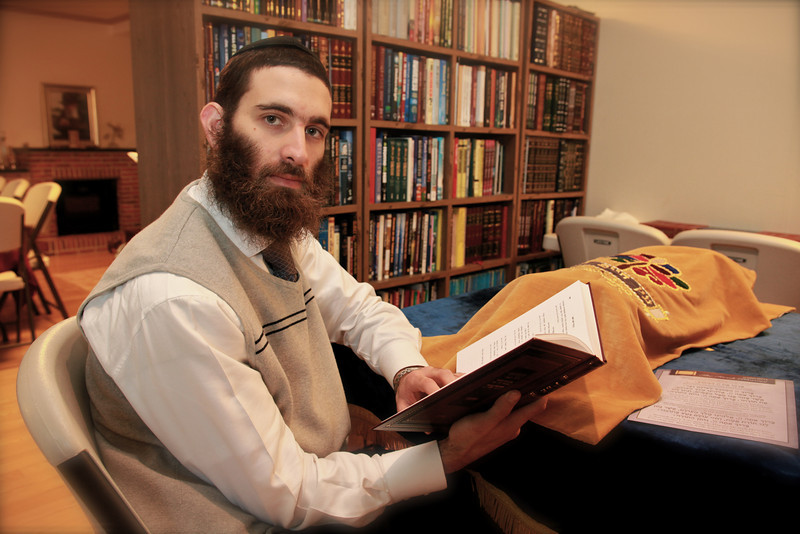
In this weeks talk, I am the one being asked a question. There is a joke. "Two Jews, three opinions."  As you will find out the Jewish method of having a discussion is asking each other constant questions. When ever I am with the Rabbi he always has the best questions and stories waiting. In this episode I have a talk with Rabbi Osher Litzman, the Chabbad Rabbi of Korea, about the Jewish perspectives, as well as his, on happiness. Enjoy, and thank you always,

Jarod

Tuesday, May 27, 2014

Pursuing Happy Episode 4

[soundcloud url="https://api.soundcloud.com/tracks/146247822" params="auto_play=false&hide_related=false&visual=true" width="100%" height="450" iframe="true" /]

During my time at Lotte Department Store with Simon we got thirsty and decided to go down to the food court. Coincidentally there was a little juice stand called happy juice. One of the employees at "Happy Juice" was kind enough to give me an interview after his shift ended. His name is Joon, he is a young kid, a student with a dream of studying in New Zealand. I'm not sure how happy he actually is but he had some interesting ideas that he picked up along his travels in India. I guess sometimes we need a guru, right?  There is no photo of Joon, he is a shy kid and didn't want to provide a photo so here is one of my abstract works I made. I call it cave ghost. Folks, when the interviewee is not willing to provide a picture for the site I will substitute with one of my works. All are on sale. ^^


Tuesday, April 15, 2014

Drink up! (The drinking culture in Asia)

Beer, vodka, soju, sake, whiskey. Whichever your preference, alcohol is a great way to unite people. Drinking has become so widespread that there are customs and cultures based on it.

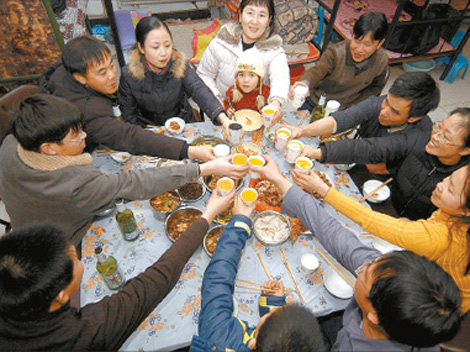
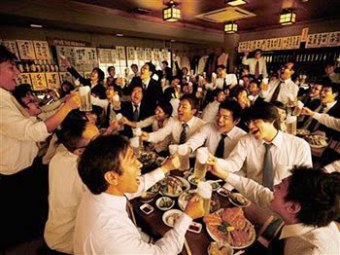
Drinking cultures vary in each country. If you’re planning to drink in Korea, China, or Japan, here are some tips to get you started on your inebriation.


China


The preferred choice of alcohol there is baijiu. Baijiu is high proof, and because drinking in China has been categorized as masculine, most men tend to drink it. Though there are times when they tend to drink beer or wine, nothing shows your masculinity like baijiu. However, it’s not always about finishing your shot of baijiu before anyone else. There’s an etiquette to drinking when you find yourself sharing drinks with business associates, be mindful of how you behave.

chinese

When someone toasts, it is expected of you to finish your cup, or ganbei. When people do toast, be sure to clink your glass against everyone’s. If the person you’re toasting against is your superior, be sure to bring your glass lower than theirs when you clink glasses. But beware, if you clink glasses, it means you want to go bottoms up! If you’re not sure how to work yourself into the Chinese drinking culture, just be sure to use both hands when offering, receiving, or drinking your beverage.

Japan


As most people may have heard, sake is popular in Japan. However, the most popular drink is actually beer. With breweries like Asahi, Kirin, and Sapporo, you’ll see restaurants, bars, and izakayas (Japanese pub) stocked and ready to serve you beer. But if you’re looking for something more traditional, most izakayas are ready to present you with sake, which can be drunk either cold or hot. It may not sound appealing, but certain sakes taste much better when served hot.

japanese-drink

If you find yourself sharing drinks with Japanese businessmen, make sure you NEVER pour your own glass. Something to keep in mind is you should always wait for other people to offer you a fill. It is custom in Japan to never leave a glass or cup empty, so if you happen to see someone in need of a refill, offer to pour. Some may refuse to show modesty, but if pressure is applied, most will accept your offer. In turn, they will insist on refilling your glass as well, so be sure to leave your glass full if you don’t plan to drink anymore.

Korea


The most sought out alcoholic beverage in Korea is soju. This traditional Korean drink has sold twice more than any other spirit or liquor worldwide. In Korea, the drink is found almost anywhere – from your local convenience stores to top-notch Korean restaurants. One of the best things about soju is that it’s relatively cheap and it’ll get you buzzed (or heavily intoxicated, depending on your consumption). What’s even more popular than soju is somaek (소맥; soju mixed with beer). The golden ratio (황금 비율) of soju to beer is 3:7. Some will choose to add more or less soju, but you can’t go wrong with 3:7.

soju

Wherever you go to drink, be sure to always toast the first glass or shot and finish it, too. Depending on whom you’re dinking with, you may have to finish your glass every time your counterpart does. In corporate Korea, your superiors will want to keep pouring you drinks and it is considered disrespectful if you don’t empty your glass. Also, be sure to use both hands when either pouring or receiving drinks (especially if the counterpart is your superior).

Despite where you are, if you're out drinking, always be sure to keep the customs of the host country. Being able to blend in with that country's drinking culture will prove more fun and interactive. Just be sure to drink responsibly. Now, drink up!

Tuesday, April 8, 2014

Christmas... in Korea?

http://www.youtube.com/watch?v=d6oy8IucCMg

Ho ho ho!


Santa and his trusty reindeer land on rooftops, and he shimmies down the chimney to deliver Christmas presents for those on his ‘Nice List.’ Sound familiar?

This is what some of you inevitably expected of Christmas when you were younger and still held onto the notion of a mystical figure who brought gifts on one magical winter holiday of the year. Although you grew up and eventually learned that (SPOILER ALERT!) Santa Claus did not actually exist, you still probably promoted the idea to future generations. Even minus a jolly red-cheeked fat man with gifts, Christmas is still a joyous holiday the world over, all about spreading holiday cheer to family and friends---even as far as Korea!

Yep, you read that correctly. Christmas is celebrated in Korea as well as in many Western countries. Indeed, the Korean notion of Christmas are pretty similar to that found in the West, but with a few tweaks.

Santa Claus exists in the hearts of most young children in Korea as in many other countries. Parents tell their children to behave and be nice if they want Santa, often called Santa haraboji (할아버지; Grandpa Santa) to bring them presents. However, as the children grow older, they discontinue their belief in Santa, and as such, they stop receiving presents. Most children stop getting presents once they become middle school students. In Korea, no strict custom exists for family or friends to give and receive Christmas gifts. No Christmas presents, you ask? Then what about the food? Surely, there shall be a feast to celebrate with the family!

Nope, the only food that is especially popular on Korean Christmas is Christmas cake. Christmas is, after all, the birth of Jesus Christ, and what better way to celebrate his birthday than with a cake? Thus, every year, bakeries try to outdo one another with extravagant cakes. Stroll into any bakery near the holidays and you’ll find the store brimming with Christmas cakes.

[caption id="attachment_1516" align="aligncenter" width="500" class=" "]Korean Christmas cake Korean Christmas cake[/caption]

Most, if not all, churches in Korea welcome anyone and serve food (don’t expect anything too special) and sometimes small gifts around Christmas. Because 25 percent of the Korean population is Christian, many churchgoers, as well as non-Christians, attend Christmas service in church. For those that prefer not to spend the holiday in church, there are other options.

Many people choose to spend Christmas with their family, regardless of how bland the holiday may be. For others, it’s a day to go out drinking and partying with friends. On Christmas Eve and Christmas day, you’ll find most pubs and bars filled to the brim with patrons looking for some holiday ‘spirit.’ In parts of Seoul like Gangnam or Hongdae, you’ll see groups of men and women mixing together, trying to see if they can find love. There’s even a huge event called "solo daecheop (솔로대첩; victory for singles)" on Christmas where single folk come out to find partners. However, for those who already have a significant other, the day is dedicated to enjoying a romantic date. On Christmas Eve and Christmas day, you’ll see many couples walking hand in hand, taking in the sights. Visit any restaurant and most of the tables are occupied with couples. Who knows? You might find a relationship too.

[caption id="attachment_1514" align="aligncenter" width="500" class=" "]Matching singles in Korea during the holidays Matching singles in Korea during the holidays[/caption]

Those who live in or frequent downtown Seoul know certain districts light up with bright Christmas decorations during December. Most decorations are put up in big shopping districts, or Korea’s many cafes. So if you’re feeling homesick, try hanging out in the booming shopping district 명동 (Myeongdong, Line 4) or Times Square in 영등포 (Yeongdeungpo, Line 1).

[caption id="attachment_3392" align="aligncenter" width="500"]Christmas in Myeongdong Christmas in Myeongdong[/caption]

There are many ways to spend the Christmas holidays. So if you happen to be an expat in Korea during them, don’t shut yourself in your home, thinking about your past holiday experiences. Go out and take in the sights, meet new people, grab a few (or more) drinks with friends, or if you have family, spend a warm and cheerful holiday with them. Christmas isn’t about where you are; it’s about those with whom you choose to spend it. Merry Christmas!