Showing posts with label south korea. Show all posts

Saturday, February 28, 2015

Planning on a Hospital Stay in South Korea? Don't Forget Your Extended Family

"I want to use the restroom," I said in my best Korean. The nurse stopped in her tracks and tilted her head as she considered what I had said.

"Where are your friends?" she asked.

Confused, I cast a glance at the clock hanging above my bed. "Working," I said in bewilderment.

The nurse sighed and hurried out of the room with one last glance in my direction. She returned after a moment with a wheelchair from the hallway and helped me navigate myself into it, taking special care of my wires and recently operated leg. I got the distinct impression that the nurse really didn't want to help me into that restroom, despite the task being what I had thought was part of her job. 

Later,  I would learn that the responsibilities of nurses in South Korea are, in fact, vastly different from those in the USA.

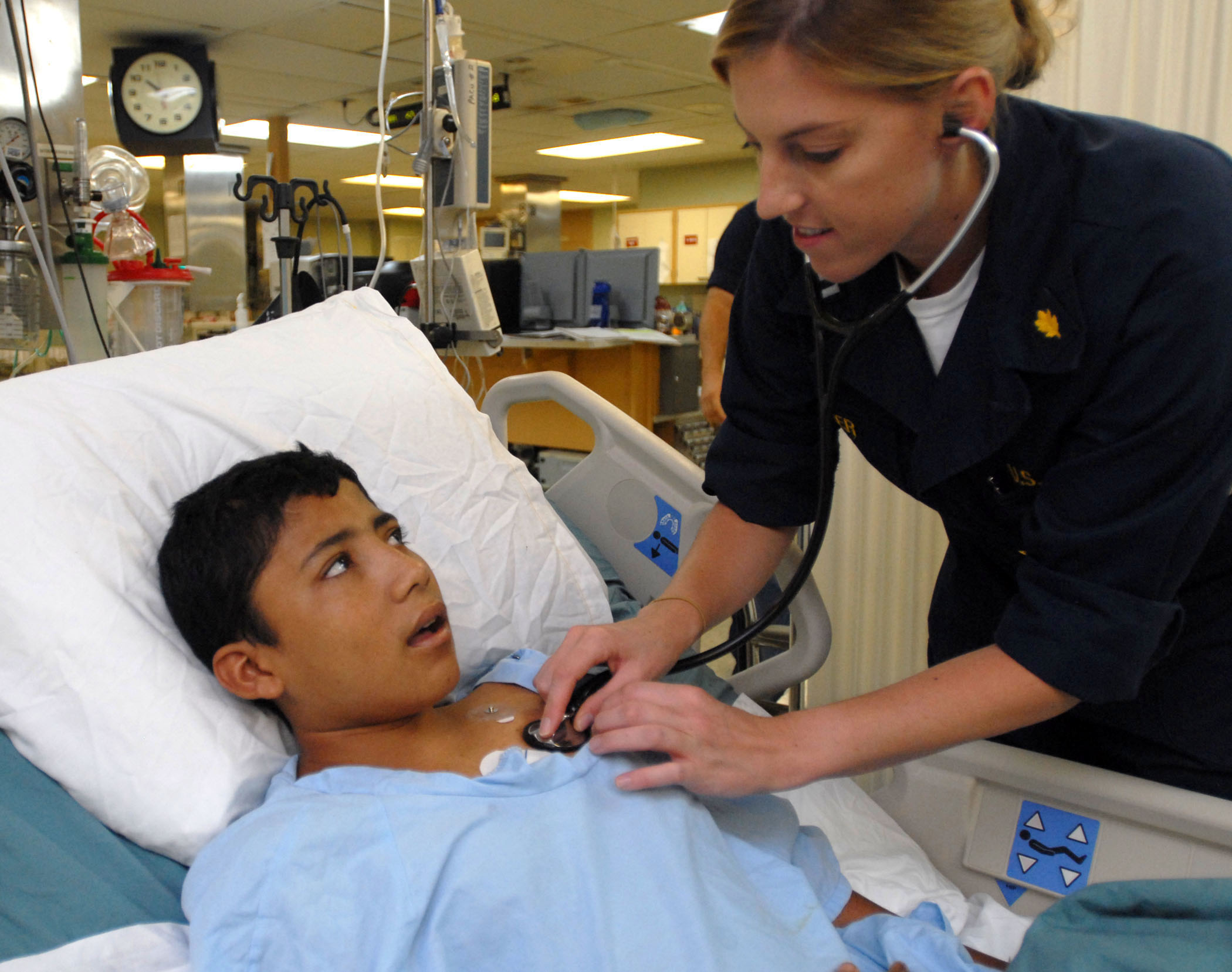
In America, nurses do a variety of small jobs. They hook up monitors, make note of the patient's fluid intake and output, check to see if the patient has been getting adequate rest, relay information given to them by the doctors, and ensure that the patient is following a prescribed diet if one exists. In many hospitals in South Korea, the story is quite different...

[caption id="attachment_3603" align="alignnone" width="2100"]Approved for release by USNS Comfort PAO LT Susan Henson (pao@comfort.navy.mil or sdhenson@comfort.navy.mil). An American nurse checks a boy's vital signs after surgery.[/caption]

I was asleep, finally. It was probably around 9 or 10 A.M. I remember having already been woken up around 5:30 A.M. for my morning butt injections. I hated those. I was victim to the nurses' needles at least three times per day. I switched sides on the nurses because each butt cheek would become so sore that sitting on it became uncomfortable. Later, someone would tell me that injections are cheaper than pills. Maybe that's why I was getting so many? I didn't know.

Anyway, it was around mid-morning, and I was finally asleep, when I suddenly heard the crinkling of cellophane. I opened my heavy eyes slowly, seeing only a wall of black fabric at first. It backed away from me, and surprised, I looked up and realized what I was seeing. A man in a suit was standing at my bedside and placing something beneath the pillow, where my face had just been a second before.

Why was a man sticking things under my head, and why was he waking me up when I was finally, finally asleep, I asked myself. By the time I opened my mouth, the man had moved on to give one of his bags to another patient. I propped myself up on my elbow and pulled the package out to look at it. It had several hard fruit candies inside with a religious leaflet. Ah. Advertising for a church, I realized.

I looked around the room. There were seven other patients and some of their family members. At the other end of the room, an older patient talked with a person I didn't recognize. They had Bibles in their hands.

In the United States, I have the impression that the nurse is like a knight standing guard between you, the patient, and the outside world. If a visitor comes into the hospital and brings forty friends, the nurse and/or nurses will not let the stress of forty visitors (plus one) into the room where the patient is fighting a battle to regain or maintain newly-won good health. It wasn't long ago that men weren't allowed into birthing rooms. It wasn't long ago that children weren't allowed into hospitals. If it brings too much stress, or too many germs, the nurse forms a human barrier against it and keeps that riff-raff out of her kingdom.

And yet here I was, trying so hard to finally get some sleep, and a strange old man in a pinstriped suit was sticking candies under my pillow. He didn't even ask if I was diabetic! On a few occasions, a woman would come with huge trash bags full of things like panties, slippers, socks, and pajamas, which she would drape across our beds and start hawking right there in our room. Other patients would come in from other rooms while dragging their IV carts behind them. Then, people would actually buy this woman's underwear.

The American parts of me thought, "What the hell is going on here!?" How could people expect to get any sleep in these conditions, and did nobody care at all about the germs from outside? Seriously? The nurses weren't monitoring the things that were happening in that room at all. By this point, I had contacted my friends and coworkers and told them that the nurses made it clear to me that I would need help from someone other than them.

It is thus impossible for me to write this without making some mention of the gratitude I owe to so many people from outside the hospital. There were people who helped me take a shower, despite how awkward it is to help your friend undress and get in and out of a wheelchair while naked. There were friends who helped me repeatedly get into a bathroom that really wasn't meant for handicapped people. There were people who brought me home-made chili, fruit trays, chocolates, chips, candies, books to read, extra blankets, and pillows. One person even painted my nails. My boss came to make sure I used the restroom and got fresh water to drink at least every morning and every night. She held a cup and straw to my mouth and stayed with me for eight hours post-operation when I was told I wasn't allowed to lift my head from my bed. I never knew how loved I was until I needed to be loved in this way. Thank you.

[caption id="attachment_3604" align="aligncenter" width="758"]10339665_10154171431865427_5693786999891649622_n My boss's lovely daughter and my coworker's brand-new son during a wonderful visit that lifted my spirits.[/caption]

But the bottom line is, we had people barging into our rooms day and night, and the nurses were doing nothing. They didn't help us get our lunches, they didn't help us into the bathroom, they didn't even help me get down to the basement when I started physical therapy and learning to walk again. I began to think about what that meant for the hospital environment. It meant that we patients had to rely on other people to fight for our right to sleep and regular bathroom visits.

Because of this initially uncomfortable situation, I realized that the hospital is a much more cheerful and welcoming place when you rely on the help of your loved ones than on a stranger to care for you.

In thinking about it, I realized that if I had to choose between my own mother helping me get my pants down for a shower or having some stranger do it, I'd rather it be my own mother. On top of your own family members caring for you, the fact that my bed had no privacy curtain coupled with the fact that I was stuck in a room with seven other people meant that those seven other people were in the same plight as I was. Though some of them could walk, they understood what it meant to be there in that moment and to be stuck in it. One of the walkers would get our lunch trays and put them on or next to our beds, and the woman who did this for me always slammed mine down and yelled "EAT YOUR RICE!!" in Korean. It was like I had my very own angry Korean grandmother, and even though I really, really did not want to eat my rice, the fact that she wanted me to eat it made me very happy---and it even made me try a little bit.

Perhaps even worse than not monitoring who was coming or going, the nurses didn't seem to care whether we left---which we did. Every couple of days, one of the walkers would simply leave the hospital altogether (still wearing her gown and still pulling her IV behind her on a wheeled stand), and return with treats for us, having walked herself all the way to the supermarket and back. Why even stay in the hospital?

The surgery I had, while I don't recommend just going in and doing it for fun, is actually an out-patient procedure in the United States. However, in Korea, I had to beg them every day to let me leave. Finally, twelve days after my operation, they let me go...but they didn't know that I had actually left before. With the help of two friends, I decided to go outside and get some fresh air, and even go to a café just behind the hospital. We had a really good time taking pictures of me pretending to walk, but really just balancing on my good leg with the wheelchair out of view.

[caption id="attachment_3605" align="aligncenter" width="720"]10288803_10154185712995427_2972673619153327745_n I would have gotten away with it, if it weren't for that meddling conscience! People probably would've worried if I disappeared.[/caption]


[caption id="attachment_3606" align="aligncenter" width="720"]983681_10154185712845427_2643229393373262939_n It was about as soft as my bed. Top-notch spot for a nap.[/caption]

I thought very seriously about going home, but since I lived two floors up on slick granite floors and was completely unable to bend my leg, I decided to stay until they released me. So why do nurses not care if their patients come and go, why do they fill such minimalistic roles, and why do they not care who visits the patients?

I found an interesting blog written by a Canadian woman who talks about her child's stay in a Korean hospital, and she recounts many of the same things I've mentioned, though it seems that her hospital was furnished with more equipment than mine. It's important to remember that my story might stray from the norm.

Originally, my thought was that patients in Korea have long hospital stays because Koreans work hard and have stressful lives, so staying in a hospital grants them a reprieve from their responsibilities. I recall someone telling me that a hospital stay can be a bit like a vacation for people there, and I remember being a little horrified by the notion, because I would have much preferred to have been at work than confined to a bed. I did some digging around on the Internet and learned that there are incentives to having patients stay longer. Apparently, South Korea ranks #2 behind Japan in average length of hospital stays in the OECD.

In my reading, I also read that there are fewer nurses per patient in South Korea than there are in the US and in most other OECD nations. Perhaps this helps to explain why nurses seem to do so little for patients in Korea. Perhaps they're stretched thin. I came across an article advocating better treatment and conditions for nurses in South Korea, and it said:
“Nursing in the two countries also differs in many respects, too. For example, in addition to the much higher patient load in South Korea, nurses there are expected to fulfill many of the duties support personnel here in the United States would normally handle. Sung Hee Kwon, an operating room RN at Korea University Hospital, was impressed that OR nurses here never leave their patients’ bedsides. Back home, she is expected to also manage all the OR equipment, supplies, cleaning, set up, ordering, and inventory."

It appears that while I thought my Korean nurses simply didn't care much for me or that culturally they weren't expected to, what may have been happening is that they were simply too busy to devote to me and my fellow patients the kind of time and attention that I expected due to my American background. I am quite impressed by the number of tasks that nurses accomplish which have so little to do with direct patient care, like the management of inventory.

Another interesting excerpt from the article is this paragraph:
“We are still thinking about what number to propose in Korea,” said Yoo Ji Hyun, RN and secretary general of KMHU. “To start, we’re looking at a range from 1:5 to 1:10. But the hospital industry is attacking that, saying that 1:10 in Korea is about the same as 1:5 in the United States. That’s why we’ve come to compare actual nursing tasks to refute their argument.”

Why would the hospital industry attest that one nurse for ten patients in Korea is the same as one nurse for five patients in the US? I think it is making a reference to the apparent fact that much of the care patients receive in hospitals comes from patient family members and friends than from nurses. Given what I've learned about nurses' responsibilities, I'm inclined to disagree with this ratio.

Korean nurses don't do less; they do different things. Perhaps if Korean hospitals hired support staff to take care of some of their responsibilities, the nurses could devote more time to patients---but is it really better that way? When I think of my very own ajumma yelling at me to eat my rice, it honestly makes me think fondly of my time there somehow.

Perhaps they're already doing things in the best way possible.

Sunday, February 1, 2015

How a Football Coach Influenced a Culture

2002_FIFA_World_Cup_logo.svgOn a warm Autumn's day after wandering aimlessly around Seoul Forest taking pictures, I decided to have a cup of coffee before heading home. I entered one of the many cafes just before the sun started to set and was greeted with a warm smile from the guy behind the counter. He was not much older than me and had those thick dark framed glasses that every Korean guy seems to have. When I ordered my coffee in Korean the guy saw that as an opportunity to strike up a conversation with me. After I answered his question about where I was from, he said: “Nederlandu? Ahh, Eindhoven!” At that moment I could not exactly place why he didn’t mention Amsterdam, Rotterdam, The Hague, or even Utrecht, but he gave me the answer himself soon after: "PSV Eindhoven! I like Hiddinguuu!" I half tried to change the subject by saying that I came from a city near Amsterdam and support Ajax, but the harm had already been done. He ignored what I just said and went on about Hiddink. "Yes, Hiddingu" I replied eventually, accepting my defeat.

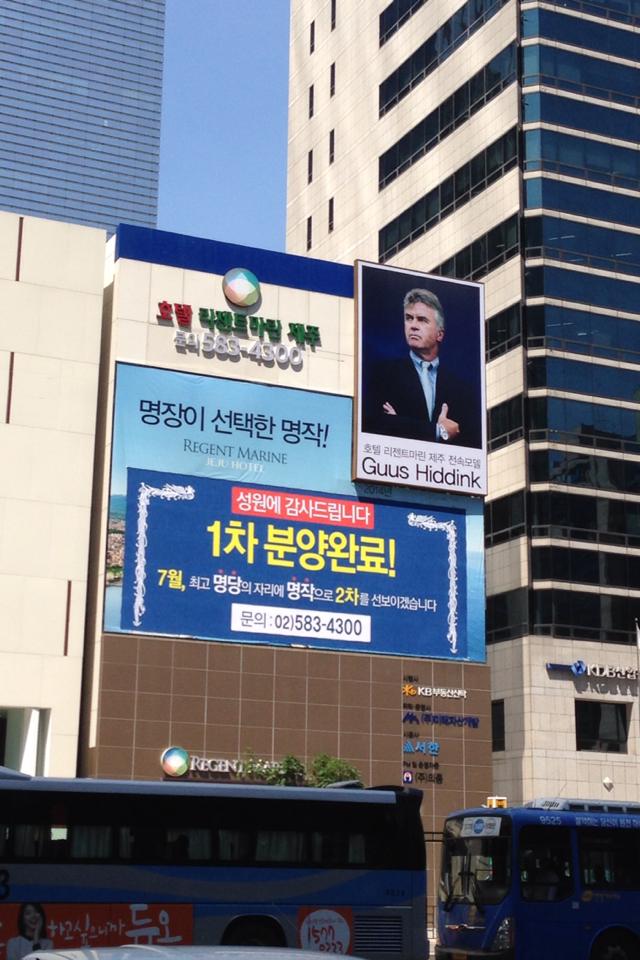
Yes, Guus Hiddink. The Dutch coach of the South Korean national team who was so successful at the World Cup of 2002 in Japan and South Korea by leading his team all the way to the semifinal and beating some top teams along the way. The success story of the Korean national football team at the 2002 World Cup is well known and documented. Just say "Italy" in South Korea and many Koreans become teary eyed and talk about the best victory in their football history. Hiddink is the cultural link between my country and South Korea, more so than Hendrick Hamel, who shipwrecked on Jeju island during the Joseon period (although they are both represented at the Dutch museum on Jeju island). Through the success of Hiddink, the Dutch became familiar with the Koreans and vice versa. Before that World Cup, I wasn't really interested in Korea. Sure, I knew about the war between the North and the South, my father drove around in a Hyundai Lantra, and we had an LG DVD player, but that was about it.  However, that would change that summer. Unable to qualify for the World Cup ourselves for the first time in 16 years, which was a tragedy all in itself (Jason McAteer, the bastard), the only Dutch link to the World Cup we had was Guus Hiddink, the coach of South Korea. So without a team of our own, the Dutch media focused on him.

I remember there was much sympathy for the South Korean team in the Netherlands. The passionate support of the Korean fans, dressed in red with all kinds of attributes, was similar to our own way of supporting our national team. We learned about the Korean fans cleaning up their own mess after supporting their team, which amazed the Dutch and started a discussion about our own short comings, because we always leave a huge mess after a game. The way South Korea played (attractive attacking football) captured the hearts of many Dutch people because of the similarity in style with our own national team.  However, nobody (the South Koreans included) had any expectations at the time, because South Korea never won a game at previous World Cups and had been beaten by the Dutch team several times with a big goal margin. Also, in their preparation for the World Cup, they had lost two games with a 5-0 margin and Hiddink had been blamed for that, earning him the nickname “Five Versus Zero” in South Korea. The Korean press was extremely negative and asked for his resignation many times; asking themselves why they needed another foreigner, that didn't understand Korean culture, in charge of their national team. To say it was a surprise to see South Korea progressing all the way to the semi-final and Hiddink becoming South Korea's national hero is an understatement. It was nothing short of amazing, although they also had a little luck on their way with favorable decisions by the referees. All in all it was one of the best World Cups I have ever seen and our own team didn't even play (although that’s not entirely true for me because Turkey played and reached the semis as well).

[caption id="attachment_3563" align="aligncenter" width="533"]Hiddink Still a hero in South Korea after 12 years.[/caption]

So how did Hiddink become so successful with a team, which had never won a single match on a World Cup? To find that answer we must first see how the Korean national team was organized before Hiddink took over. Korean culture is very suitable in many situations, but sadly running a professional football team isn't one of them. The not-question-your-boss and don't-take-any-risks-mentality and seniority-rules-over-all-culture kills competition in sports. Longstanding personal, familial, and school connections were factors in being selected for the national team and a head coach couldn't ignore them. Older players had more privilege than younger ones (younger players even had to polish the shoes of their seniors) and often didn't have to fear for their place in the team. Such a power imbalance isn't healthy in a professional sports environment. In addition, the risk of losing in the preparation to the World Cup, and an early exit for the head coach, was being avoided by playing generally weaker teams, so it would appear that the Korean team was ready to play at the World Cup. Korean culture was a hindrance in starting with the best eleven and a leading cause in the poor performance of the Korean national team in every World Cup before 2002.

When Hiddink took over, he had asked and received plenary powers in operating the national team, including the selection of players, strategies, training, and support. He basically had complete control. The first thing Hiddink did was demanding domestic professional football teams to give up their top players to the national team for 18 months to prepare for the World Cup. He then did away with the risk avoidance; playing strong teams so his side would get used to the resistance they would experience at a World Cup (hence the 5-0 losses against France and the Czech Republic). Then he cut everybody out that didn't agree to his way of working (that included coaching staff as well as players). Hiddink completely abolished traditional selection policies linked to personal, family, education, and social class affiliations within Korean society. He replaced some of the older players with talented youngsters and the older players that were left he convinced of his way of working. He told older players that they had to respect the younger players and not use their authority against them. He mixed older and young players at the dining tables (a practice that wasn't common before). All these measures were taken to break the Korean culture within the team. He didn't abolishing Korean culture completely though, but made use of elements that would give him an edge to improve the team. For instance, he made use of how bosses are never questioned by subordinates brilliantly. In matches during training, where Hiddink refereed, he made mistakes on purpose and asked his players if he was correct. Their culture prevented the players from responding honestly, but he saw in their eyes that they thought he was wrong. So he raised his voice and repeated if they felt they were wronged until they finally responded, and then told them they should put that feeling and energy in their football. This is how he fired up his players. He also did things that Korean coaches could never do, for example asking the president if his players would be exempted from military service so they could make a career as a professional football player (which the president arranged for them), all to get the players so fired up that they would do anything to win.

Hiddink’s method became a model for success in South Korea that was picked up not only by other coaches and other sport organizations, but also by a wide range of businesses. Many books about his methods became bestsellers in South Korea. It was seen as a potential way of advancing Korea’s global interests in all fields, including sport, politics, science, education, the economy, and citizenship. The fact that Hiddink, a foreigner, was able to challenge the authorities and even operate outside traditional cultural protocols signaled that Korean society was changing. It was called the Hiddink syndrome and has affected many aspects of Korean society.  Since going through the International Monetary Fund’s (IMF) financial crisis in the late 1990s, Korea's society became more open due to government policy, but Hiddink, being the first foreigner awarded honorary national citizenship and the law even being changed for that, had an even bigger impact in accepting foreigners in Korean society. Public calls for him to be naturalized as a Korean citizen and the eventual introduction of special government legislation to award him honorary citizenship were unprecedented. It lead to awareness, discussion, and debate about the historically homogenous nature of Korea’s exclusive citizenship, particularly with respect to race and ethnicity.

However, that doesn't mean that Korean society is suddenly very different after Hiddink's success. Sure, it's easier for a foreigner to get a visa and even attain citizenship, but South Korea is still a long way from being a multi cultural nation. In spite of all those copies of Hiddink's method sold, Korean society is still very much top down and young people's voices are still often ignored. The effect that Hiddink's success had in the years after the 2002 World Cup has stagnated somewhat, when looking at election results, corruption scandals, and workplace culture of the past couple of years (the conservative party has won the presidency at parliamentary elections twice in a row). Rather, the success of Hiddink signals a particular point where the nation may have become more open to alternative ways of thinking about its past, present, and future with respect to citizenship and identity. However, I don't think another stint of Hiddink taking charge of the national team will help South Korea forward again. Everything has its own time and place. For South Korean society to go forward again South Koreans need to change society themselves and, as in any other nation on this planet, that is a slow and difficult process.


Sources used:


  • Nammi Lee, Steven J. Jackson, and Keunmo Lee, "South Korea’s “Glocal” Hero: The Hiddink Syndrome and the Rearticulation of National Citizenship and Identity," Sociology of Sport Journal, 2007, 24, 283-301 http://users.polisci.wisc.edu/schatzberg/ps616/Lee2007.pdf

  • Wat HR-managers kunnen leren van voetbaltrainers (Dutch: What HR managers can learn from football coaches), http://www.timing.nl/9572953/Wat-HR-managers-van-voetbaltrainers-kunnen-leren.html

  • Coen Verbraak, "Guus Hiddink 'Ik heb mijn macht nooit misbruikt' (Dutch: Guus Hiddink 'I have never abused my power')," VN 03-05- 2003, http://www.coenverbraak.nl/hiddink.htm

  • De Bewustzijnsfabriek, Hiddink-methode: kijk en luister! (Dutch: The Hiddink method: watch and listen!), http://www.debewustzijnsfabriek.nl/inspiratie-1016/de-hiddinkmethode-17


Whitewater Kayaking in South Korea

Greetings! Today, I will take you on another splendid journey through time. You have the honor of accompanying me as I recount my personal quest to go whitewater kayaking in South Korea. Is it possible? Is it popular? How can it be done? Not only will these questions be answered, but they will also be placed in a cultural context. Do you think you know everything there is to know about Korea? Have you thought about how recent Korean history may have shaped whitewater activity in the country? If you find yourself unable to answer these questions, continue reading.

Kayaking Becomes a Part of My Life


In my home state of Tennessee, whitewater activity generates millions of dollars in economic growth each year as a result of local tour businesses, the sale of locally-made equipment, and profits generated by the Tennessee Valley Authority (TVA). The TVA releases water from dams periodically in controlled amounts in order to provide whitewater for sport while conserving the state's resources. Arguably the most popular of such rivers, the Ocoee river generated over 40 million dollars in the space of a single year due to guided rafting trips alone. Two geographic features make this sport possible: mountains and moving water.

[caption id="attachment_3526" align="aligncenter" width="1452"]IMG_6207 resized I promise there's a raft in there somewhere.[/caption]

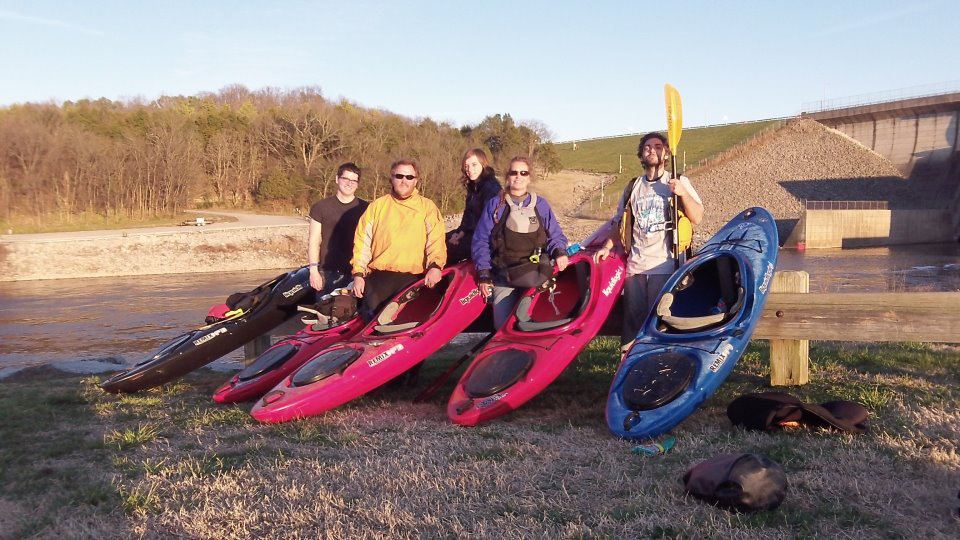
I had gone whitewater rafting on the Ocoee every Spring and Summer for a couple of years. One day, I brought my father along and my family was forever changed. Suddenly, my dear old dad put down his xbox controller and each member of my family had a kayak of his or her own. I like to joke that he hit his mid-life crisis, and instead of finding a younger woman and buying a sports car, he decided to throw us all in the river.

With our new kayaks (liquidlogic xp9's and an xp10 for my dad), we set out to learn everything we could. I had just gotten into the sport, having paddled a couple of small whitewater rivers in the area, when I surprised everyone and graduated from my university. Ready to step out into the great big world, I found myself in contact with a recruiter for teachers to go teach English as a foreign language in South Korea.

[caption id="attachment_3528" align="aligncenter" width="1304"]1557598_10154155800180427_8147608077929357128_n Apparently, this is what aging looks like.[/caption]

Moving to South Korea


When asked where in Korea I'd like to live, I said it didn't matter much to me- but that I liked the outdoors. I signed a contract with a school in the city of Chuncheon. “Chuncheon” means “spring river,” and is described as being one of Korea's best cities for nature and the outdoors. It's also called the city of three rivers, because of the three rivers that wind through it. Nestled in a mountain range in a mountainous country, it seemed like I would find whitewater there.

I lived in Korea for a total of 25 months. I am not sure if I ever saw a single kayak while there.

The Quest Begins: River Rafting and Sea Kayaking


I tried finding whitewater. I found dams, rivers, and waterfalls, but never heard of anyone actually kayaking whitewater. I learned that in the city of Inje, one can sign up for a rafting trip. Curious about how “big” the water would be, I did a search to see how the river was classed. Whitewater ranges in levels from class I-VI. Class I is very easy water to paddle. Class VI is something people rarely attempt, as rescue may be impossible and death likely. I wasn't able to find out what class the river rafting trip in Inje would be, so I decided to go and find out for myself.

[caption id="attachment_3532" align="aligncenter" width="1320"]Niagara Falls Do you recognize this class VI river? [The answer is at the end of the article].[/caption]River rafting in Inje would probably have been very enjoyable if I had not already been paddling larger water. If I had to make a guess, I'd say that Inje was a class I-II river. I was not satisfied, and I set out to find something bigger. Unfortunately, my Google searches were yielding nothing. I learned about a trip to a place called “Pirate's Island,” in Namhae. It was about as far away as possible from my home in the province of Gangwon-do, but among the other activities, the trip listed sea kayaking. I signed up to go on the trip and promptly fell ill. I had to cancel.

The next year, the same travel company advertised the same trip. I signed up and went. After travelling two hours by train to meet the travel company in Seoul, we drove overnight in a bus for five hours toward our destination. At this point, I had travelled seven hours. We started the morning by hiking up a mountain to the most beautiful temple I have ever seen in South Korea: Boriam Temple. We watched the sun rise over the sea. Its brightness spread across the sky and cleared away the twinkling lights of the ships at sea near the coastline along the stars perched in the sky above them. It was breathtakingly beautiful but I was distraced by my excitement for sea kayaking later in the day.

We left the temple and boarded the bus. After another hour of driving through winding mountain roads, while I coped with my fatigue and car sickness, we arrived at a beach. A tour guide left the bus, said he'd return, and after a few minutes he came back. He explained to everyone on the bus that due to choppy seas, we would not be kayaking.

Making a Greater Effort


The rest of the trip was enjoyable and I am glad I saw the temple, but after having travelled all night long and all morning, I was tired and disappointed. Upon returning home, I again searched for a place to go kayaking and came up with nothing. During a conversation with my dad, he told me that one of his friends working for Jackson Kayak, a company which designs and builds kayaks and equipment based in Tennessee, was a customer service representative. Apparently, he worked with a Korean business that sells kayaking gear and equipment. It became my new goal to track them down.

With all of the mountains, rivers, and people dressed in outdoor equipment, I knew that real whitewater had to be somewhere. Finally, it was winter. In Tennessee, kayaking can be considered a winter sport. There is more water in the rivers during winter, so people gear up in special winter equipment and throw themselves down water-filled ravines, often with snow on the rocks beside them. I appealed to my Korean friends on Facebook, asking if anyone knew of a place where I could go whitewater kayaking in Korea. A very, very helpful friend told me about Inje. I explained that I'd already been there and was looking for something bigger, and not rafting. He told me it sounded strange that I wanted to go kayaking in the dead of winter, so I explained that I was used to the idea of paddling in the snow. Finally, he found me a link to a kayaking school. If I remember correctly, they were affiliated with the same company that my dad's friend worked with.

When I went to their website, I learned that they would take people on kayaking trips through their school, but in order to paddle with them on Class III water (which was my goal at the time), I would first have to paddle with them on flat water, Class I, and Class II water. At each level, I would have to be certified by them before advancing to the next level. The classes were very, very expensive.

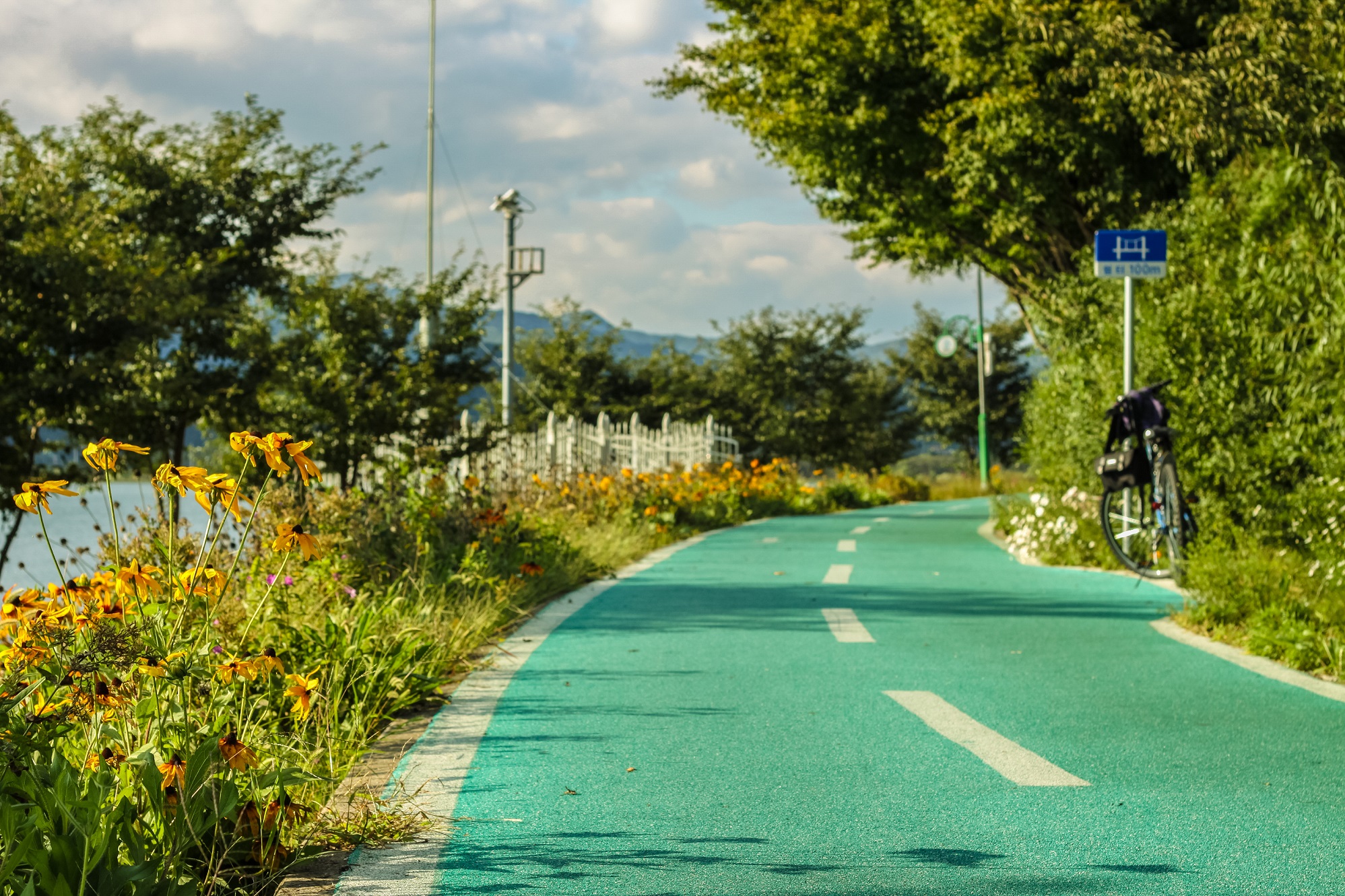
I gave up and threw myself into a new sport, which I had fallen in love with in Korea: cycling. I've biked in the US, France, and in the Netherlands. It is my very strong opinion that no country so far rivals Korea in cycling infrastructure. It is by far my favorite activity in South Korea. I hope to write about its merits one day.

Asking Why I Failed


I am living in France now, and I've learned that kayaking competitions are sometimes held in a town nearby. It should be easy for me to find a place to kayak here. So, in Tennessee, the eastern half of which is mountainous, I can go kayaking. In Normandy, which is not mountainous but does have rolling hills, I can go kayaking. But in Gangwon-do, South Korea, a region of mountains, valleys, and rushing water, it took me two years of searching for a place to go kayaking and I never truly found what I was looking for.

Why?

Why have whitewater sports taken such deep roots in Appalachia and in Normandy, but have not done so in South Korea? One of the first things that outsiders will often notice when they visit Korea for the first time is the droves of people dressed fashionably in outdoor clothing: hiking boots, sturdy hiking pants, windbreakers, and waterproof hats with wide brims. Hiking into the mountains is an extremely popular activity in Korea, and the trails are generally well-maintained and beautiful. Personally, I am impressed with them. Hundreds of miles of beautiful running, walking, and cycling paths stretch across the country from east to west, north to south, and along the eastern coastline. Along these paths, one will often discover people exercising on equipment installed there for public use.

Tennis courts, driving ranges, soccer fields, swimming pools, gyms, and public parks are found everywhere. It has always appeared to me that healthy eating and exercise are large considerations in Korean society. So, why have whitewater sports not caught on in a country which, geographically, seems to be made for it? Why especially have they not caught on in a country which seems to enjoy outdoor sports to a vast degree?

IMG_1566_bike path_resized

Maybe It's Cultural


One of the jobs of an expatriot ought to be discovering not only how other cultures differ, but also ask himself or herself the question of why it is different. I remember a conversation I had with another American in Korea; we were discussing the idea that “Koreans can't swim.” It's not a good idea to make broad generalizations, but this statement danced around inside my head like a carrot in front of a horse for a long time. If I were to accept the idea that Koreans swim less often or less well than their American counterparts do, this might help explain the curious lack of interest in Korean whitewater.

The first thing I began doing was questioning what I knew about Korean swimming habits. Contrary to what my friend said, I knew that many of my students attended swimming classes, and I knew of a few swimming pools in my city. I suggested to my friend that he might be mistaken, and he countered with the idea that Korean children are now learning to swim perhaps because their parents could not. He suggested that maybe their parents wanted to make sure that their children had the opportunity to learn a skill they were not able to learn in their youth.

He told me a story about the time when Park Geun-Hye's father was a dictator in the newly-recreated nation. He claimed that he read about the Han River in Seoul being surrounded by fences and access to it forbidden. My friend said that since the time of the Korean War, people were discouraged from swimming and from visiting beaches because of the opportunity it might present to defect to either side. Given that the country is so mountainous and the border so heavily guarded, the beach might present a much safer passage across the border. In addition, crossing the border sometimes means crossing a river. Crossing a river means that the defector may have to swim.

Are the Rumors True?


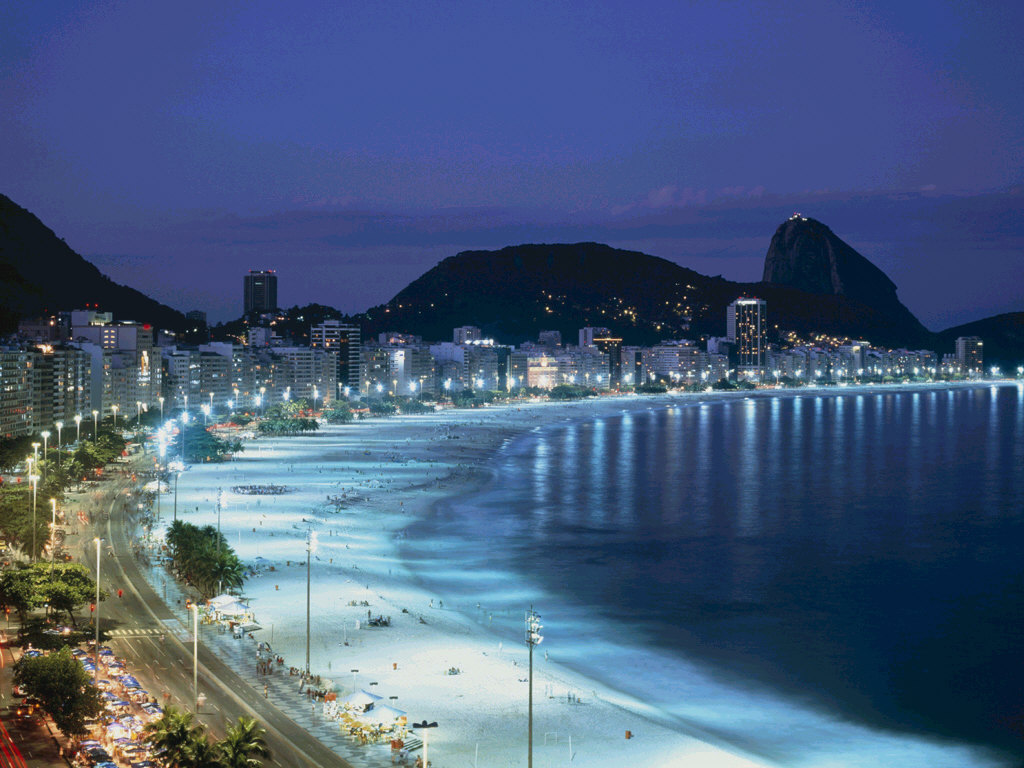
Even now, at night on certain beaches, you'll find that they are sometimes lit up like the top of a birthday cake before the candles are blown out. I was born in Florida and attended middle school there. I had a particularly vocal biology teacher who lamented the city lights on our coasts because they encouraged hatchling sea turtles to move toward the lights and cross into the road instead of following the reflection of the moon into the sea, as is their instinct. So, when I visited a certain beach at night in Korea, and I saw the flood lights stretched as far as I could see in either direction, I wondered about the effect it might have on the nearby wildlife. What would drive a city to install floodlights on a beach that isn't used at night?

It made me wonder if the stories about using the beaches to defect were true and it made me wonder if stories about older Koreans not knowing how to swim might actually have some merit. The next day, I went swimming in a very small area of the beach that was roped off and guarded vigilantly by two very fit lifeguards. Most people simply bobbed around where they could still stand up if they needed to, and nobody was trying to do laps. When my friend and I ventured further out to the edge of the barrier, the lifeguards immediately came near to us. Did they think we were in danger of drowning? I'll never know without asking.

[caption id="attachment_3531" align="aligncenter" width="1414"]Haeundae_Busan Haeundae Beach at night.[/caption]

What Do You Think?


I urge the readers of this article to tell me about their experiences with Korean beaches at night. I also ask that you share with me your thoughts on Korean swimming habits and culture. I do not think that a simple, “general inability to swim” can explain the lack of whitewater activity in South Korea. As I said before, geographically, Korea is as perfect for whitewater as a hand is to a glove.

The image of the Class VI waterfall is Niagara Falls.

Friday, December 5, 2014

Why Atheists celebrate Christmas

Christmas decoration

I must have been 5 or 6 years old when my best friend told me during gym class that Sinterklaas (the Dutch version of Santa Claus) didn’t exist. I didn’t want to believe it, but he kept insisting. “It’s your parents who are giving you those gifts,” he said. I kept being in denial until I got home and asked my parents about it. When they confirmed, I lost my faith in Sinterklaas. It was then and there that I stopped believing in claims of a higher power if not proven by science. In other words: I’m an atheist.

It’s difficult to know that you are the only one you can fall back on, that you’re alone in this world, without some higher power looking over your shoulder. No guardian angel, no deity, no force that’s with me; I have to do everything myself. My father knows both sides of the story: as a devoted muslim he felt comfortable that God was always watching over him, but when he abandoned his faith, so did His watchful eye. He tells me life was easier as a Muslim, because his faith in God would always help him when he would face difficulties. Now, he has to face them all by himself. My father still goes to a mosque sometimes to feel the spirituality of the place, whereas I go for the magnificent architecture, which I like to photograph. Spirituality is meaningless to me; it’s like telling myself Sinterklaas still exists when I know he does not. I have no use for it in my life.

Now that I am living in Korea, I sometimes feel out of place when spirituality is involved. However modern it may look on the outside, Korean society still has a big place for spirituality. Soothsayers and palm readers play a big role in many people’s choices in life, Buddhist temples and churches are still frequented for guidance and prayer, and multiple times a year rituals are performed to honor deceased ancestors. All this spirituality means nothing to me. I think that the soothsayers and palm readers are a bunch of frauds that make a good living off the uncertainty of people, I frequent Buddhist temples and churches only for the amazing architecture and scenery I love to photograph, and I have no need for honoring my dead ancestors because they are dead and can’t hear me anymore.

Although spirituality hasn’t any meaning to me, I can’t escape it due to my Korean wife’s family. My wife used to go to a palm reader in the early stages of our relationship. She was shocked to hear the palm reader say that we would break up a few years later, at which I got angry and told her she shouldn’t see those people anymore. The problem resolved itself. When the deadline of the prophecy passed, our relationship was stronger than ever. She hasn’t gone to one of them since. I don’t have any problems with my mother-in-law going to a Buddhist temple every week. Being an atheist doesn’t necessarily mean that you think other people should be atheists as well. Religion and spirituality is something personal that everybody should figure out for themselves. No, the most frequent exposure to spirituality is the ritual to honor the dead that I have to go through multiple times a year. There is charye (차례) on New Year’s Day and Chuseok (추석) in the Fall, and because my wife’s grandmother died a couple of weeks after Chuseok, we need to repeat the whole ceremony again on the day she died (which is called Jesa or 제사). My wife’s grandfather died on another day still so there’s another day for that too.

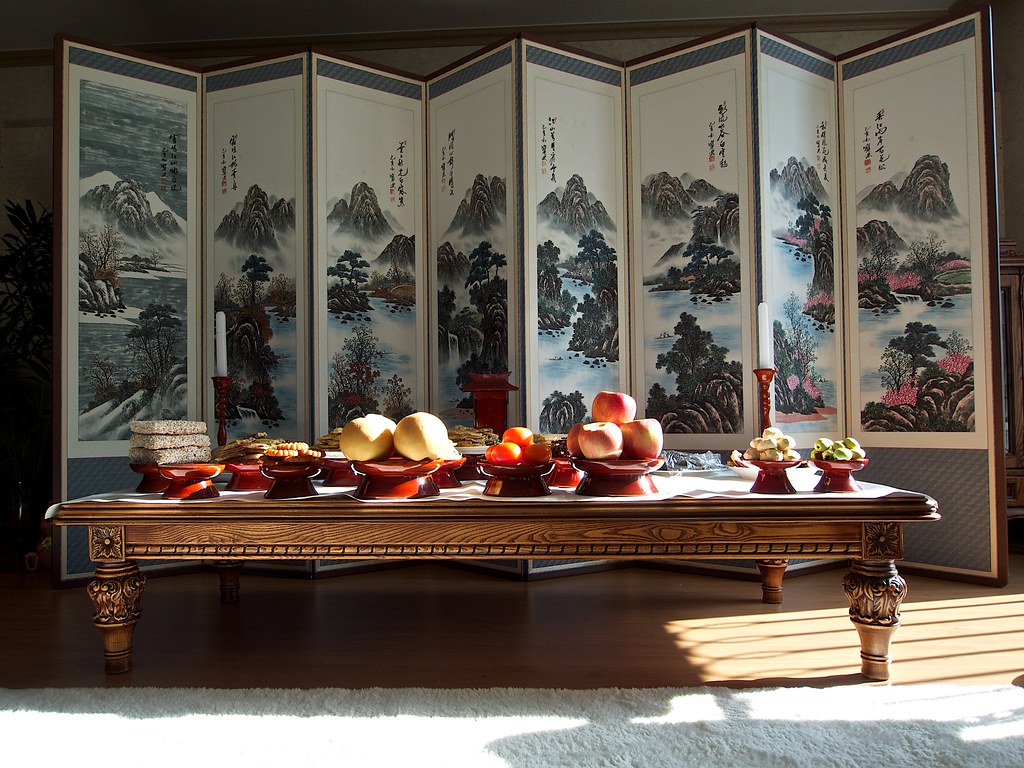
[caption id="" align="aligncenter" width="1024"]Chuseok Table Table set for Chuseok (photo by Emre Kanik)[/caption]

The ceremonies are almost identical (I haven’t found a difference yet, but then again, I could be wrong): It starts with preparing a lot of food and putting it on a table in a predetermined way, organized by color and/or type of food. Nobody seems to know because every time we are arguing what goes where and shifting around the food. Several times we need to refer to a printed piece of paper with the set up on it to get it right. Then my father-in-law and his brother change into their nicest suit and the ceremony begins. Well, not immediately because my father in law, who needs to lead the ceremony, always forgets what must be done. He’s studying a book with instructions and pictures intensively before we start. During the ceremony he constantly reaches for it too, because he’s not sure about the next step. While not having the need for any spirituality, I still participate in all the bowing and circling a cup of rice wine (Jeong Jong, 정종) around incense three times. There is also a period just before the final bow when we shouldn’t look at the table so the spirits of our ancestors wouldn’t be disturbed while eating the food from the table. Though I think the reason you shouldn’t look is that you won’t see that there’s actually nothing going on at all. We awkwardly wander around in the living room until my father in law says it is time to continue the ceremony.

So why participate in all this if I’m so skeptical, you might ask. The answer is the same as when we celebrated Sinterklaas during my childhood. After I stopped believing in Sinterklaas we didn’t stop celebrating it. Partly it was because of my little sister, who still very much believed, but also when she stopped believing we continued celebrating. Although it shifted to celebrating Christmas, which is even weirder to celebrate as an atheist when you think about it. I remember we would really look forward to the gifts we would receive and preferably open all at once. Now that I’m an adult and living in Korea I’m in a whole different situation. I don’t celebrate Sinterklaas nor Christmas anymore and I don’t need all the rituals and spirituality. However, when people express their gratitude when I know the proper way to bow in a funeral, or help my in-laws setting up the table and participating in the ceremony, I know I still do it for the same reason as celebrating Sinterklaas when I was just a kid. I’m still doing it for the gifts, but I’m not on the receiving end anymore and that makes it even more rewarding.

Don't get me wrong, if you believe in a god I still think you're wrong, but it's just not worth it disrupting Christmas for. Like I found my way to deal with spirituality you have found yours. People throughout history have been wrong or right on numerous issues and have solved them in any number ways, including the really ugly ones like suppression and violence, and good ones like dialogue and arguing. I like to choose for the latter rather than the former, so unless you are one of those people who advocate the former, I think we're going to do just fine.

Thursday, November 20, 2014

Fooling The General Public: Mass Media in South Korea & Turkey

[caption id="attachment_3261" align="aligncenter" width="300"]IMG_6872 “Naneun Ggomsuda's” (나는 꼼수다) hosts (photo by Emre Kanik)[/caption]

While living in the Netherlands my Korean wife followed the political situation of her country very closely. She gave me regular updates on what was discussed on the popular podcast “Naneun Ggomsuda” (나는 꼼수다) to which she listened every week. The podcast was the voice of young people in South Korea, addressing issues that wouldn't be touched by the conservative mainstream media. Allegations against government officials were frequent, and the government sought a way to stop the podcast by making the life of the hosts very difficult. For example Chung Bong-ju (정봉주), one of the four hosts and national lawmaker at the time, was found guilty of spreading false rumors in what many of his supporters have called a political process, accusing then-presidential candidate Lee Myung-bak in 2007 of being affiliated with a company that forged stock prices. My wife was outraged by the prison sentence, and I was surprised that such a claim could land you in jail, being a politician myself at the time, in a country where you still drink a beer with your greatest political enemy after a city council meeting. So when our visit to South Korea coincided with the protest against Chung Bong-ju’s imminent incarceration, my wife insisted on joining.

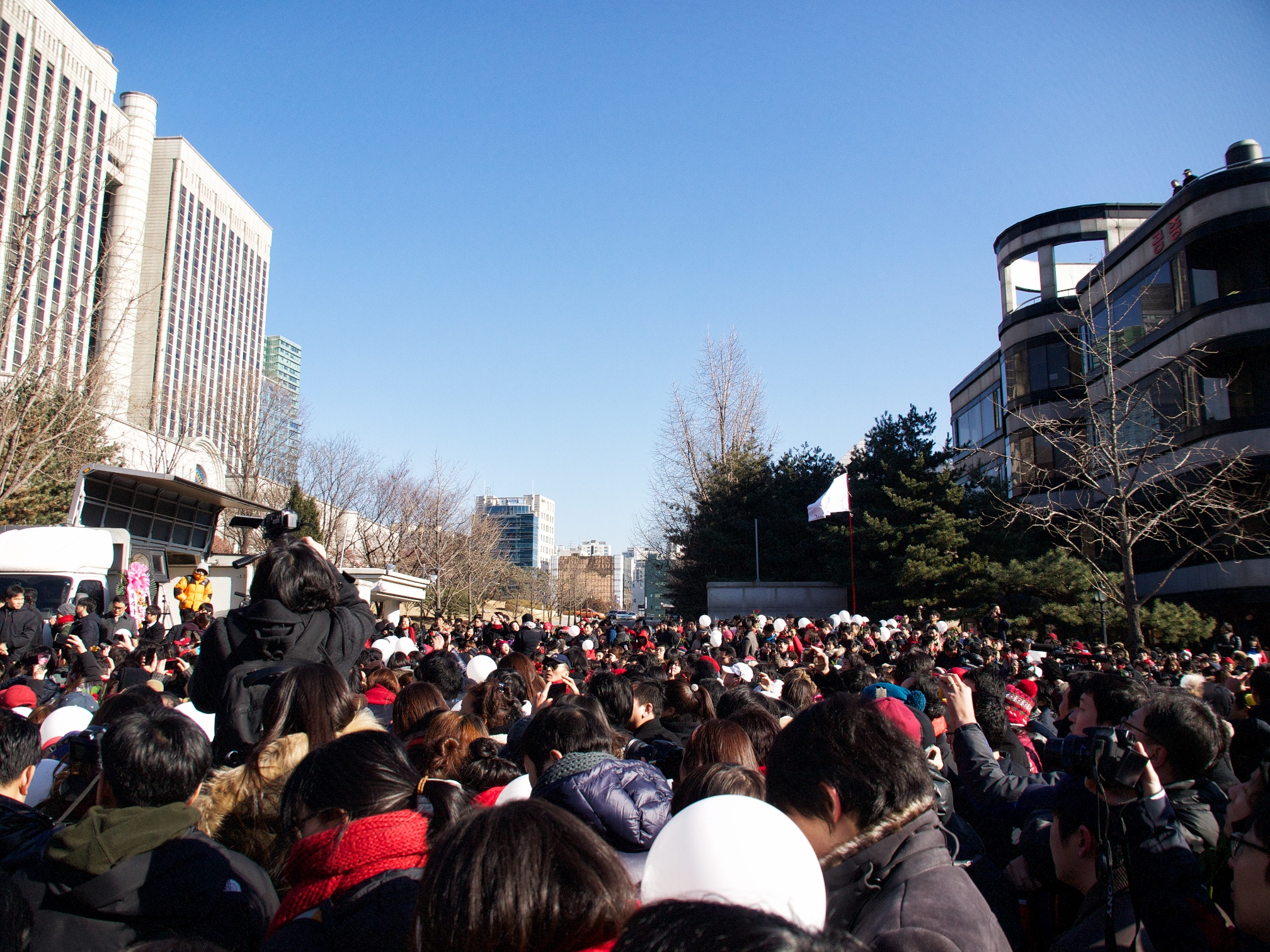
On a cold but sunny December morning, we arrived at the subway station near the courthouse where the protest was held. At the station I saw small groups of young people dressed in red, bringing signs, balloons, and roses with them. It didn’t seem like a massive protest, but when we arrived at the entrance of the courthouse, the road was full of people. A white van with a sound system was parked on the curb, playing music and occasionally someone would play the MC and say something in Korean, which I didn’t understand at the time. Cameras of the press were positioned on the roof of one of the buildings in the surrounding area and in front of the entrance of the courthouse. Even the police had someone filming the protesters, which I found kind of odd at the time.

[caption id="attachment_3229" align="aligncenter" width="1024"]The protest The protest (photo by Emre Kanik)[/caption]

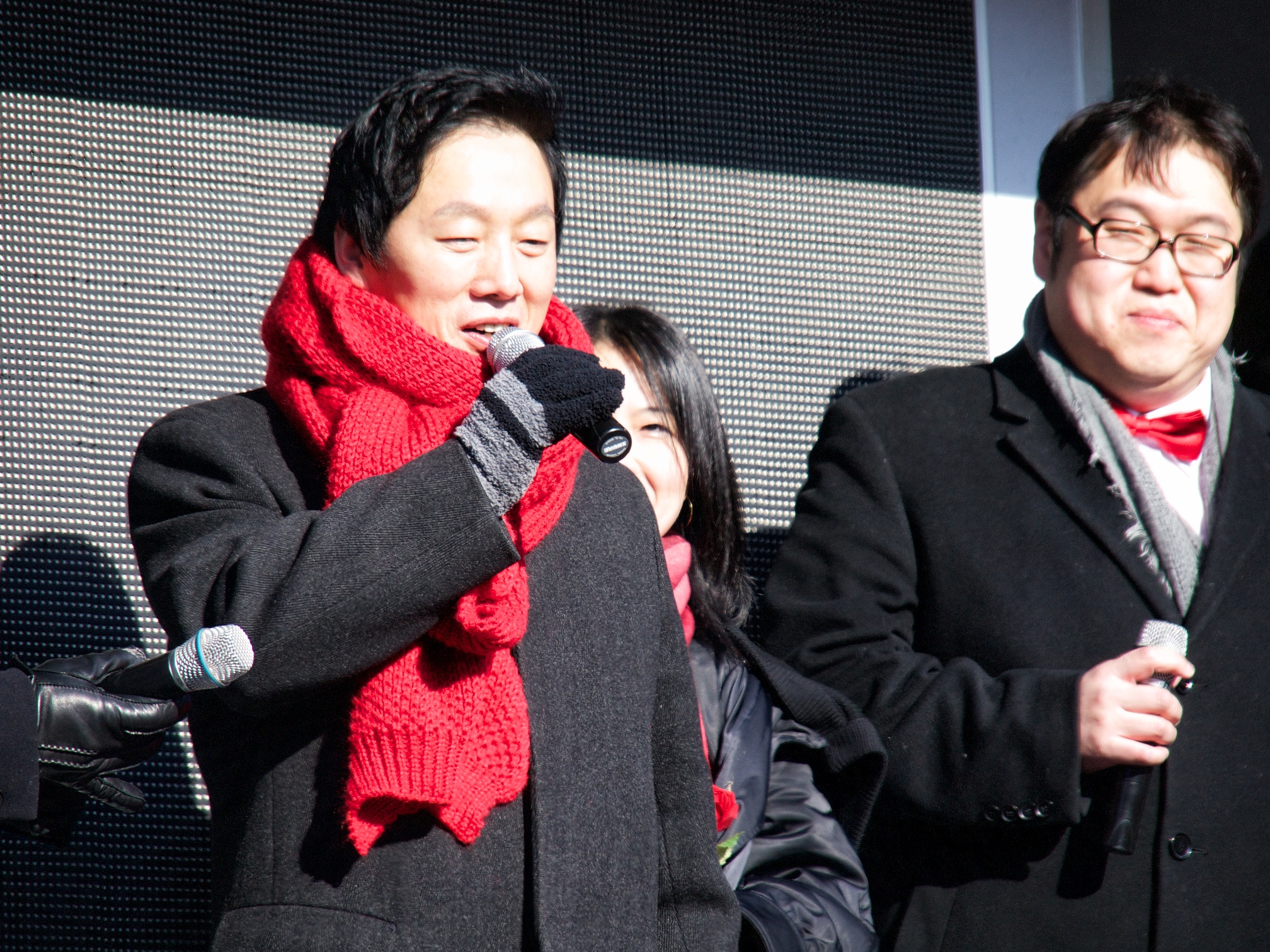
The crowd was cheerful and the atmosphere was not at all aggressive. They were singing and dancing and sometimes they all sat on the ground when the MC was telling them to. I didn’t understand why this was happening, but I knew what the cause was, so I sat down as well. Sometimes my wife would translate parts for me, but most of the time she was caught up in the protest. When the hosts of the podcast arrived things got even more lively with speeches and cheers. When it was time for Chung Bong-ju to enter the courthouse, the crowd parted to make a passage and roses were thrown on the ground where he would walk while All you need is love by the Beatles was played and sung by the protesters. He went to an area behind the police line where protesters were not allowed to come, made a final statement to the media (which were surrounding him at this point) and went inside. At the end of the protest when we walked back to the subway station a small fight almost broke out. Apparently an older lady had shouted to some of the protesters that the color red is used by communists. Some curses were exchanged, but that concluded the incident.

[caption id="attachment_3228" align="aligncenter" width="1024"] Chung Bong-ju addressing the crowd (photo by Emre Kanik)[/caption]

The purpose of the protest and the situation with the old lady at the end reminded me of Turkey. It sometimes shocks me how similar the Turkish and Korean cultures are: the close family ties and friendships, how people with different opinions are immediately treated as enemies, and how losing face is one of the worst things that can happen to a person. Similar cultures make similar societies, so it is not a surprise that there are many similarities between Turkey and South Korean politics as well. Opposing political parties are each other's mortal enemies. Whoever is in power uses everything they can to destroy anybody who opposes them. One of the most commonly used tools: mass media.

In both countries the ruling party wants to control what the people see and read. Having a population that still relies heavily on newspapers and news broadcasts, they keep those under strict control. Although organized differently in the two countries, the effects of that control are the same. It is sufficient to say that high positions at TV stations and newspapers are filled by people friendly to the regime and journalists are pressured (or voluntarily) report what the high management is ordering them to. I won’t go into too much detail how it is exactly organized (Groove magazine has an excellent article on the South Korean situation), but have seen the effects firsthand. When we got home from the protest and turned on the news, we saw how state control operates by outright lying to its inhabitants. The news reported that there was little support for Chung Bong-ju at the protest, showing only the last part where he was in an area where the protesters were prohibited from entering and not showing footage from the rooftops, which would show the true number of people present. This is a mild way of bending the facts, but since then measures have been much stricter to prohibit the people of South Korea to see the truth. During the presidential elections, the Korean secret service has even been accused of trying to manipulate the discussion on Twitter in favor of the ruling party's candidate and now president Park Geun-hye by starting a smear campaign against her main rival. Another example of mass media control became clear during and after the Sewol disaster. The major newspapers and TV stations blindly published and reported government statements and press releases without checking if what they reported was true (many media outlets would apologize for this later). Public confidence in the media fell to a record low.

While state control over the media in South Korea is troubling, in Turkey it is a disaster. Ruled by the conservative Islamist Justice and Development Party (AKP) since 2002, Turkey has the highest number of jailed journalists in the world and the AKP has most major media outlets under firm control. The AKP isn’t afraid to use its control over the media for its own personal gain, a fact that became painfully apparent during the wave of protests that followed after the government violently tried to end a friendly sit-in at Istanbul’s Taksim Gezi Park in 2013. Protests engulfed the country addressing press freedom, freedom of expression and assembly, and the government's intrusion on secularism. The government replied with brutal force, teargassing and cracking down on peaceful protesters. The role of mass media in the protests? CNN Türk broadcasting a documentary about penguins. While the country burned, the state controlled media first tried to ignore it. When that didn’t work because all international media were reporting in full force (regular CNN was showing the protests) and Twitter exploded with images and videos about what was really going on, on came the fabricated lies. From reporting that protesters had entered a mosque with their shoes on and drunk beer inside to showing them burning the Turkish flag (which was actually footage from 2010), the state controlled media did everything in their power to slander the protesters. Sadly because so many Turkish people still rely on traditional media for their news, a large part of the country believes this all actually happened. In the recent presidential elections, TV stations wouldn't say anything critical about the leader of the AKP Erdoğan, while the opposition was heavily attacked. The official state channel TRT spent time only on Erdoğan and ignoring his rivals all together. That is pretty problematic in a country where less then half of the population uses the Internet and therefore relies on these broadcasts as their sole source of information.

So is there no way to get reliable information in Turkey and South Korea? As in many cases, the Internet is your friend. Although it is becoming a troubled friendship because of the government of both countries want to control information there as well, it is still possible to find the real story on what is going on. However, if so many people keep relying on traditional media to keep themselves informed it is fairly easy for the government to keep feeding half-truths and lies to the general public. Without true reform in both countries’ mass media their democracies will always be in danger of turning into something uglier. Having the power to vote is just one part of a democracy. Having unbiased information on who you can vote for is just as important.

Pop Culture: Enjoy... But Be Cautious

Stuck in Stereotypes

I once read that the majority of Americans don’t have a passport. As a European, I thought this was an incredibly shocking, if not dismaying, piece of trivia. On the other hand, presumably even those without passports know that Italians eat pizza and pasta and the typical French person cycles around with a baguette, wearing a black beret. An Irish citizen wears green and stumbles drunk down the street. Australians throw boomerangs at kangaroos. All the classic stereotypes.

These examples seem perhaps quite harmless at first glance, but what about the others---all Arabs are Muslim, all Blacks are poor, all Jews are greedy.

Stereotypes influence our decision making and are difficult to unlearn. Where do we form these ideas? How do we come to know---or think we know---so much about countries and cultures we have never experienced firsthand? The answer is through popular culture – the media of film, books, magazines, music and videos.

Mass Media: The Importance of Popular Culture

We cannot underestimate the power of mass media and pop culture in shaping our perceptions, ideals or prejudices of another culture. When it comes to ‘exporting culture’, there is both “High Culture" and "Low Culture" (a.k.a. Pop Culture). High Culture includes opera and ballet but reaches a smaller audience. Pop culture is much more ubiquitous and as a result arguably more influential. Let’s look at the most popular example---violence on our screens.

It is well documented that watching violence in film and on television could negatively influence the viewer. There is evidence to suggest this is true. Recently, a young man in the USA killed and dismembered his girlfriend after being inspired by a popular show about a serial killer, Dexter. On the other hand, Norway is regarded as a very peaceful country with low internal conflict. Is it a coincidence that the same country attempts to control, avoid and limit negative influences from its media? Crime is not sensationalized, television has little violence, boxing is banned from television. Even E.T. was rated too violent for viewers under 12.

Violence on television is a widely debated topic in the public eye. Why then, is less thought put into monitoring and researching the power of pop culture? Most people would look down at the importance of studying pop culture, believing it to be insignificant. Pop culture can be fun and educating but at the same time, it is a major factor in building prejudices and creating stereotypes. When original content is made by one culture and exported to another, we need to examine it carefully and make an educated decision on whether or not it is accurately portraying a culture’s image.

[caption id="" align="aligncenter" width="329"] How are Asians usually represented in film? The men traditionally played the role of the villain such as Ming in Flash Gordon. On the hand, women tend to be painted as soft, feminine and desirable.[/caption]

Film: Learning about Cultures without Personal Experience

While I have yet to visit most of the countries in the world, it seems that I already know so much about them. You probably feel the same. Those who have yet to visit Paris, New York or London all have wonderful images and notions of their streets and alleys. Bustling Asian markets, piranhas in the Amazon and tribes in Africa. We are all constantly learning about cultures without firsthand personal experience. This increases the risk of misshaping our attitudes.

Through mass media, I know that India, for example, is a colorful place with a rich history, delicious food and with wonderful landscapes and locals. I do however, also know that a series of high-profile rape cases have tarnished the country’s image over the past few years. This has lead to a decrease in tourism. I know this from reading the news or watching a documentary but often it is film that is the most widespread channel in delivering gateways into other cultures. Looking at India again, the film Slumdog Millionaire was criticized by Indians for showing the country in such a dim light. Yet friends who have visited there can’t speak highly enough of such a beautiful place. Who to trust more, media sources or those who have been there and done that?

[caption id="" align="aligncenter" width="556" class=" "] Slumdog Millionaire presented the slums of Mumbai in a brutal but honest light. Still, it would most likely turn viewers away from India.[/caption]

Taken, the Hollywood blockbuster about human trafficking in Paris, apparently led to a decline in annual tourism in France. Parents told the movie’s leading front man Liam Neeson, “I’ll never send my kids to Europe.” To Asia, after the movie The Beach was released showing Leonardo Di Caprio’s adventures in Thailand, tourism soared there. People saw what an interesting culture Thailand had to offer with friendly locals, crazy parties and pristine beaches. They also expected shots of snake blood, shark infested-waters and drugs growing out of thin air on their arrival.

Heading north, to eastern Asia and Korea, a French actress Brigitte Bardot highlighted that Koreans eat dog in the French media prior to the 2002 FIFA World Cup. This spread across the global media and painted Koreans in a barbaric way, despite their huge advances in modern technology and innovation. The eating of dog, although a separate topic, is a custom that has lasted centuries and is ingrained in local culture here. We shouldn't compare cultures as being right or wrong, simply different. On a better note, Korean dramas have recently become huge in Cuba, of all places.

[caption id="" align="aligncenter" width="488"] Phi Phi island in Thailand. Since the Beach, the area has received an incredible boost to tourism but local culture and the surrounding environment have taken a battering.[/caption]

Media: Objective or Subjective?

In general, we often believe that the media---whether a newspaper, a television show or a documentary---is objective and reflect their subjects much like a mirror would do. However, in fact the media is more like a window. It is mostly subjective and only offers us one viewpoint. Another window from the same building may cast a different light. This is to say that when we consume foreign pop culture we must do so with an open mind. What we are seeing, reading and hearing may not represent the true culture of a nation. The media is usually affected by local constraints that we are not aware of such as religious, political, historical or gender differences.

Korean director Kim Ki-Duk has had great success at international film festivals but his movies have never been widely appreciated in his homeland. If someone was to watch just one of his films, they would have a misrepresentation of Korea. Traditionally African-American women were portrayed as domestic stereotypes like in Tom and Jerry (which now carries a racial warning to viewers). Often media that is ‘factual’ or ‘based on a true story’ is only telling one side of a tale. Others rewrite history altogether; Disney’s Pocahontas, for example, all but overhauled the tragic history between natives and European adventurers.

[caption id="attachment_3259" align="aligncenter" width="250" class=" "]Media framing - what we see may not be a true reflection Media framing - what we see may not be a true reflection[/caption]

Keep an Open Mind

As technology improves, culture is spreading more and more. However, there is also a major global imbalance. Individuals from less populous cultural groups tend to import huge amounts of foreign content as it isn't plausible to consume only their own. Societies that watch too much foreign media may lose touch with their own. On the other hand, major nations like America, tend to view or consume little or no foreign content.

Finally, for many of us, some cultures and some nations exist only through popular culture. Mass media and pop culture are major powers in building our perceptions of other cultures and can often be only somewhat correct and educational. Those who do use media as their primary source of learning about other cultures thus need to consume as much as possible with an open mind in order to see a wider, probably more accurate picture of a nation, group or culture. Still, the best way to learn is still to get out there and mingle with real people.

Tuesday, October 28, 2014

Curb your enthusiasm: Korean internet is not all it's cracked up to be.

IMG_0744

Roughly two years ago I moved from a country where net neutrality is implemented by law (the Netherlands) to a country where the freedom of the Internet is under pressure (South Korea). It has been a world of difference using the Internet in both of these countries. To give a feel for how bad the situation really is in South Korea, I will first describe the situation in the Netherlands as a contrast.

The history of how net neutrality in the Netherlands came to be is a fairly recent one. I vividly remember the time when the news leaked that one of the Netherlands' biggest Internet providers had admitted to its investors it was using a technique called Deep Packet Inspection (DPI), with which they could differentiate what the customer was doing on their network. Basically it meant the company was spying on its customers. The plan was to charge extra for certain VoIP and message services because the company was losing money due to decreasing use of SMS and regular calls. The indication that they soon had to pay extra for their WhatsApp use was too much to handle for the Dutch, being the frugal people that they are, and caused such an outrage that the telecom company had to cancel its plan to use the technique. In addition, the Dutch society is also an open one where everybody has the right to express themselves and press freedom is being held in high regard. Therefore, the more informed people worried that the Internet would be controlled by several companies. With these two main arguments, the people urged the Dutch political parties to take action. On 22 June 2011 the Dutch parliament decided to include net neutrality in the new telecom law, and by ratification by the Dutch Senate on 8 May 2012, the Netherlands became one of only two countries in the world (the other being Chile) where net neutrality is guaranteed by the legal system. Thus mirroring the democratic principles of Dutch society in cyberspace.

The benefits of the Dutch net neutrality law for the consumer are many: Internet providers can't limit or charge extra for certain services, the contents of your Internet traffic can be accessed by your Internet provider only in certain extreme cases, your Internet connection can be disconnected only if you don’t pay your bills or you commit fraud, and you have to give explicit permission to let tracking cookies be installed on your computer, which in turn makes it difficult for advertisers to track your behavior on the Internet. All in all it was and is a huge victory for freedom on the Internet. Although at the time I realized to some extent that this was a big deal, since roughly two years I really know by experience how fortunate the Dutch are.

When, in August 2012, I moved to South Korea, which has a reputation of being the Internet capital of the world, I thought I was going to live in the Valhalla of the Internet. Due to several news stories, I thought positively about the South Korean Internet, which seemed to dazzle the world with not only the fastest download and upload speeds around but also nearly universal LTE and WiFi accessibility. Unfortunately, there are some aspects of the South Korean Internet that don't get the attention that they deserve in the news, because of the focus of Western media on the speed of the Internet here. I quickly found out that a new 5G network isn't the most important thing about Internet usage.

A fast Internet connection doesn't get you anywhere if you're not able to access everything you want. Sadly, like in the Netherlands, South Korean cyberspace mirrors its society as well. Internet censorship is common: blocking everything from North Korean sites and materials harmful to minors to pornography and even simple nudity. If the government deems it inappropriate, you won't be able to see it without using a workaround. Unfortunately, blocking some sites is not all the government does; commenting on the Internet isn't anonymous anymore, since you need to register with your social security number to be able to comment on any Korean Internet portal. That makes it easier to extensively monitor the Internet on anti-government comments. Sometimes action is being taken to cut of the perpetrator's Internet or even making arrests in some cases. For example Chung Bong-ju, one of the four hosts of the popular South Korean podcast "Naneun Ggomsuda" (나는 꼼수다) and national lawmaker at the time, was found guilty in 2011 of spreading false rumors, accusing then-presidential candidate Lee Myung-bak in 2007 of being affiliated with a company that forged stock prices. Critics have claimed that it was a political motivated sentence, because of its timing just before the presidential elections. The podcast was a very influential channel of anti-government views. All of this is very serious, but the by far most annoying thing on the Korean Internet ever is Active-X.

The country that has the reputation to be years ahead in technology relative to the rest of the globe relies on this archaic 90's program for its entire e-commerce economy. Forget buying something on your iMac if you're not willing to partition and install Windows as well. Not only that, Active-X is Internet Explorer only, hence the biggest market share of Internet Explorer in the world. Being the Apple fan boy that I am, this frustrates me immensely. I refuse to install Windows on my iMac and if I would, I don't want to have anything to do with Internet Explorer. Fortunately, I have a workaround: if I spot something I want, I'll ask my wife to buy it at her office where she uses a Windows machine. Also I found a bank that has Internet banking for OS X. Well, had Internet banking for OS X.

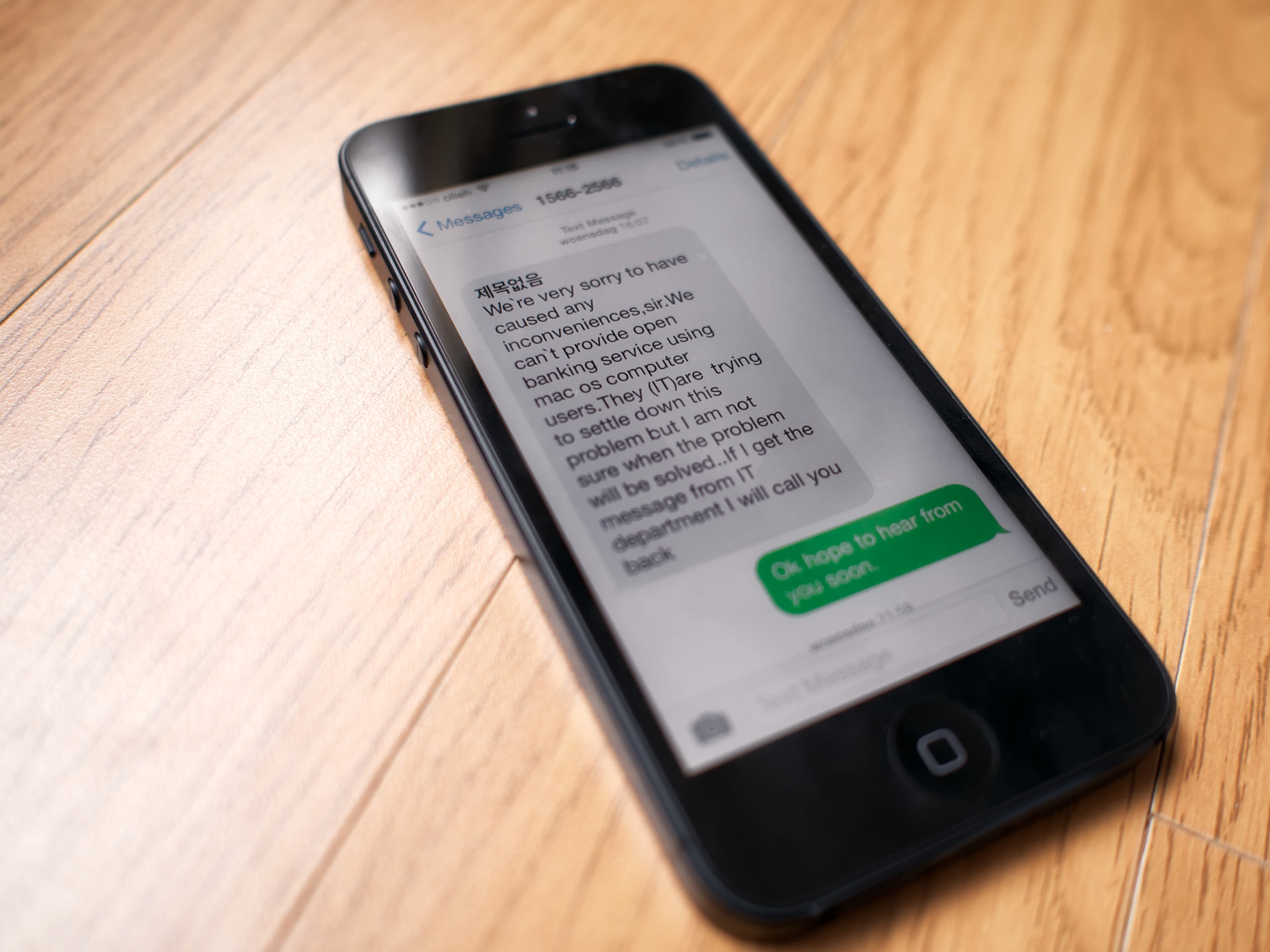
As a Mac user, you're such a rarity in this country that you're met with a lot of misunderstanding and disbelief. When my bank updated their security protocol they somehow forgot that they used to support OS X as well. As a result the site stopped working on an Apple computer and I had to contact the bank's service center. Their solution was to take over my computer to take a look by sending me an .exe file. When that didn’t work they were genuinely surprised and apparently had no alternative way to access my computer. Not much later after the service center employee promised me she would get back to me and hung up the phone, I got a message that they were unable to solve the problem. So now I have to use my workaround for my Internet banking as well.

iPhone bank message

Having lived here for two years, I now know that not South Korea, but the Netherlands is the real champion of the Internet. Although the overall Internet speed isn't as fast as that of South Korea, it's close enough. There is no monitoring, no blocking (although there was one issue with Pirate Bay being blocked), and no Active-X. All government websites have to be accessible by all major browsers and all purchases can be done with any operating system. You can criticize the government without being afraid of being cut off from the Internet. While Dutch cyberspace is a free and open world, South Korean citizens have no access to unfiltered Internet. I have not been homesick often in the two years that I lived in South Korea, but when I stumble on news of Internet censorship being used or when I get confronted by the limitations when browsing the web on my iMac, I long for the possibilities of net neutrality in my own country. I secretly wish South Korea would implement it too. Unfortunately, with democracy more and more under strain, I don’t see that happening in the near future.