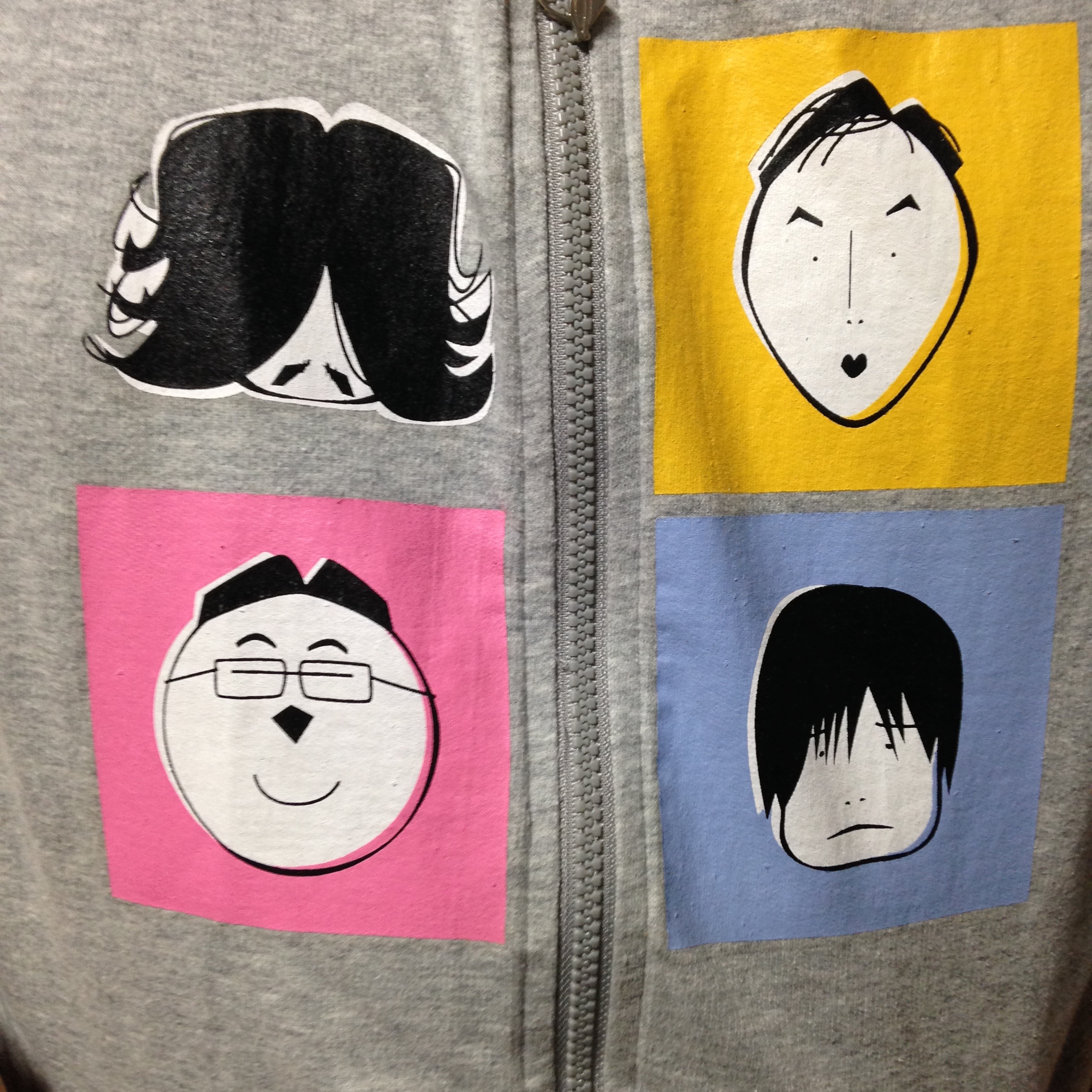
 “Naneun Ggomsuda's” (나는 꼼수다) hosts (photo by Emre Kanik)[/caption]
While living in the Netherlands my Korean wife followed the political situation of her country very closely. She gave me regular updates on what was discussed on the popular podcast “Naneun Ggomsuda” (나는 꼼수다) to which she listened every week. The podcast was the voice of young people in South Korea, addressing issues that wouldn't be touched by the conservative mainstream media. Allegations against government officials were frequent, and the government sought a way to stop the podcast by making the life of the hosts very difficult. For example Chung Bong-ju (정봉주), one of the four hosts and national lawmaker at the time, was found guilty of spreading false rumors in what many of his supporters have called a political process, accusing then-presidential candidate Lee Myung-bak in 2007 of being affiliated with a company that forged stock prices. My wife was outraged by the prison sentence, and I was surprised that such a claim could land you in jail, being a politician myself at the time, in a country where you still drink a beer with your greatest political enemy after a city council meeting. So when our visit to South Korea coincided with the protest against Chung Bong-ju’s imminent incarceration, my wife insisted on joining.
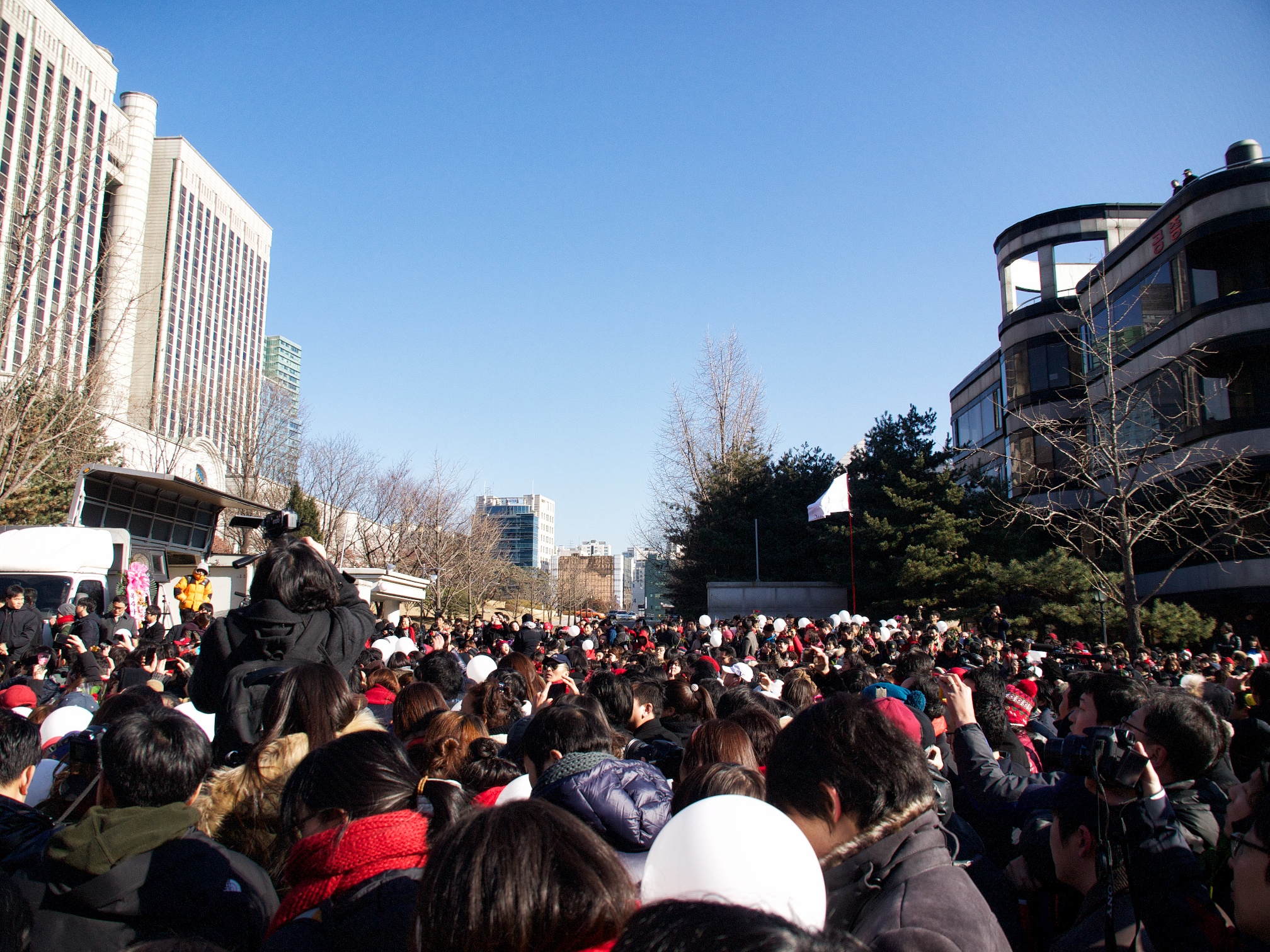
On a cold but sunny December morning, we arrived at the subway station near the courthouse where the protest was held. At the station I saw small groups of young people dressed in red, bringing signs, balloons, and roses with them. It didn’t seem like a massive protest, but when we arrived at the entrance of the courthouse, the road was full of people. A white van with a sound system was parked on the curb, playing music and occasionally someone would play the MC and say something in Korean, which I didn’t understand at the time. Cameras of the press were positioned on the roof of one of the buildings in the surrounding area and in front of the entrance of the courthouse. Even the police had someone filming the protesters, which I found kind of odd at the time.
[caption id="attachment_3229" align="aligncenter" width="1024"]
 The protest (photo by Emre Kanik)[/caption]
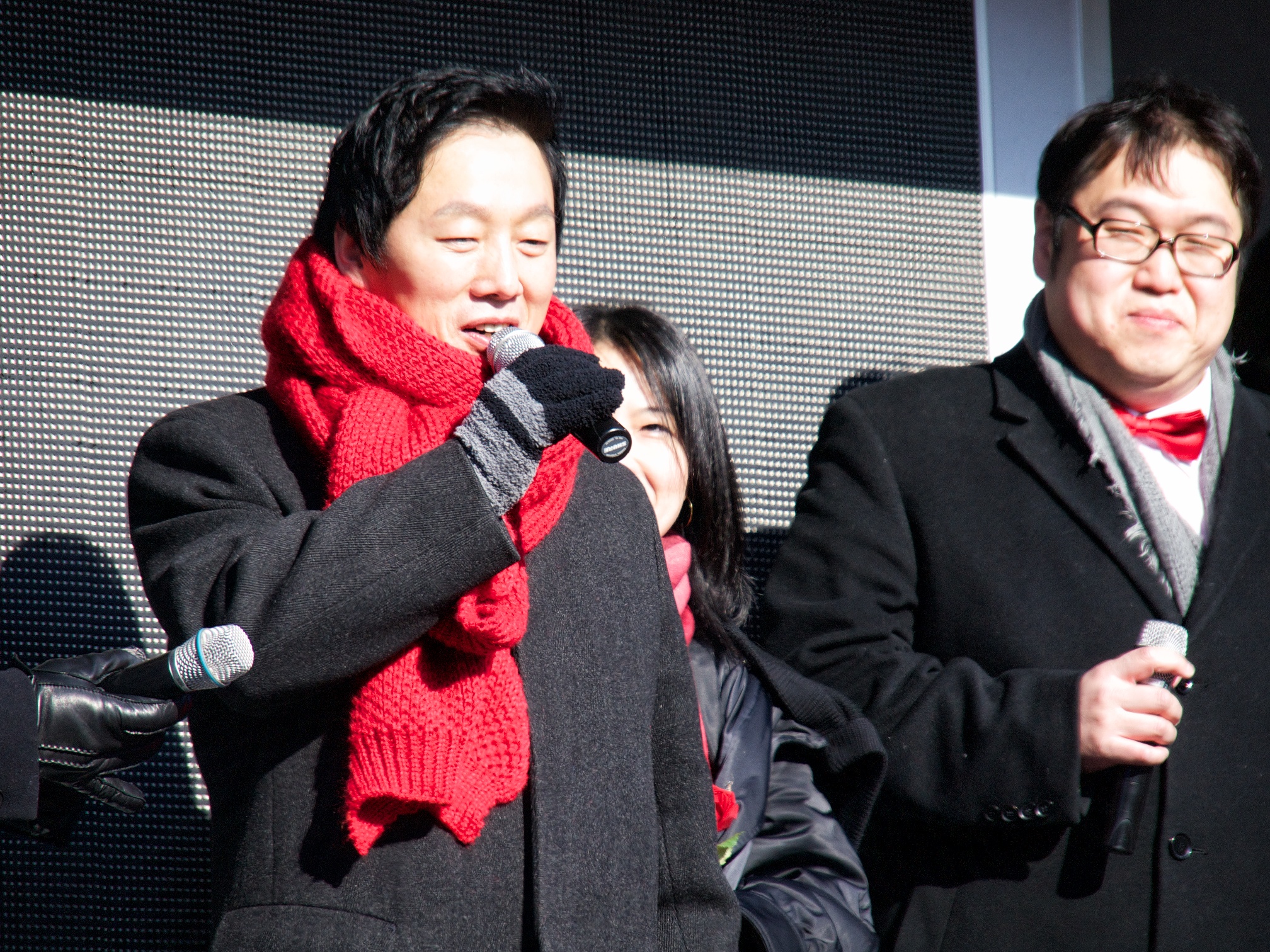
The crowd was cheerful and the atmosphere was not at all aggressive. They were singing and dancing and sometimes they all sat on the ground when the MC was telling them to. I didn’t understand why this was happening, but I knew what the cause was, so I sat down as well. Sometimes my wife would translate parts for me, but most of the time she was caught up in the protest. When the hosts of the podcast arrived things got even more lively with speeches and cheers. When it was time for Chung Bong-ju to enter the courthouse, the crowd parted to make a passage and roses were thrown on the ground where he would walk while All you need is love by the Beatles was played and sung by the protesters. He went to an area behind the police line where protesters were not allowed to come, made a final statement to the media (which were surrounding him at this point) and went inside. At the end of the protest when we walked back to the subway station a small fight almost broke out. Apparently an older lady had shouted to some of the protesters that the color red is used by communists. Some curses were exchanged, but that concluded the incident.
[caption id="attachment_3228" align="aligncenter" width="1024"]
 Chung Bong-ju addressing the crowd (photo by Emre Kanik)[/caption]
The purpose of the protest and the situation with the old lady at the end reminded me of Turkey. It sometimes shocks me how similar the Turkish and Korean cultures are: the close family ties and friendships, how people with different opinions are immediately treated as enemies, and how losing face is one of the worst things that can happen to a person. Similar cultures make similar societies, so it is not a surprise that there are many similarities between Turkey and South Korean politics as well. Opposing political parties are each other's mortal enemies. Whoever is in power uses everything they can to destroy anybody who opposes them. One of the most commonly used tools: mass media.
In both countries the ruling party wants to control what the people see and read. Having a population that still relies heavily on newspapers and news broadcasts, they keep those under strict control. Although organized differently in the two countries, the effects of that control are the same. It is sufficient to say that high positions at TV stations and newspapers are filled by people friendly to the regime and journalists are pressured (or voluntarily) report what the high management is ordering them to. I won’t go into too much detail how it is exactly organized (Groove magazine has an excellent article on the South Korean situation), but have seen the effects firsthand. When we got home from the protest and turned on the news, we saw how state control operates by outright lying to its inhabitants. The news reported that there was little support for Chung Bong-ju at the protest, showing only the last part where he was in an area where the protesters were prohibited from entering and not showing footage from the rooftops, which would show the true number of people present. This is a mild way of bending the facts, but since then measures have been much stricter to prohibit the people of South Korea to see the truth. During the presidential elections, the Korean secret service has even been accused of trying to manipulate the discussion on Twitter in favor of the ruling party's candidate and now president Park Geun-hye by starting a smear campaign against her main rival. Another example of mass media control became clear during and after the Sewol disaster. The major newspapers and TV stations blindly published and reported government statements and press releases without checking if what they reported was true (many media outlets would apologize for this later). Public confidence in the media fell to a record low.
While state control over the media in South Korea is troubling, in Turkey it is a disaster. Ruled by the conservative Islamist Justice and Development Party (AKP) since 2002, Turkey has the highest number of jailed journalists in the world and the AKP has most major media outlets under firm control. The AKP isn’t afraid to use its control over the media for its own personal gain, a fact that became painfully apparent during the wave of protests that followed after the government violently tried to end a friendly sit-in at Istanbul’s Taksim Gezi Park in 2013. Protests engulfed the country addressing press freedom, freedom of expression and assembly, and the government's intrusion on secularism. The government replied with brutal force, teargassing and cracking down on peaceful protesters. The role of mass media in the protests? CNN Türk broadcasting a documentary about penguins. While the country burned, the state controlled media first tried to ignore it. When that didn’t work because all international media were reporting in full force (regular CNN was showing the protests) and Twitter exploded with images and videos about what was really going on, on came the fabricated lies. From reporting that protesters had entered a mosque with their shoes on and drunk beer inside to showing them burning the Turkish flag (which was actually footage from 2010), the state controlled media did everything in their power to slander the protesters. Sadly because so many Turkish people still rely on traditional media for their news, a large part of the country believes this all actually happened. In the recent presidential elections, TV stations wouldn't say anything critical about the leader of the AKP Erdoğan, while the opposition was heavily attacked. The official state channel TRT spent time only on Erdoğan and ignoring his rivals all together. That is pretty problematic in a country where less then half of the population uses the Internet and therefore relies on these broadcasts as their sole source of information.
So is there no way to get reliable information in Turkey and South Korea? As in many cases, the Internet is your friend. Although it is becoming a troubled friendship because of the government of both countries want to control information there as well, it is still possible to find the real story on what is going on. However, if so many people keep relying on traditional media to keep themselves informed it is fairly easy for the government to keep feeding half-truths and lies to the general public. Without true reform in both countries’ mass media their democracies will always be in danger of turning into something uglier. Having the power to vote is just one part of a democracy. Having unbiased information on who you can vote for is just as important.