Showing posts with label Europe. Show all posts

Sunday, February 1, 2015

How a Football Coach Influenced a Culture

2002_FIFA_World_Cup_logo.svgOn a warm Autumn's day after wandering aimlessly around Seoul Forest taking pictures, I decided to have a cup of coffee before heading home. I entered one of the many cafes just before the sun started to set and was greeted with a warm smile from the guy behind the counter. He was not much older than me and had those thick dark framed glasses that every Korean guy seems to have. When I ordered my coffee in Korean the guy saw that as an opportunity to strike up a conversation with me. After I answered his question about where I was from, he said: “Nederlandu? Ahh, Eindhoven!” At that moment I could not exactly place why he didn’t mention Amsterdam, Rotterdam, The Hague, or even Utrecht, but he gave me the answer himself soon after: "PSV Eindhoven! I like Hiddinguuu!" I half tried to change the subject by saying that I came from a city near Amsterdam and support Ajax, but the harm had already been done. He ignored what I just said and went on about Hiddink. "Yes, Hiddingu" I replied eventually, accepting my defeat.

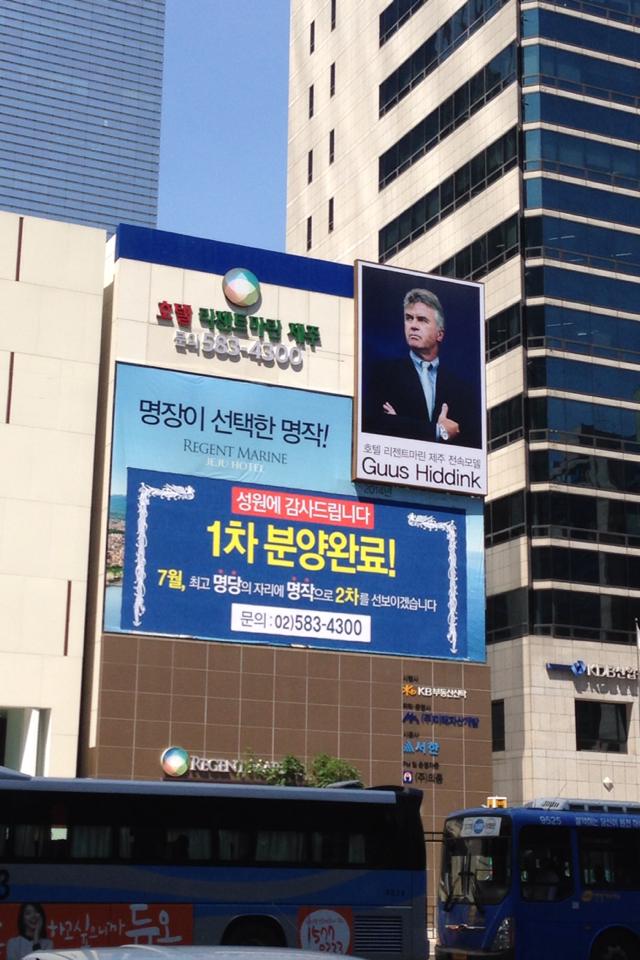
Yes, Guus Hiddink. The Dutch coach of the South Korean national team who was so successful at the World Cup of 2002 in Japan and South Korea by leading his team all the way to the semifinal and beating some top teams along the way. The success story of the Korean national football team at the 2002 World Cup is well known and documented. Just say "Italy" in South Korea and many Koreans become teary eyed and talk about the best victory in their football history. Hiddink is the cultural link between my country and South Korea, more so than Hendrick Hamel, who shipwrecked on Jeju island during the Joseon period (although they are both represented at the Dutch museum on Jeju island). Through the success of Hiddink, the Dutch became familiar with the Koreans and vice versa. Before that World Cup, I wasn't really interested in Korea. Sure, I knew about the war between the North and the South, my father drove around in a Hyundai Lantra, and we had an LG DVD player, but that was about it.  However, that would change that summer. Unable to qualify for the World Cup ourselves for the first time in 16 years, which was a tragedy all in itself (Jason McAteer, the bastard), the only Dutch link to the World Cup we had was Guus Hiddink, the coach of South Korea. So without a team of our own, the Dutch media focused on him.

I remember there was much sympathy for the South Korean team in the Netherlands. The passionate support of the Korean fans, dressed in red with all kinds of attributes, was similar to our own way of supporting our national team. We learned about the Korean fans cleaning up their own mess after supporting their team, which amazed the Dutch and started a discussion about our own short comings, because we always leave a huge mess after a game. The way South Korea played (attractive attacking football) captured the hearts of many Dutch people because of the similarity in style with our own national team.  However, nobody (the South Koreans included) had any expectations at the time, because South Korea never won a game at previous World Cups and had been beaten by the Dutch team several times with a big goal margin. Also, in their preparation for the World Cup, they had lost two games with a 5-0 margin and Hiddink had been blamed for that, earning him the nickname “Five Versus Zero” in South Korea. The Korean press was extremely negative and asked for his resignation many times; asking themselves why they needed another foreigner, that didn't understand Korean culture, in charge of their national team. To say it was a surprise to see South Korea progressing all the way to the semi-final and Hiddink becoming South Korea's national hero is an understatement. It was nothing short of amazing, although they also had a little luck on their way with favorable decisions by the referees. All in all it was one of the best World Cups I have ever seen and our own team didn't even play (although that’s not entirely true for me because Turkey played and reached the semis as well).

[caption id="attachment_3563" align="aligncenter" width="533"]Hiddink Still a hero in South Korea after 12 years.[/caption]

So how did Hiddink become so successful with a team, which had never won a single match on a World Cup? To find that answer we must first see how the Korean national team was organized before Hiddink took over. Korean culture is very suitable in many situations, but sadly running a professional football team isn't one of them. The not-question-your-boss and don't-take-any-risks-mentality and seniority-rules-over-all-culture kills competition in sports. Longstanding personal, familial, and school connections were factors in being selected for the national team and a head coach couldn't ignore them. Older players had more privilege than younger ones (younger players even had to polish the shoes of their seniors) and often didn't have to fear for their place in the team. Such a power imbalance isn't healthy in a professional sports environment. In addition, the risk of losing in the preparation to the World Cup, and an early exit for the head coach, was being avoided by playing generally weaker teams, so it would appear that the Korean team was ready to play at the World Cup. Korean culture was a hindrance in starting with the best eleven and a leading cause in the poor performance of the Korean national team in every World Cup before 2002.

When Hiddink took over, he had asked and received plenary powers in operating the national team, including the selection of players, strategies, training, and support. He basically had complete control. The first thing Hiddink did was demanding domestic professional football teams to give up their top players to the national team for 18 months to prepare for the World Cup. He then did away with the risk avoidance; playing strong teams so his side would get used to the resistance they would experience at a World Cup (hence the 5-0 losses against France and the Czech Republic). Then he cut everybody out that didn't agree to his way of working (that included coaching staff as well as players). Hiddink completely abolished traditional selection policies linked to personal, family, education, and social class affiliations within Korean society. He replaced some of the older players with talented youngsters and the older players that were left he convinced of his way of working. He told older players that they had to respect the younger players and not use their authority against them. He mixed older and young players at the dining tables (a practice that wasn't common before). All these measures were taken to break the Korean culture within the team. He didn't abolishing Korean culture completely though, but made use of elements that would give him an edge to improve the team. For instance, he made use of how bosses are never questioned by subordinates brilliantly. In matches during training, where Hiddink refereed, he made mistakes on purpose and asked his players if he was correct. Their culture prevented the players from responding honestly, but he saw in their eyes that they thought he was wrong. So he raised his voice and repeated if they felt they were wronged until they finally responded, and then told them they should put that feeling and energy in their football. This is how he fired up his players. He also did things that Korean coaches could never do, for example asking the president if his players would be exempted from military service so they could make a career as a professional football player (which the president arranged for them), all to get the players so fired up that they would do anything to win.

Hiddink’s method became a model for success in South Korea that was picked up not only by other coaches and other sport organizations, but also by a wide range of businesses. Many books about his methods became bestsellers in South Korea. It was seen as a potential way of advancing Korea’s global interests in all fields, including sport, politics, science, education, the economy, and citizenship. The fact that Hiddink, a foreigner, was able to challenge the authorities and even operate outside traditional cultural protocols signaled that Korean society was changing. It was called the Hiddink syndrome and has affected many aspects of Korean society.  Since going through the International Monetary Fund’s (IMF) financial crisis in the late 1990s, Korea's society became more open due to government policy, but Hiddink, being the first foreigner awarded honorary national citizenship and the law even being changed for that, had an even bigger impact in accepting foreigners in Korean society. Public calls for him to be naturalized as a Korean citizen and the eventual introduction of special government legislation to award him honorary citizenship were unprecedented. It lead to awareness, discussion, and debate about the historically homogenous nature of Korea’s exclusive citizenship, particularly with respect to race and ethnicity.

However, that doesn't mean that Korean society is suddenly very different after Hiddink's success. Sure, it's easier for a foreigner to get a visa and even attain citizenship, but South Korea is still a long way from being a multi cultural nation. In spite of all those copies of Hiddink's method sold, Korean society is still very much top down and young people's voices are still often ignored. The effect that Hiddink's success had in the years after the 2002 World Cup has stagnated somewhat, when looking at election results, corruption scandals, and workplace culture of the past couple of years (the conservative party has won the presidency at parliamentary elections twice in a row). Rather, the success of Hiddink signals a particular point where the nation may have become more open to alternative ways of thinking about its past, present, and future with respect to citizenship and identity. However, I don't think another stint of Hiddink taking charge of the national team will help South Korea forward again. Everything has its own time and place. For South Korean society to go forward again South Koreans need to change society themselves and, as in any other nation on this planet, that is a slow and difficult process.


Sources used:


  • Nammi Lee, Steven J. Jackson, and Keunmo Lee, "South Korea’s “Glocal” Hero: The Hiddink Syndrome and the Rearticulation of National Citizenship and Identity," Sociology of Sport Journal, 2007, 24, 283-301 http://users.polisci.wisc.edu/schatzberg/ps616/Lee2007.pdf

  • Wat HR-managers kunnen leren van voetbaltrainers (Dutch: What HR managers can learn from football coaches), http://www.timing.nl/9572953/Wat-HR-managers-van-voetbaltrainers-kunnen-leren.html

  • Coen Verbraak, "Guus Hiddink 'Ik heb mijn macht nooit misbruikt' (Dutch: Guus Hiddink 'I have never abused my power')," VN 03-05- 2003, http://www.coenverbraak.nl/hiddink.htm

  • De Bewustzijnsfabriek, Hiddink-methode: kijk en luister! (Dutch: The Hiddink method: watch and listen!), http://www.debewustzijnsfabriek.nl/inspiratie-1016/de-hiddinkmethode-17


Hot New Sports! Come Read All About It!

This month, I Dig Culture is celebrating Sports, a rather exciting topic to tackle. Here is an opportunity to cover the history, the physicality, the winning, the losing, the traditions, and the power of sports. But, haven't we seen all of this in previous films and live broadcasts? Remember the Titans, Miracle, ESPN, The Waterboy... Perhaps what is more important is the is opportunity to share some unique sports which exist from opposite sides of the globe. For anyone who is like me and has never really cared for sports of any sort - perhaps this short article will give you a little inspiration, a little kick in the pants to care about a new sport. So, let’s explore two very unique sports that exist on completely opposite ends of the globe, shall we?

dog dancing


Dog Dancing: A Human’s Best Dance Partner?


The sport, or perhaps the art, of Dog Dancing originated in Canada during the mid-1980's. From there, the idea of dogs’ freestyling to music with their handlers quickly spread to other countries such as England, the Netherlands, the United States and various others. The dancing participants, human and canine alike, have gained popularity for their talents, tricks, and rhythmic show of companionship. How could I forget to mention the various styles of freestyle dance that the dogs and their handlers get to explore? Some of my favorites include the Salsa, Meringue, and Swing.

Uploads of previous filming induce heart-warming feelings for the goofy and cutesy routines between handler and show dog while also leaving the viewer amazed at the almost telepathic connection between the two stars. This sport not only awards its participants with physical trophies and world recognition via the Internet, but also the feeling of becoming one with your freestylin’ doggie.

To learn more about what it takes to become a world-traveling, freestyle-competing, handling team of two, view this YouTube video of trainer Carolyn Scott and her dog Rookie performing a dance routine to a song from the classic movie ‘Grease’. 

If that isn't enough, there's also an entire website devoted to dog-dancing routines.


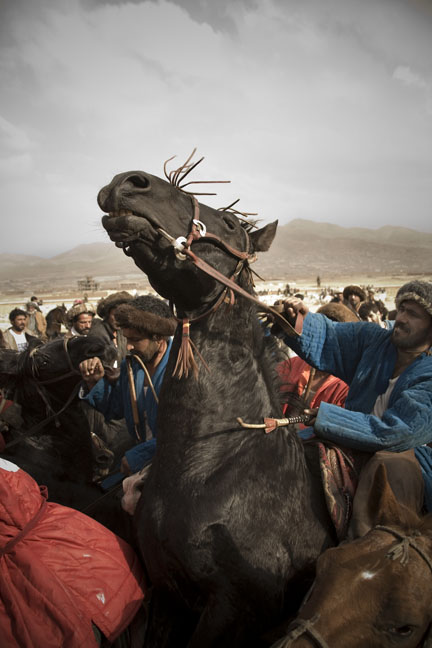
[caption id="attachment_3553" align="aligncenter" width="460" class=" "]Buzkashi Gangtas Buzkashi Gangtas[/caption]


Buzkashi: Afghanistan's Life-Threatening National Sport


Dating back to the reign of Genghis Kahn and his fellow traveling Mongols, the game of Buzkashi was born in Northern Afghanistan and Eastern Turkey. Today’s current riders of the surrounding communities treat the ‘game’ as a traditional sport with high hopes of someday competing in the Olympics. So, what is it exactly?

In the simplest terms…
a. Men ride the strongest horses they can buy; the more horses a man owns, the better and richer he is.
b. Once on the horse, the men pick up a dead carcass---usually a goat with its head and hooves cut off---from a designated circular area.
c. While holding the carcass in one hand or with it wrapped up in a whip, the man and his horse ride around until they make it around a pole and back into the circle originally containing the carcass.

Two points to remember:

  1. Buzkashi requires men and their horses to work together, either in teams or individually.

  2. Buzkashi is extremely dangerous.


It has been previously asserted that “in Buzkashi, human life counts less than the result” [1]. This is certain. Humans and their horses are battered up and even trampled at times just attempting to retrieve the stone-cold carcass of the headless goat. It is really hard to watch footage of the sport if you are not used to this type of competition.

Today the sport itself is evolving along with the Afghan culture and region itself. Since 9/11, The United States has been pouring hundreds of billions of US dollars into the country Afghanistan but also apparently its national sport of Buzkashi. One analysis from ESPN reflected on the new wealth of current riders who often make big money from their sponsors and through gambling. It was stated by current professional rider, Mohammad Hasan Palwan, that in the past, if you won, it was “for the province. Now, the sponsors have changed the allegiances, the pride. Victory is no longer for your community.” Now the sport is won for power of the individual [2]. It is apparent that today’s riders are playing the game for more than the revival of traditional sport, but for the power and money available to win. Gambling goes anywhere from $20 to $17,000. It is all seemingly aggressive and involves a lot of different high risks.

A short YouTube video which visually aides one into further understanding into the sport of Buzkashi and its dangerous reality is listed below.

Buzkashi: A Dangerous Game, The Death Game, A Real Sport

It’s apparent that these two ‘sports’ are completely different from one another. Dancing, happy dogs versus life-threatening danger and the high stakes of gambling. In Buzkashi, the rider is putting himself, his horse, other players, and even his family at serious risk. The actual sport involves a dead carcass being carried and dragged across a rugged, dirty surface.  The game itself is, safe to say, brutal versus the extremely quirky yet heart-warming groovy sport of Dog-Dancing. In dog-dancing, there are rarely any dead animals that we know of yet, and the dogs seem to be enjoying themselves for the most part. Whereas the horses, being thrown against one another and clunked amongst hard shoes and kicking.

Despite their many differences, these two unique sports can appear similar in a few ways. For instance, both require the acquisition of personal talents and the talent of a live, animal companion to get their ‘routine’ awarded and as a means to win the competition or sport. Both sports require a form of companionship. In dog-dancing, the owner and the live dog must use their companionship to work together to win. In Buzkashi, the riders use connection with their horses to work together. Their companionship has to be on a higher and more spiritual level. How the individual performs with the animal, connects with the animal, takes care of the animal, and uses the animal are all quite similar. In both sports, the riders and the dog owners must learn to accept and deal with both victory and defeat, not just the competition itself. However, those who love sports often love the thrill of a competition and thus world riders, trainers, handlers, et al, are all viewed as competitors in the end. They want to win; they want the cheese, or goat cheese.

So, there you have it. If you're not into football, soccer, baseball, volleyball, weightlifting, or any 'mainstream' sport - you can be a good sport and check out the trying and telepathic sport of dog-dancing or let yourself and horse get rustled and toughened up in a game or two of Buzkashi. Hey, it's all about learning another's culture and their interests isn't it?

Saturday, January 31, 2015

Blood, Sweat and Tears: the Power of Sport

Sport is a key part of both the past and present worlds. Along with music, literature and dance, it’s something that is both magnificent, yet odd: we don’t need any of these things to survive really but it’s difficult to imagine living without them. Most appreciate sports for their entertaining, inspiring or competitive values while others dismiss them as “just a game.” For me, sport carries a much heavier weight in society than was previously known or appreciated. It has been well documented that generals used gladiators in ancient Rome to entertain a public and take their eyes off more serious social issues. But even today, out of the gyms, away from the courts, pitches and fields, sport can play a pivotal role in changing lives, communities and even break through age-old domestic and international rivalries.  Because of this, governments and institutes all over the world and stepping up their efforts to support sports diplomacy. Previously major powers saw ‘cultural diplomacy’ such as sport as being weak, inferior or just not worthwhile. This kind of ‘soft power’ diplomacy includes sporting events, language schools and university exchange programs between nations. Governments had underestimated the power of culture and how it can affect people and their perception of foreign nations.

Changing Perceptions


On an international scale, the BRICS association which consists of 5 emerging financial powers (Brazil, Russia, India, China and South Africa) have (or will have) all invested in major sporting events by 2018. South Africa, Brazil and Russia had/will have the FIFA World Cup, one of the greatest spectacles on the planet. China has and Brazil will have held the Olympic Games which is as big as the World Cup in attracting worldwide attention. These events cost billions to hold and run but can influence the world’s collective image of a nation. Hence the grand opening and closing ceremonies in which nations try to showcase their culture and create a positive brand of their nation which will hopefully lead to an increase in foreign investment or increased tourism in the future.

[caption id="" align="aligncenter" width="309"] China held the Olympics in 2008. Can the money spent on lavish ceremonies and stadia change the world's perception of China?[/caption]

Bridging Divides


"Sport has the power to change the world…it has the power to inspire. It has the power to unite people in a way that little else does. It speaks to youth in a language they understand. Sport can create hope where once there was only despair. It is more powerful than government in breaking down racial barriers."

Nelson Mandela


(http://www.bbc.com/sport/0/25262862)


Sport can also influence people who have no interest in the games themselves. Sport can provide the perfect platform for groups to work cohesively together and encourage those watching to follow suit. Two famous examples stand out for me. One, during apartheid in South Africa when the Rugby World Cup was heading to SA. At that time only white players were allowed to play for the national team. Eventually, thanks to President Nelson Mandela, this rule was broken and black players were allowed to play. Despite initial disapproval, the nation soon got behind the team and their success was evident off the field by uniting the nation. The second example that springs to mind is the 1991 table tennis championships in China in which North and South Korea entered as a joint team and defeated the favorites China. This situation overcame the unique and unfortunate circumstances between the two Koreas.

[caption id="" align="aligncenter" width="554" class=" "] 'Korea' or 'As One' was a 2012 movie that depicted the true story of the two Koreas united at last.[/caption]


Local challenges and Local Success


My favorite sport by far is ‘the Beautiful Game’ as it is known: football (or soccer depending on where you are). I love the sport like millions around the world. Growing up, not only does it help kids stay fit and learn to work in teams, but even as an adult it shows how sport is a universal language that can be enjoyed by everyone. Though playing time has become limited, I play with guys from nearly 10 countries, all whom have different backgrounds and languages yet while playing, everyone is able to communicate. By sensing the power and passion that football carries, some wise people have used it to promote great projects in underdeveloped communities. Academies set up by pros in Sierra Leone for example offer kids a chance to be a part of something meaningful and lighten up their otherwise grim lives. Even in western nations, football leagues have been set up in London for teenagers who are involved in gangs. Games kick off at 3am. Research showed that this was the peak of night when knife crime and anti-social behavior occurred among youths in the area. The project has been running successfully and helped teens explore other options out of gang life.


Sport is a financial giant with sponsors, merchandise, ticketing and stadia development all contributing to the games natural values. However, the power that sport brings should be worth greater investment. Games can bring families together to the couch, communities gather for cup finals and nations stand up and sing anthems as one. Everyone needs a sport of some kind to appreciate the effects it can over the individual and on a larger scales, institutes, governments and nations should appreciate the diplomatic value of sport.

Saturday, December 27, 2014

Globalization Will Kill Black Pete

Every November there’s a good chance that you’ll hear a conversation in the Netherlands that goes something like this: "I just came back from the store and they already sold Christmas decorations! Really? Sinterklaas didn’t even start yet! Every year they start selling the Christmas decorations earlier. What a shame!"  It’s no wonder that stores are selling Christmas decoration so early, given the rising popularity of Christmas over our own local holiday Sinterklaas. Already for many years, many people have not been celebrating Sinterklaas anymore, and the blame is put on globalization, or, to be more exact, Americanization.

Sinterklaas (a traditional figure based on Saint Nicholas) is celebrated annually with the giving of gifts on Saint Nicholas Eve (5 December). He traditionally arrives by steamboat from Spain each year in another city on the first Saturday after 11 November. He then parades through the streets on his white horse, welcomed by children cheering and singing traditional Sinterklaas songs. His Zwarte Piet (Black Pete) assistants (white men in blackface with a wig of black curly hair and dressed up like a 17th-century page in colorful attire---more on that later) throw candy and pepernoten (small, round, gingerbread-like cookies) into the crowd. All of this is televised on national TV. In the period between Sinterklaas' arrival and Saint Nicholas Eve, children put their shoes next to the fireplace (or when you don't have one of those, under a small open window or any other place your parents let you believe a full-grown man can crawl through) before going to bed and singing a Sinterklaas song. My sister and I would also leave some carrots with our shoes "for Sinterklaas' horse," of which only the stumps would remain in the morning, because my father had eaten them all after we went to bed to make it even more believable that Sinterklaas really visited our house. We would also find a small present or candy in our shoes, which was of course the reason we would be awake much earlier than usual.

[caption id="attachment_3463" align="aligncenter" width="367"]Sinterklaas in Schiedam (2009) Sinterklaas in Schiedam (2009)[/caption]

In the Netherlands, a nation with Christian roots, Christmas has been around as long as Sinterklaas has. It has always been celebrated (reluctantly) one day with your family and one day with your in-laws (yes, we have two Christmas days). Fights would (and still will) break out about which family you would visit on the first day, but there isn’t much gift giving involved. That was reserved for celebrating Sinterklaas, and not only for children, but for adults too. Adults write each other snarky poems and/or construct surprises (pronounced as the French surpris, not the English way), a very creative way of gift wrapping by making something out of cardboard or other solid materials, which contains the gift and some substance as disgusting as possible (usually syrup and Styrofoam, or any other sticky/disgusting combination). However, with Hollywood movies came the commercialization of Christmas and therefore the decline of celebrating Sinterklaas in favor of Christmas. As soon as the children don’t believe in Sinterklaas anymore, the family usually shifts the celebrations to Christmas and puts the gifts under the tree. The poems are sometimes still there, but  the surprises have disappeared. This makes a lot of people in the Netherlands feel sad because they think we're losing a tradition, while in fact, they are the cause of its disappearance.

Is losing a tradition like this always a bad thing, you may ask? Not necessarily. Holding too much onto one's traditions causes a lack of progress in society. Not marrying outside of your religious circle, pulling the head off a live goose for entertainment, and football matches available for men only are examples of traditions that have vanished when society thought they were outdated and wrong. Even our beloved Sinterklaas celebration has something outdated in the form of Zwarte Piet (Black Pete), Sinterklaas' helpers that help him to get all the presents to the children. Although as a child I loved Zwarte Piet for being so funny and throwing pepernoten at my face, as an adult I can't see past the colonial relic of the white man wearing blackface acting like fools while poorly emulating a Suriname accent (Suriname is a former Dutch colony in South America where we used black slaves to work on our plantations).

[caption id="attachment_3461" align="aligncenter" width="650"]Two women in "Black Pete" (2009) Two women in "Black Pete" (2009)[/caption]

I didn't always think like this. I never stood still by the fact that Zwarte Piet may be offensive and racist to some until 2013, when the discussion about the controversial figure of Zwarte Piet started to intensify. Before that it simply didn't concern me; I never considered that the black make up that people would put on their faces was in fact blackface. I never saw race when I saw Zwarte Piet, and I was convinced other children wouldn't see that as well. Change never comes from those who are unaffected. However, when the discussion flared up in 2013 I started reading interviews with black people and started listening to what they had to say. They told stories about how they hated the Sinterklaas celebration because people (children and adults) would call them Zwarte Piet and make racist remarks. They were told this by their classmates in elementary school or while playing on the street, which I think must have been very traumatizing. As adults, the abuse continued by children calling them Zwarte Piet. For them it didn't feel they were included in this big children's celebration. When I heard those stories I knew I was wrong and felt ashamed that I hadn't figured it out sooner. Although not black myself, I'm part Turkish. Knowing the amount of racism Turkish people have encountered when they started to settle in the Netherlands as immigrants, I feel I should have known better.

Now the celebration of Sinterklaas in 2014 has come and gone and I'm more convinced than ever that something has to change. Slowly more people are waking up to see that Zwarte Piet is in fact racist, mainly due to the racist slurs of the defenders of Zwarte Piet. The awakening of these people was touched off by events within the Netherlands, but are certainly influenced by globalization. The way the international community speaks with shame about our tradition and that many people still defend that tradition also reaches the Netherlands and has an influence on people's behavior. This happened before with the famous number 39 with rice incident, where a judge on Holland's Got Talent made racist remarks to one Chinese contestant, asking him if he was going to sing number 39 with rice (a reference to an item on the menu of a Chinese restaurant and basically stereotyping all Chinese people in the Netherlands). It initially didn't cause a stir in the Netherlands until a clip of the TV show showed up on reddit and being criticized by commenters all over the world. Subsequently it reached other foreign media as well and from then on a huge debate broke out in the Netherlands about whether it was an innocent joke or pure racism. The same is happening with Zwarte Piet, where people on the Internet and foreign media are criticizing the fact that we still keep him around in the Sinterklaas celebration. The effect is that in 2014 there were already changes made to Zwarte Piet's appearance in some places. Although still not acceptable and not nearly enough, it is a start.

This is the real power of globalization. Because we are more interconnected we see more quickly what's wrong in other people's societies and have the ability via the Internet to let them know. Some might say mind your own business because you don't understand the culture, but as a man with experience with many cultures, I say we must be able to criticize and debate with each other to come to a better world for everyone. Many defenders of Zwarte Piet often say that foreigners don't understand our culture and therefore can't claim that Zwarte Piet is racist (Click here for an excellent article about the 10 most common excuses Dutch people make to defend the racist tradition of Zwarte Piet). However, we must stop playing the culture card when racism is involved and be able to admit our own mistakes. Only then will globalization be a positive thing instead of metaphor for a bunch of Western multinationals taking over the world. So people of the world, please criticize those that still defend Zwarte Piet. We can keep our tradition of Sinterklaas, but the Zwarte needs to go out of Piet.


Sunday, December 14, 2014

French Historical Conversations: Pope Edition

Sometimes people believe that walking under a ladder is bad luck. Sometimes people think that swallowing a watermelon seed means that a watermelon will grow inside their bodies, eventually killing them. This is silly. You know what else is silly? The notion that nothing of intellectual value was occurring between the fall of the Roman Empire and the Renaissance.

While it may be true that advances in science were lacking at this time in comparison to the Renaissance, it doesn't mean that people were less creative or less intelligent than just a couple of hundreds of years prior. The Renaissance was born out of an acceptance of the self as a powerful being, capable of accomplishing large tasks. It has been said (by my tour guide in Florence) that before the Renaissance, instead of making great things happen, people simply prayed and hoped that God would make great things happen. It would be much easier that way, wouldn't it?

With this in mind, we understand that the people of the Medieval Period were somewhat more hesitant to undertake grand construction projects and were very dependent on God. Much of Europe in the 11th century, through which we will take an historic adventure today (aren't you lucky!), considered itself one great land area under the name of Christendom. In Christendom, spiritual needs were addressed by one branch of power, called the sacerdotium. Secular needs were addressed by a different branch of power, called the imperium. It was very important for the imperium's actions to be supported and recognized by the sacerdotium, given the importance of God in the medieval conscience. This division of power and responsibility was intended to meet all of the needs of the people. Therefore, it also meant that clashes between the two branches were about as pleasant as walking in on your parents giving each other a sponge bath. 

Now that I have provided you with this enlightening information about medieval society, you are prepared to enter proudly into the life of one of the most interesting characters in human history: William the Conqueror.

In 1066, William, the Duke of Normandy, waltzed himself across the English Channel and claimed the throne of England. He was a bit like the honey badger; he saw what he wanted and he took it. Way before William became William the Conqueror, however, he was known as William the Bastard. 

This can be a difficult title to carry around when one intends to rule a large territory. Just imagine poor William attempting to go about his business in any normal fashion:

"You there! Hello, I'd like for you to make a longsword with a snake on the pommel, please."

"Yes sir, Mister Bastard, sir!"

How embarrassing! 

Poor William was saddled with this unfortunate title because he had been born to a powerful father and his mistress, who was not an important character in Norman society. We know so little about her that historians continue to argue about the simplest details concerning her. Historians are very good at arguing with each other. This is why I recommend never inviting more than one historian to a party.

[caption id="attachment_3368" align="aligncenter" width="598"]brother-yelling-at-sister Historians.[/caption]


Anyway, William's mommy and daddy were not married; this meant that William was illegitimate. Despite this, he was given power over the lands his father held, but not without a great deal of anarchy that he was forced to work diligently to contain. Being illegitimate at this time was probably one of the worst things a person could be; William's very existence was like a slap in the face of God. People who had been loyal to his father were loathe to grant fealty to someone like William. It was worse than cooties.

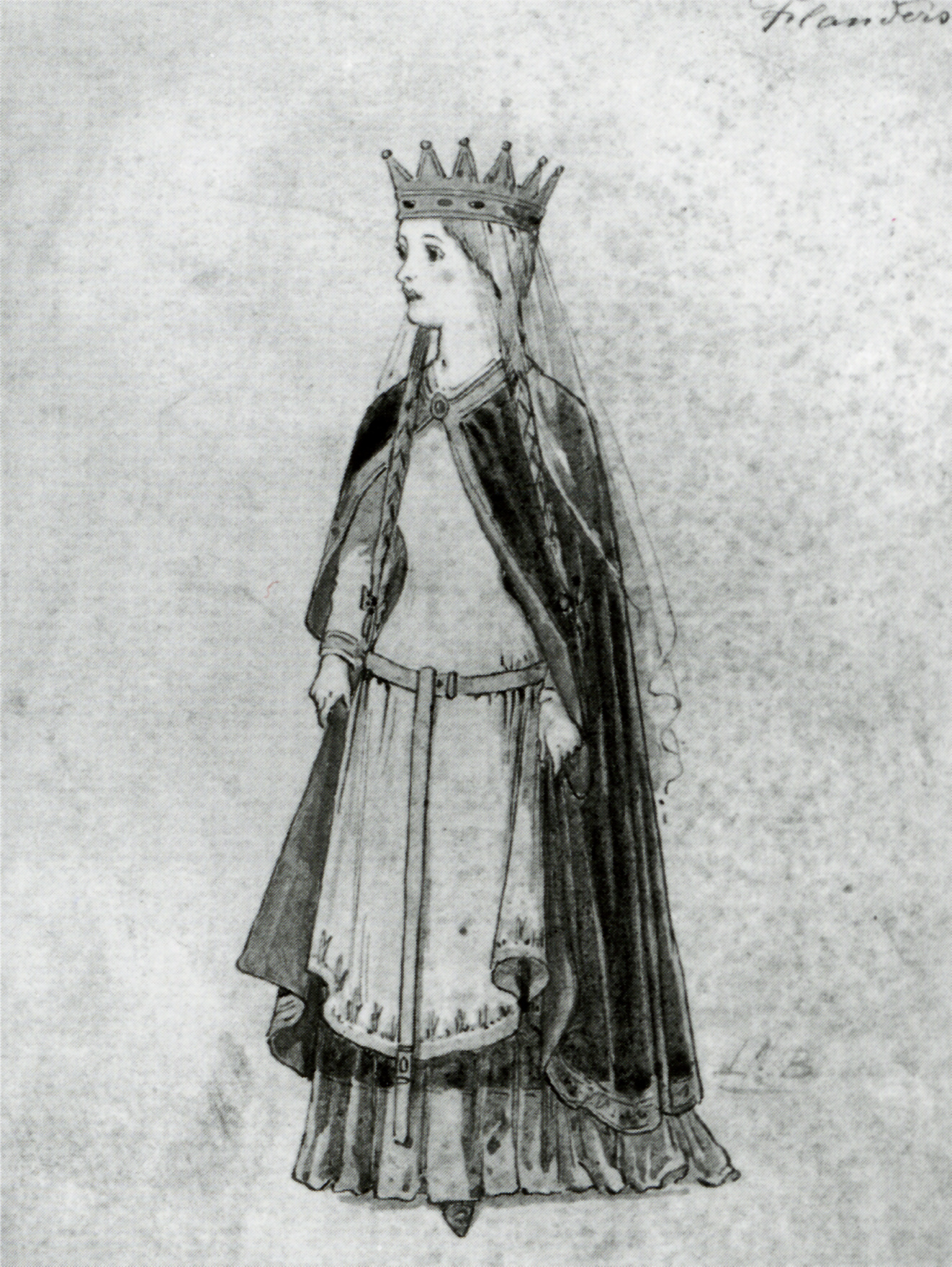
William was greatly concerned with retaining power over his lands, but he also wanted to bag a sweet chick. It was because of this that he became absolutely enamored with a sweet mademoiselle who was called Mathilda. Mathilda was remarkable for a number of reasons, one of these being that she came from the territory of Flanders.

[caption id="attachment_3332" align="alignnone" width="1322"]Matilda_of_Flanders I wonder if he called her "cupcake."[/caption]

At a time when William was working fastidiously against efforts to usurp him, he decided to marry the aforementioned cutie pie. This posed a problem because William's contenders feared that they would be unable to remove him from power if he was also given control of Flanders. So, they concentrated their efforts against him. It was also problematic because William and Mathilda were cousins.

Understandably, opponents of William seized upon this unfortunate fact in a manner akin to an untrained mongrel devouring an unattended cut of beef. William's intention to marry darling Mathilda was so unnerving that even some of his supporters threw their hands up in the air and declared, " No way, dude!" (Probably).

According to the social norms of the time, cousin-marrying was pretty bad. It was an affront to God Himself.

William really, really like-liked Mathilda, though. So, he asked the pope to sanction their marriage.

If the sacerdotium was cool with it, the people of the court should be cool with it, too

Their conversation probably went like this:

"Oh, hey Pope! What's up, dude?"
"Oh, you know,  just chillin' and kickin' it in the Vatican. It's hot as hell, though. Heh heh. Get it?"
"Ah, yeah. That sucks, dude. Listen, Pope- have you heard about my new girlfri-"
"Yeah, dude. WTF. You gotta stop that, man. It's like, gross."
"Aw, but Pope! She's so so cute!"


[caption id="attachment_3333" align="alignnone" width="1109"]Charlemagne and the Pope This is Charlemagne and Pope Adrian I, but we can imagine it all went down like this.[/caption]

And then, William went ahead and married her anyway- even though the pope said it wasn't cool. We know from historical evidence that William later asked the pope to make a declaration that his marriage wasn't an absolute travesty and a sin breaking the laws of nature. The conversation probably went like this:

"WTH, man?! WTF. I told you that was super icky. I don't even wanna be your friend anymore."
"But, Popey! I couldn't help myself!"
"Sick, dude."
"Listen, what can I do to make you let this go?"
"...um..."
"Please, Pope!"


"Alright, I want you to build me some abbeys. I want one for men, and one for women, and hopefully their work with each gender will prevent this kind of atrocity from recurring."
"Okay, you got it!"
"But wait! I want them to be, like, super awesome. I'm not kidding around, dude. I want towers and spires, and stonework, expertly carved."


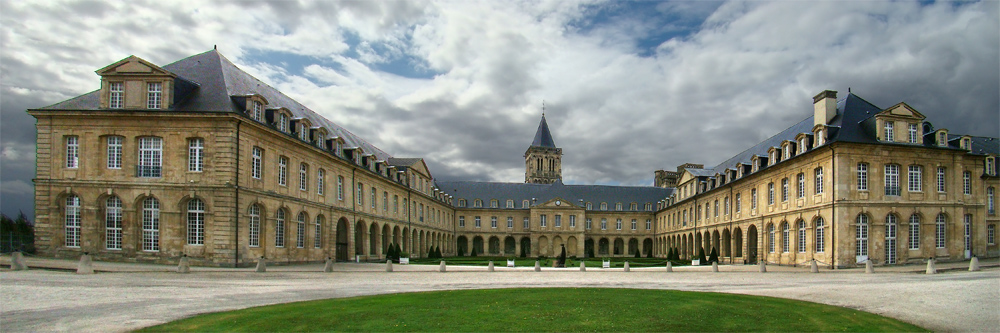
So, William commissioned the construction of two individual, distinct structures which were aesthetically pleasing and innovative. 

[caption id="attachment_3334" align="alignnone" width="1204"]Normandie_Calvados_Caen1_tango7174 Women's Abbey[/caption]

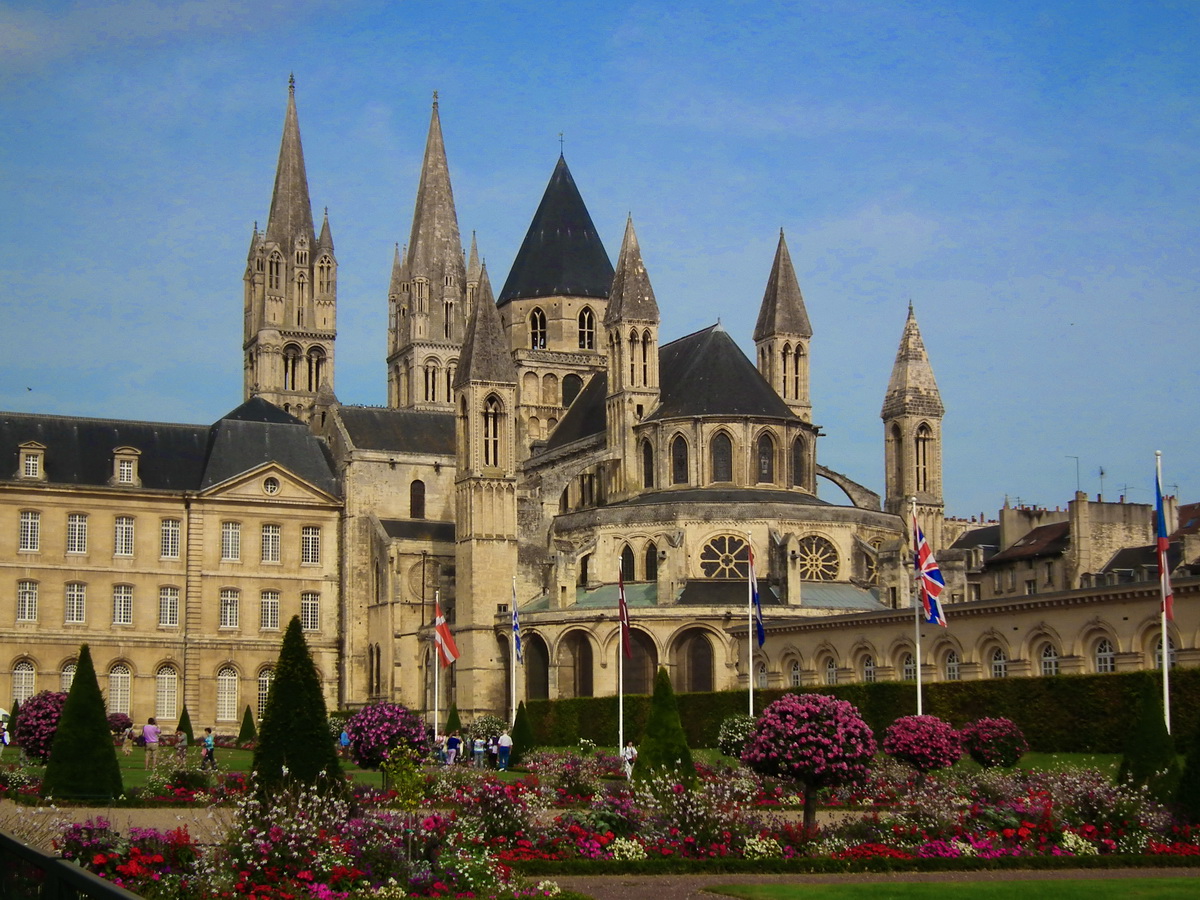
[caption id="attachment_3335" align="alignnone" width="1200"]Caen,_Abbaye_aux_Hommes_02 Men's Abbey[/caption]

If you'd like to visit these enduring tributes to forbidden love and papal indulgence, you can find information about visiting hours here. 

Friday, December 5, 2014

Why Atheists celebrate Christmas

Christmas decoration

I must have been 5 or 6 years old when my best friend told me during gym class that Sinterklaas (the Dutch version of Santa Claus) didn’t exist. I didn’t want to believe it, but he kept insisting. “It’s your parents who are giving you those gifts,” he said. I kept being in denial until I got home and asked my parents about it. When they confirmed, I lost my faith in Sinterklaas. It was then and there that I stopped believing in claims of a higher power if not proven by science. In other words: I’m an atheist.

It’s difficult to know that you are the only one you can fall back on, that you’re alone in this world, without some higher power looking over your shoulder. No guardian angel, no deity, no force that’s with me; I have to do everything myself. My father knows both sides of the story: as a devoted muslim he felt comfortable that God was always watching over him, but when he abandoned his faith, so did His watchful eye. He tells me life was easier as a Muslim, because his faith in God would always help him when he would face difficulties. Now, he has to face them all by himself. My father still goes to a mosque sometimes to feel the spirituality of the place, whereas I go for the magnificent architecture, which I like to photograph. Spirituality is meaningless to me; it’s like telling myself Sinterklaas still exists when I know he does not. I have no use for it in my life.

Now that I am living in Korea, I sometimes feel out of place when spirituality is involved. However modern it may look on the outside, Korean society still has a big place for spirituality. Soothsayers and palm readers play a big role in many people’s choices in life, Buddhist temples and churches are still frequented for guidance and prayer, and multiple times a year rituals are performed to honor deceased ancestors. All this spirituality means nothing to me. I think that the soothsayers and palm readers are a bunch of frauds that make a good living off the uncertainty of people, I frequent Buddhist temples and churches only for the amazing architecture and scenery I love to photograph, and I have no need for honoring my dead ancestors because they are dead and can’t hear me anymore.

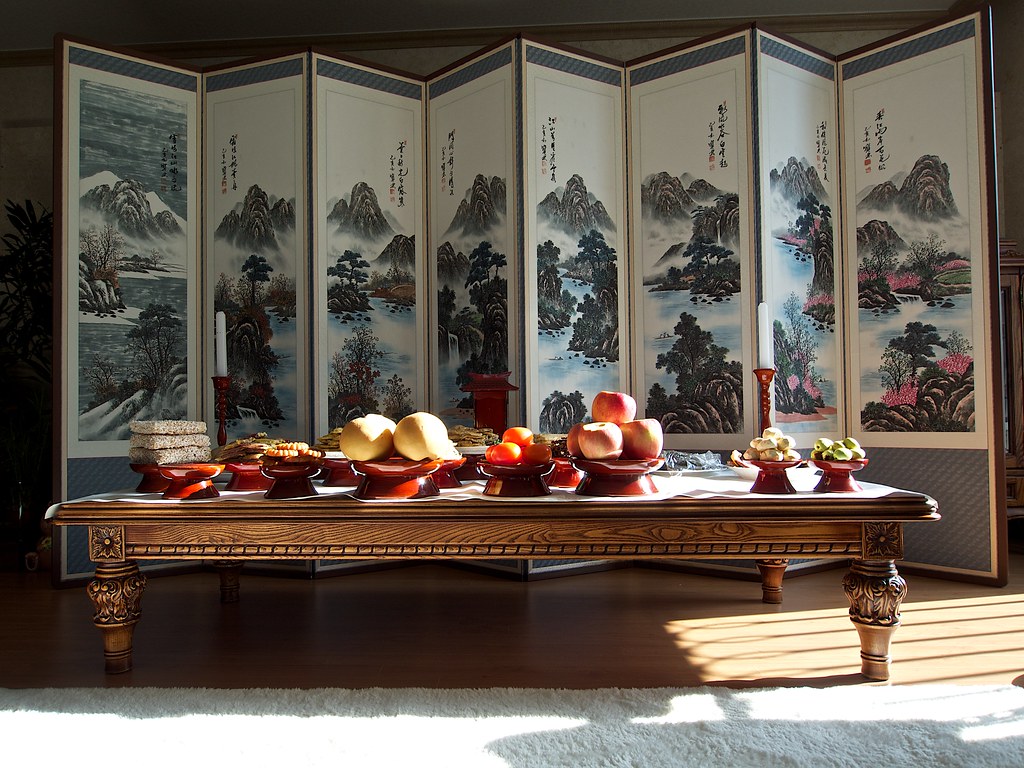
Although spirituality hasn’t any meaning to me, I can’t escape it due to my Korean wife’s family. My wife used to go to a palm reader in the early stages of our relationship. She was shocked to hear the palm reader say that we would break up a few years later, at which I got angry and told her she shouldn’t see those people anymore. The problem resolved itself. When the deadline of the prophecy passed, our relationship was stronger than ever. She hasn’t gone to one of them since. I don’t have any problems with my mother-in-law going to a Buddhist temple every week. Being an atheist doesn’t necessarily mean that you think other people should be atheists as well. Religion and spirituality is something personal that everybody should figure out for themselves. No, the most frequent exposure to spirituality is the ritual to honor the dead that I have to go through multiple times a year. There is charye (차례) on New Year’s Day and Chuseok (추석) in the Fall, and because my wife’s grandmother died a couple of weeks after Chuseok, we need to repeat the whole ceremony again on the day she died (which is called Jesa or 제사). My wife’s grandfather died on another day still so there’s another day for that too.

[caption id="" align="aligncenter" width="1024"]Chuseok Table Table set for Chuseok (photo by Emre Kanik)[/caption]

The ceremonies are almost identical (I haven’t found a difference yet, but then again, I could be wrong): It starts with preparing a lot of food and putting it on a table in a predetermined way, organized by color and/or type of food. Nobody seems to know because every time we are arguing what goes where and shifting around the food. Several times we need to refer to a printed piece of paper with the set up on it to get it right. Then my father-in-law and his brother change into their nicest suit and the ceremony begins. Well, not immediately because my father in law, who needs to lead the ceremony, always forgets what must be done. He’s studying a book with instructions and pictures intensively before we start. During the ceremony he constantly reaches for it too, because he’s not sure about the next step. While not having the need for any spirituality, I still participate in all the bowing and circling a cup of rice wine (Jeong Jong, 정종) around incense three times. There is also a period just before the final bow when we shouldn’t look at the table so the spirits of our ancestors wouldn’t be disturbed while eating the food from the table. Though I think the reason you shouldn’t look is that you won’t see that there’s actually nothing going on at all. We awkwardly wander around in the living room until my father in law says it is time to continue the ceremony.

So why participate in all this if I’m so skeptical, you might ask. The answer is the same as when we celebrated Sinterklaas during my childhood. After I stopped believing in Sinterklaas we didn’t stop celebrating it. Partly it was because of my little sister, who still very much believed, but also when she stopped believing we continued celebrating. Although it shifted to celebrating Christmas, which is even weirder to celebrate as an atheist when you think about it. I remember we would really look forward to the gifts we would receive and preferably open all at once. Now that I’m an adult and living in Korea I’m in a whole different situation. I don’t celebrate Sinterklaas nor Christmas anymore and I don’t need all the rituals and spirituality. However, when people express their gratitude when I know the proper way to bow in a funeral, or help my in-laws setting up the table and participating in the ceremony, I know I still do it for the same reason as celebrating Sinterklaas when I was just a kid. I’m still doing it for the gifts, but I’m not on the receiving end anymore and that makes it even more rewarding.

Don't get me wrong, if you believe in a god I still think you're wrong, but it's just not worth it disrupting Christmas for. Like I found my way to deal with spirituality you have found yours. People throughout history have been wrong or right on numerous issues and have solved them in any number ways, including the really ugly ones like suppression and violence, and good ones like dialogue and arguing. I like to choose for the latter rather than the former, so unless you are one of those people who advocate the former, I think we're going to do just fine.

Thursday, November 20, 2014

France's Apéro Géant: Cultural Events Fueled by the Internet

Today's world is a world of our own making. It is very exciting to be a participant in globalization. We have the good fortune to see the people of the world growing closer despite geographical limitations. We are using the Internet and mass communication to reach each other in ways we never imagined before. But are we doing it right?

In 2010, the world's tallest building opened in Dubai. Chile experienced an 8.8 magnitude earthquake. Eyjafjallajökull erupted in Iceland, closing much of Europe's airspace. California's Proposition 8 was overturned.

Meanwhile, in France people were worried about the dangers of eating snacks and having a beer outdoors.

Here in “the Hexagon,” there is a really nifty custom called the “apéritif.” It's one of those not-so-easily-translated-into-English words that one sometimes hears about. The reason it isn't so easy to translate is that it refers to an event in which English speakers don't ordinarily take part. Imagine you've been invited to the home of a French friend or colleague. They tell you that you'll be having lunch, and instantly you think “Okay, I'll have a sandwich and perhaps have a cup of coffee with them.” When you arrive, they sit you down and pass around some bowls of nuts, crackers, chips, or what have you.

You feel betrayed. You wonder where lunch is.

[caption id="attachment_3294" align="aligncenter" width="530"]"I was told there would be food." "I was told there would be food."[/caption]

They start to ply you with alcohol: “Here, have some red wine. Now try the white wine. Would you like something else?” and, with your stomach being mostly empty, you start to feel the alcohol affecting you. Suddenly you are oh-so-sociable and your French is better than it has been in years. Then, everyone sits down around the table and they start serving actual food.

This is what I think of when I think of the apéro, as it is called in short. Of course, I am an outsider looking in on the customs of another culture, so don't consider me an expert. As I see it, the apéro is the moment when everyone is waiting for the chicken to finish baking. We start drinking a bit and eat some savory snacks. It's like warming up for a long run, except you'll be horribly bloated at the finish.

One day, as I did every day, I walked through the town where I was studying and approached the local castle (cool, I know). Normally on a beautiful spring day, I'd walk through the tranquil grounds, drinking in the sights and sounds of gravel crunching underfoot, birds chirping in the trees, and the sun shining on the grass outside the walls. On this particular day, however, the grounds were absolutely covered with bodies all busy drinking and snacking on treats.

While marveling at the strange and wonderful sight, I suddenly noticed an armored vehicle at the perimeter, surrounded by police officers in riot gear. I didn't know what was happening, and as far as I knew, it was the strangest riot I had ever seen, given that everyone looked so very jubilant.

Later, I learned that what I had seen wasn't a mass of people angrily protesting something. I had witnessed an apéro géant (giant apéritif). It's the same idea as the apéritif I described before, but this time, it was in public, and with hundreds of people.


4463047699_7425515639_o


A few years ago in France, young people began taking advantage of Facebook to communicate to one another the locations and times of these apéros géants.


In the US, public intoxication is a punishable offense that is taken very seriously. In many other countries around the world, however, it's just fine to drink yourself into a stupor and talk to pigeons, stare at the sky, or play a board game in the park- whatever you'd like to do, unless it isn't breaking a law like stealing or breaking-and-entering. It's also illegal in France, but I doubt that I'd be arrested for stumbling along the street on my way home here. Perhaps a more relaxed treatment of public intoxication enabled this kind of event to expand?


[caption id="attachment_3296" align="aligncenter" width="480"]"I don't care if you think it's weird; he understands me." "I don't care if you think it's weird; he understands me."[/caption]

As we communicate more easily, we can begin to see this communication affecting our cultures and the way we interact in them. This is exciting and dangerous. While the apéro géant is a nice idea- it is akin to an American college party---it does have negative aspects. Apéros géants have been used as political platforms, some of them anti-Islamic in nature. At one apéro géant with more than 9,000 participants, a 21 year old man fell from a bridge he had climbed. He later died as a result of his injuries. At a different apéro géant, three men were arrested on charges of having raped a 17 year old Irish girl.


Under current French law, apéros géants are treated as public gatherings that can be regulated according to laws designed to maintain public order. In order to host one of these events, someone must first declare her or his plan to host it and may be held responsible for the conduct of the participants. The host(s) must sign their name(s), include the names of participants, the motivation for holding the event, and might even be required to include an itinerary. Failing to comply with the law may result in a fine of up to 7, 500 euros and/or 6 months in prison.


Should the French government have the right to limit the freedom of the people to gather for these apéros géants? Should the government be required to provide security and safety at these or other public events? Is it wrong for people to use Facebook and other forms of social media to manipulate long-standing cultural traditions? In doing so, are these traditions diluted, or are they enhanced?


What do you think?


[Click on images to find their sources; the image of the apero geant has been slightly modified for better visibility in accordance with copyright restrictions.]

Fooling The General Public: Mass Media in South Korea & Turkey

[caption id="attachment_3261" align="aligncenter" width="300"]IMG_6872 “Naneun Ggomsuda's” (나는 꼼수다) hosts (photo by Emre Kanik)[/caption]

While living in the Netherlands my Korean wife followed the political situation of her country very closely. She gave me regular updates on what was discussed on the popular podcast “Naneun Ggomsuda” (나는 꼼수다) to which she listened every week. The podcast was the voice of young people in South Korea, addressing issues that wouldn't be touched by the conservative mainstream media. Allegations against government officials were frequent, and the government sought a way to stop the podcast by making the life of the hosts very difficult. For example Chung Bong-ju (정봉주), one of the four hosts and national lawmaker at the time, was found guilty of spreading false rumors in what many of his supporters have called a political process, accusing then-presidential candidate Lee Myung-bak in 2007 of being affiliated with a company that forged stock prices. My wife was outraged by the prison sentence, and I was surprised that such a claim could land you in jail, being a politician myself at the time, in a country where you still drink a beer with your greatest political enemy after a city council meeting. So when our visit to South Korea coincided with the protest against Chung Bong-ju’s imminent incarceration, my wife insisted on joining.

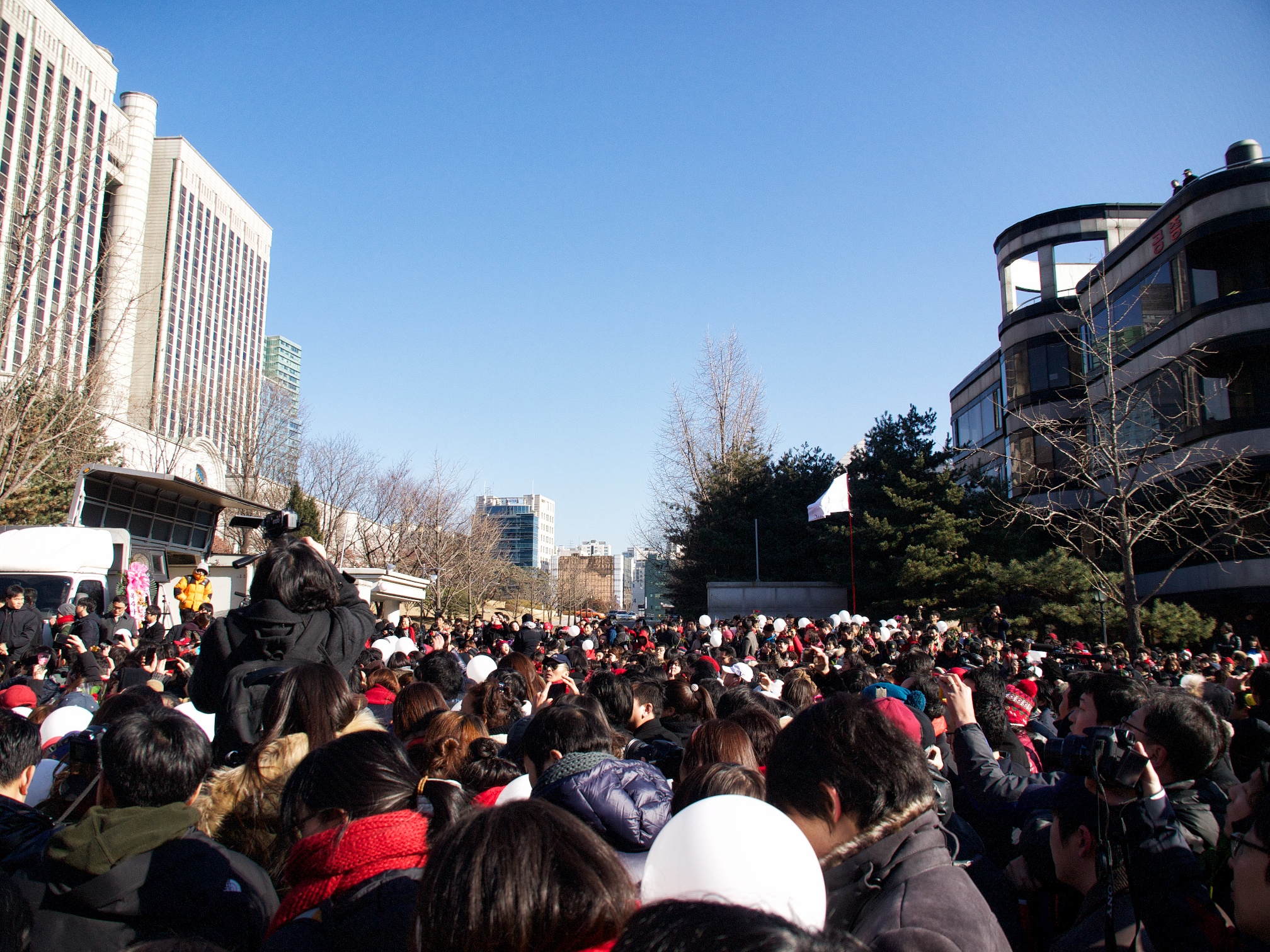
On a cold but sunny December morning, we arrived at the subway station near the courthouse where the protest was held. At the station I saw small groups of young people dressed in red, bringing signs, balloons, and roses with them. It didn’t seem like a massive protest, but when we arrived at the entrance of the courthouse, the road was full of people. A white van with a sound system was parked on the curb, playing music and occasionally someone would play the MC and say something in Korean, which I didn’t understand at the time. Cameras of the press were positioned on the roof of one of the buildings in the surrounding area and in front of the entrance of the courthouse. Even the police had someone filming the protesters, which I found kind of odd at the time.

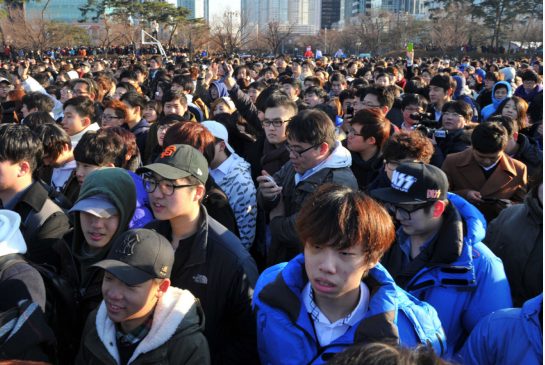
[caption id="attachment_3229" align="aligncenter" width="1024"]The protest The protest (photo by Emre Kanik)[/caption]

The crowd was cheerful and the atmosphere was not at all aggressive. They were singing and dancing and sometimes they all sat on the ground when the MC was telling them to. I didn’t understand why this was happening, but I knew what the cause was, so I sat down as well. Sometimes my wife would translate parts for me, but most of the time she was caught up in the protest. When the hosts of the podcast arrived things got even more lively with speeches and cheers. When it was time for Chung Bong-ju to enter the courthouse, the crowd parted to make a passage and roses were thrown on the ground where he would walk while All you need is love by the Beatles was played and sung by the protesters. He went to an area behind the police line where protesters were not allowed to come, made a final statement to the media (which were surrounding him at this point) and went inside. At the end of the protest when we walked back to the subway station a small fight almost broke out. Apparently an older lady had shouted to some of the protesters that the color red is used by communists. Some curses were exchanged, but that concluded the incident.

[caption id="attachment_3228" align="aligncenter" width="1024"] Chung Bong-ju addressing the crowd (photo by Emre Kanik)[/caption]

The purpose of the protest and the situation with the old lady at the end reminded me of Turkey. It sometimes shocks me how similar the Turkish and Korean cultures are: the close family ties and friendships, how people with different opinions are immediately treated as enemies, and how losing face is one of the worst things that can happen to a person. Similar cultures make similar societies, so it is not a surprise that there are many similarities between Turkey and South Korean politics as well. Opposing political parties are each other's mortal enemies. Whoever is in power uses everything they can to destroy anybody who opposes them. One of the most commonly used tools: mass media.

In both countries the ruling party wants to control what the people see and read. Having a population that still relies heavily on newspapers and news broadcasts, they keep those under strict control. Although organized differently in the two countries, the effects of that control are the same. It is sufficient to say that high positions at TV stations and newspapers are filled by people friendly to the regime and journalists are pressured (or voluntarily) report what the high management is ordering them to. I won’t go into too much detail how it is exactly organized (Groove magazine has an excellent article on the South Korean situation), but have seen the effects firsthand. When we got home from the protest and turned on the news, we saw how state control operates by outright lying to its inhabitants. The news reported that there was little support for Chung Bong-ju at the protest, showing only the last part where he was in an area where the protesters were prohibited from entering and not showing footage from the rooftops, which would show the true number of people present. This is a mild way of bending the facts, but since then measures have been much stricter to prohibit the people of South Korea to see the truth. During the presidential elections, the Korean secret service has even been accused of trying to manipulate the discussion on Twitter in favor of the ruling party's candidate and now president Park Geun-hye by starting a smear campaign against her main rival. Another example of mass media control became clear during and after the Sewol disaster. The major newspapers and TV stations blindly published and reported government statements and press releases without checking if what they reported was true (many media outlets would apologize for this later). Public confidence in the media fell to a record low.

While state control over the media in South Korea is troubling, in Turkey it is a disaster. Ruled by the conservative Islamist Justice and Development Party (AKP) since 2002, Turkey has the highest number of jailed journalists in the world and the AKP has most major media outlets under firm control. The AKP isn’t afraid to use its control over the media for its own personal gain, a fact that became painfully apparent during the wave of protests that followed after the government violently tried to end a friendly sit-in at Istanbul’s Taksim Gezi Park in 2013. Protests engulfed the country addressing press freedom, freedom of expression and assembly, and the government's intrusion on secularism. The government replied with brutal force, teargassing and cracking down on peaceful protesters. The role of mass media in the protests? CNN Türk broadcasting a documentary about penguins. While the country burned, the state controlled media first tried to ignore it. When that didn’t work because all international media were reporting in full force (regular CNN was showing the protests) and Twitter exploded with images and videos about what was really going on, on came the fabricated lies. From reporting that protesters had entered a mosque with their shoes on and drunk beer inside to showing them burning the Turkish flag (which was actually footage from 2010), the state controlled media did everything in their power to slander the protesters. Sadly because so many Turkish people still rely on traditional media for their news, a large part of the country believes this all actually happened. In the recent presidential elections, TV stations wouldn't say anything critical about the leader of the AKP Erdoğan, while the opposition was heavily attacked. The official state channel TRT spent time only on Erdoğan and ignoring his rivals all together. That is pretty problematic in a country where less then half of the population uses the Internet and therefore relies on these broadcasts as their sole source of information.

So is there no way to get reliable information in Turkey and South Korea? As in many cases, the Internet is your friend. Although it is becoming a troubled friendship because of the government of both countries want to control information there as well, it is still possible to find the real story on what is going on. However, if so many people keep relying on traditional media to keep themselves informed it is fairly easy for the government to keep feeding half-truths and lies to the general public. Without true reform in both countries’ mass media their democracies will always be in danger of turning into something uglier. Having the power to vote is just one part of a democracy. Having unbiased information on who you can vote for is just as important.

Tuesday, October 28, 2014

Curb your enthusiasm: Korean internet is not all it's cracked up to be.

IMG_0744

Roughly two years ago I moved from a country where net neutrality is implemented by law (the Netherlands) to a country where the freedom of the Internet is under pressure (South Korea). It has been a world of difference using the Internet in both of these countries. To give a feel for how bad the situation really is in South Korea, I will first describe the situation in the Netherlands as a contrast.

The history of how net neutrality in the Netherlands came to be is a fairly recent one. I vividly remember the time when the news leaked that one of the Netherlands' biggest Internet providers had admitted to its investors it was using a technique called Deep Packet Inspection (DPI), with which they could differentiate what the customer was doing on their network. Basically it meant the company was spying on its customers. The plan was to charge extra for certain VoIP and message services because the company was losing money due to decreasing use of SMS and regular calls. The indication that they soon had to pay extra for their WhatsApp use was too much to handle for the Dutch, being the frugal people that they are, and caused such an outrage that the telecom company had to cancel its plan to use the technique. In addition, the Dutch society is also an open one where everybody has the right to express themselves and press freedom is being held in high regard. Therefore, the more informed people worried that the Internet would be controlled by several companies. With these two main arguments, the people urged the Dutch political parties to take action. On 22 June 2011 the Dutch parliament decided to include net neutrality in the new telecom law, and by ratification by the Dutch Senate on 8 May 2012, the Netherlands became one of only two countries in the world (the other being Chile) where net neutrality is guaranteed by the legal system. Thus mirroring the democratic principles of Dutch society in cyberspace.

The benefits of the Dutch net neutrality law for the consumer are many: Internet providers can't limit or charge extra for certain services, the contents of your Internet traffic can be accessed by your Internet provider only in certain extreme cases, your Internet connection can be disconnected only if you don’t pay your bills or you commit fraud, and you have to give explicit permission to let tracking cookies be installed on your computer, which in turn makes it difficult for advertisers to track your behavior on the Internet. All in all it was and is a huge victory for freedom on the Internet. Although at the time I realized to some extent that this was a big deal, since roughly two years I really know by experience how fortunate the Dutch are.

When, in August 2012, I moved to South Korea, which has a reputation of being the Internet capital of the world, I thought I was going to live in the Valhalla of the Internet. Due to several news stories, I thought positively about the South Korean Internet, which seemed to dazzle the world with not only the fastest download and upload speeds around but also nearly universal LTE and WiFi accessibility. Unfortunately, there are some aspects of the South Korean Internet that don't get the attention that they deserve in the news, because of the focus of Western media on the speed of the Internet here. I quickly found out that a new 5G network isn't the most important thing about Internet usage.

A fast Internet connection doesn't get you anywhere if you're not able to access everything you want. Sadly, like in the Netherlands, South Korean cyberspace mirrors its society as well. Internet censorship is common: blocking everything from North Korean sites and materials harmful to minors to pornography and even simple nudity. If the government deems it inappropriate, you won't be able to see it without using a workaround. Unfortunately, blocking some sites is not all the government does; commenting on the Internet isn't anonymous anymore, since you need to register with your social security number to be able to comment on any Korean Internet portal. That makes it easier to extensively monitor the Internet on anti-government comments. Sometimes action is being taken to cut of the perpetrator's Internet or even making arrests in some cases. For example Chung Bong-ju, one of the four hosts of the popular South Korean podcast "Naneun Ggomsuda" (나는 꼼수다) and national lawmaker at the time, was found guilty in 2011 of spreading false rumors, accusing then-presidential candidate Lee Myung-bak in 2007 of being affiliated with a company that forged stock prices. Critics have claimed that it was a political motivated sentence, because of its timing just before the presidential elections. The podcast was a very influential channel of anti-government views. All of this is very serious, but the by far most annoying thing on the Korean Internet ever is Active-X.

The country that has the reputation to be years ahead in technology relative to the rest of the globe relies on this archaic 90's program for its entire e-commerce economy. Forget buying something on your iMac if you're not willing to partition and install Windows as well. Not only that, Active-X is Internet Explorer only, hence the biggest market share of Internet Explorer in the world. Being the Apple fan boy that I am, this frustrates me immensely. I refuse to install Windows on my iMac and if I would, I don't want to have anything to do with Internet Explorer. Fortunately, I have a workaround: if I spot something I want, I'll ask my wife to buy it at her office where she uses a Windows machine. Also I found a bank that has Internet banking for OS X. Well, had Internet banking for OS X.

As a Mac user, you're such a rarity in this country that you're met with a lot of misunderstanding and disbelief. When my bank updated their security protocol they somehow forgot that they used to support OS X as well. As a result the site stopped working on an Apple computer and I had to contact the bank's service center. Their solution was to take over my computer to take a look by sending me an .exe file. When that didn’t work they were genuinely surprised and apparently had no alternative way to access my computer. Not much later after the service center employee promised me she would get back to me and hung up the phone, I got a message that they were unable to solve the problem. So now I have to use my workaround for my Internet banking as well.

iPhone bank message

Having lived here for two years, I now know that not South Korea, but the Netherlands is the real champion of the Internet. Although the overall Internet speed isn't as fast as that of South Korea, it's close enough. There is no monitoring, no blocking (although there was one issue with Pirate Bay being blocked), and no Active-X. All government websites have to be accessible by all major browsers and all purchases can be done with any operating system. You can criticize the government without being afraid of being cut off from the Internet. While Dutch cyberspace is a free and open world, South Korean citizens have no access to unfiltered Internet. I have not been homesick often in the two years that I lived in South Korea, but when I stumble on news of Internet censorship being used or when I get confronted by the limitations when browsing the web on my iMac, I long for the possibilities of net neutrality in my own country. I secretly wish South Korea would implement it too. Unfortunately, with democracy more and more under strain, I don’t see that happening in the near future.

Saturday, September 13, 2014

Loving Abroad #4: A Date with a Romanian Girl

[youtube http://www.youtube.com/watch?v=GgCatE600z8]
Romania is famous for being the birthplace of Dracula, but they are also famous for having gorgeous women. I was lucky enough to have one of these lovely ladies join me on my next adventure on Loving Abroad.
Preda Laura, a beautiful Romanian woman, had a lot to comment about her experiences with Romanian and Korean culture.

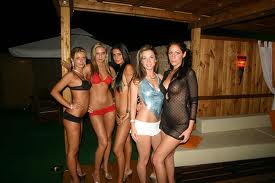
[caption id="attachment_2282" align="aligncenter" width="379"]Pictured: Romanian girls Pictured: Romanian girls[/caption]

Korean men aren't really conservative
I watched Korean dramas and I saw so many handsome Korean men treating women very graciously and politely. They would never touch a girl without her consent and even if they did, it would just be the wrist.

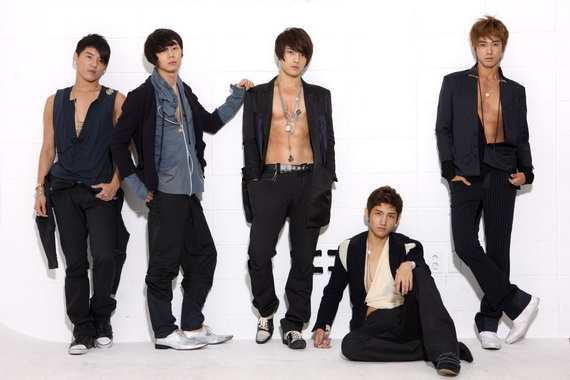
[caption id="attachment_2283" align="aligncenter" width="371"]What foreign women think Korean men look like (thanks to Korean drama and K-pop). What foreign women think Korean men look like (thanks to Korean drama and K-pop).[/caption]

However, when I went on a few blind dates with Korean men, I had a different experience than what I expected. I don’t know if it’s because I’m a foreigner, but they were very touchy. One of them tried to put his arm around me – on the very first date. The other one tried to hold my hand, and I had only met him for the first time.
I’m not sure if all Korean men are like that or they think that foreign women are easier, but I was a little disappointed to find out that all Korean men aren't like the characters I saw in Korean dramas.

[caption id="attachment_2281" align="aligncenter" width="402"]What Korean men actually look like What Korean men actually look like... You disappointed?[/caption]

Dating differences in Romania and Korea
Korean women are often whiny and complain a lot when they want something from their boyfriends. That would never happen in Romania. If that did happen in Romania, the guy would throw the girl out the door, and there will be 100 more girls waiting for him.

[caption id="attachment_2279" align="aligncenter" width="300"]The door The door[/caption]

It seems like Korean women are more demanding and aggressive in the relationship. In Romania, men are often the more aggressive ones. Romanian women would only be really aggressive to other Romanian women because they are always competing against each other.
The reason is because there are more women than men, and there are only a handful of handsome men. That’s also why the women are so competitive with each other. It’s to the point that the girls always dress themselves up and wear makeup all the time. They would never go out without getting all dressed up.
I like to dress comfortably when I go out somewhere close or go grocery shopping, but if I do, other girls will make fun of me.

What are some differences between men in Korea and Romania?
In Korea, there are many different types of men. There are those who are cute, those who are macho, and there are those that are just a mix of different styles. But in Romania, there is only one: the tough masculine type.

[caption id="attachment_2278" align="aligncenter" width="362"]Tough as a brick Tough as a brick[/caption]

Even if a man is really thin, studious, or just plain nerdy, they try to act like something they are not. There’s so much pressure for men to be tough and cool, so it’s ridiculous to see men try to be something they are not.

What do Romanians think of Koreans?
Actually, no one really knows about Koreans. The only thing they might understand about Korea is Psy’s Gangnam Style, and even then, some people think that it’s Chinese. Romanians generally don’t go after Asians, and when it comes to Asians, most people think of rice, chopsticks, and slanted eyes. There are even jokes about Asians and their eyes.

[caption id="attachment_2280" align="aligncenter" width="395"]Psy - The epitome of Korean culture Psy - The epitome of Korean culture[/caption]

Living in Korea, it’s hard to think that Korea isn’t at the center of the universe, or to believe that there are countries out there that don’t know much about Korea. The world is full of many cultures that have yet to be explored and learned. Don’t take for granted that people will automatically know about your culture. After all, how much do you know about culture foreign to your own?
Open yourself up to new cultures and be receptive of other cultures. Learning culture gives you power to perhaps even date people from different parts of the world. I hear the women in Romania are quite beautiful. I know where I’m going when I travel Europe (someday). Do you?

Preda Laura is a 34-year-old babysitter who likes art and Korean culture. She has been in Korea for a year and thinks of the country as her new adopted home. 

You can also listen to the entire date on soundcloud at Loving Abroad #4 Audio

Wednesday, July 23, 2014

The Amber Road

AmberMy family comes from Latvia, a beautiful Baltic country made up of various trees, rivers and lakes, and a very wide range of biodiversity. While Latvia is well known for its amazing architecture and extensive liquor making, Latvia is also often sought after its beautiful and very resourceful Amber coast.

Since I was a child, special beads, bracelets, necklaces, and other ornaments made of Amber have been passed around in and outside of the family. My elders and even young cousins still tend to ooh-and-ah over all of the various colors, shapes, sizes, textures, and even insect surprises they find in their amber pieces. Needless to say, it has always been an honor in our small Latvian-American culture to receive a new piece of Amber.

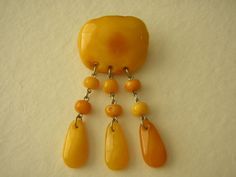
Amber essentially is translucent, fossilized tree resin which varies in color from orange, yellow, cherry, green, and in rare cases, blue. Although over 90% of amber is found in north-eastern Europe on the Baltic Coast, there is a surprising amount found in the Caribbean and Dominican Republic. In the Dominican Republic, blue and florescent amber is dwelled out from big tunnels and shipped around the world for profit. Amber can be sold in its rawest, most natural form, or it can be modified, reconstructed, and even bonded.

What makes Amber so special? Perhaps it is the way it is made. Perhaps it is the prehistoric and legendary history. For my family, it has always been the heart-warming feeling when holding onto something from ‘home’. For Latvians, Amber generates a lot of trade and tourism for the country. For others, the amber may be considered special because of its natural beauty as it is often used as jewelry, in glass blown smoking pipes, as folk medicine, and even in perfumes.

Amber is often referred to as “The Gold of the North”, as it has been used as a trading resource since before the Stone Age. Even more interesting, there are pieces of amber which contain flies and mosquitoes which date back 40-60 million years ago.  Amber has also  been found in the ancient tombs and temples of popular ancient rulers throughout Egypt, Syria, and surrounding the North Sea. This is includes ancient Egyptian Pharaoh Tutankhamen and even Apollo of Delphi. The best way to trade and ship amber in the past and today was by use of the Amber Road. The Amber Road makes up multiple routes throughout the Baltic States, the Netherlands, Switzerland, Belgium, Germany, France, and other parts of Central Europe. The Amber Road continues to bring trade and tourism to the continent, especially in the Baltic States.

Culturally, amber is the result from an Amber Palace bursting at sea in The Legend of the Sea Queen, as told by many Lithuanians. In the Baltic legend, Queen of the Sea, Jurate, lives in an Amber Palace. When her father finds that she in love with a fellow named Kastytis, he jealously destroys her palace leaving the sea and shore with pieces of her beautiful-resin made estate.

The real Amber Palace perhaps is the Palanga Amber Museum found in Lithuiana. This beautiful museum houses all forms and sorts of amber from all over the world. My family and I cannot wait to go and visit.

Thursday, May 1, 2014

What I Learned from the Amish

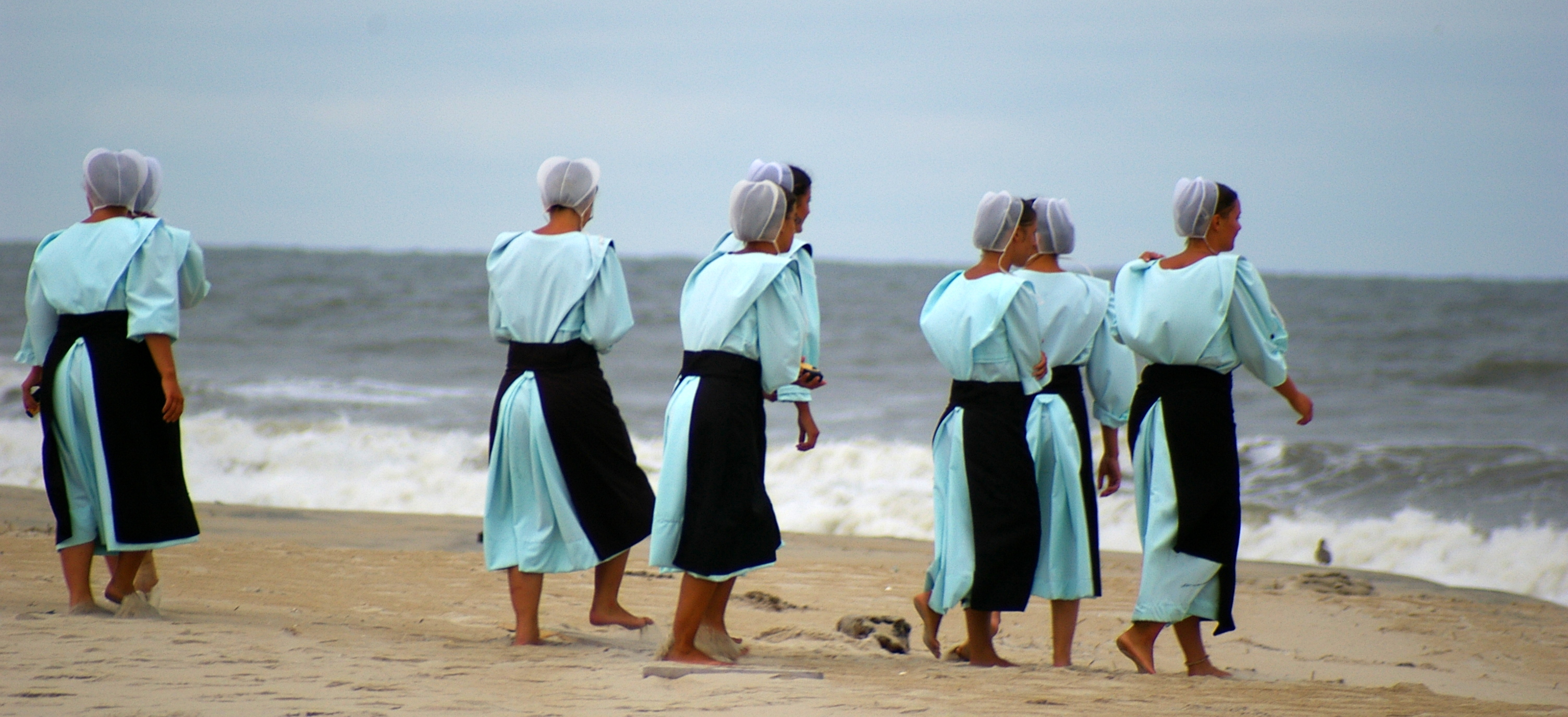
Femmes-Amish

Whilst waiting in a long line to board onto the Chicago AmTrak train one afternoon, I couldn’t help but to study and enjoy the presence of a large Amish family nearby. The bearded man wearing suspenders was accompanied by three adult women and four absolutely adorable small children.  They had suitcases of various vibrant colors and sipped from just-purchased plastic water containers. The line of travelers started to descend as everyone was loaded onto the train. To my surprise, I would be surrounded by the Amish family on the seats to the left and front of mine.

The little children would stare at me, and we would have smiling contests. I did not have much to share with the children or show them. Trying to respect the culture’s preference of a non-technological lifestyle and the choice to avoid excessive dress and style, I was somewhat nervous to show them things I had with me. My worries of what the children could be exposed to could somehow affect the rest of their lives. They were so innocent and sweet. I instead wanted them to show me their things, and learn more about their way of life.

They spoke in a language I could not decipher, but could only assume it to be of Dutch origin. They also spoke in English, but not as often. The women would read to the little children in their preferred language rather than in English, although the books were written in the latter. The books appeared to be youth primers for their religion, and they included songs, poems, stories, pictures, and coloring pages. One adult sat in a separate section and allowed the children to walk back and forth to the different seats and would all sit on the adults' laps. I wondered if the family practiced polygamy because the man had so many adult women with him and all of the children were clinging to each adult, especially the man. However, the Amish do not practice polygamy, and these families were just working together like a small community.

Their dress is plain and simple, and they sew their own fashions. How do they acquire the dark blue, black, and brown materials? Rural markets and dry goods stores. The women do not cut their hair, and the men, once married, do not cut their beards. Bonnets cover the heads of the baptized women and little girls, while males sport a traditional hair cut fashion and are forbidden to have mustaches. Men are not allowed to wear mustaches in Amish communities because it is thought to resemble men in the military. The Amish do not partake in violence and therefore are not forced to join the military.

The woman sitting to my upper left seemed to be much more confident with the children. She looked to the man often to tell him a feeling or thought with her eyes, and also using their unique dialect. The woman sitting to my left, however, sparked my curiosity even more. She was quieter, younger, and wore glasses. She would cuddle the visiting children and would read to them.  When she wasn't taking care of the children, she would look at her surroundings and seemed to be philosophizing about what and why things were. She would stare out of the train window and take in all of the urban outside life. Was she wondering what life was like for the "modern folk"? Did she want to walk in the old abandoned buildings to investigate and dream up a place for the family’s sofa? Did she want to experience driving a car? Or was her faith so deeply rooted that none of things crossed her mind as they would mine? Perhaps she just loved and enjoyed the life she was blessed with and was content with what she already had. Either way, it somehow felt really special to witness that Amish woman looking out of her window.

A funnier experience was when one of the Amish women accidentally walked in on me using the train's restroom. As the door opened and our eyes met, she looked almost horrified and said, “Oh! Sorry!” I really could only laugh about the situation.

The sweetest experience was noticing two sleeping children sprawled all over their father figure. I had just gotten up to leave as the train had reached its destination. I looked at the man and he gave me a smile and nod as I whispered, “They are so sweet."

Since my experiences among the Amish family, I have become much more interested about the Amish and even Mennonite culture. What a beautiful and simplistic way to live.