Showing posts with label Gender amp; Sexuality. Show all posts

Saturday, September 13, 2014

Loving Abroad #4: A Date with a Romanian Girl

[youtube http://www.youtube.com/watch?v=GgCatE600z8]
Romania is famous for being the birthplace of Dracula, but they are also famous for having gorgeous women. I was lucky enough to have one of these lovely ladies join me on my next adventure on Loving Abroad.
Preda Laura, a beautiful Romanian woman, had a lot to comment about her experiences with Romanian and Korean culture.

[caption id="attachment_2282" align="aligncenter" width="379"]Pictured: Romanian girls Pictured: Romanian girls[/caption]

Korean men aren't really conservative
I watched Korean dramas and I saw so many handsome Korean men treating women very graciously and politely. They would never touch a girl without her consent and even if they did, it would just be the wrist.

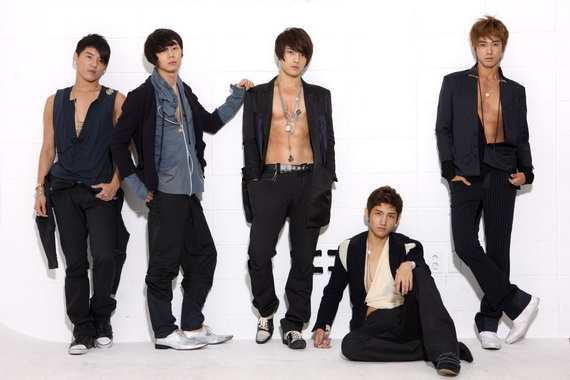
[caption id="attachment_2283" align="aligncenter" width="371"]What foreign women think Korean men look like (thanks to Korean drama and K-pop). What foreign women think Korean men look like (thanks to Korean drama and K-pop).[/caption]

However, when I went on a few blind dates with Korean men, I had a different experience than what I expected. I don’t know if it’s because I’m a foreigner, but they were very touchy. One of them tried to put his arm around me – on the very first date. The other one tried to hold my hand, and I had only met him for the first time.
I’m not sure if all Korean men are like that or they think that foreign women are easier, but I was a little disappointed to find out that all Korean men aren't like the characters I saw in Korean dramas.

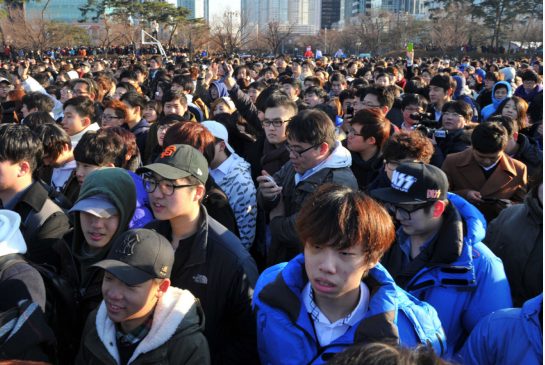
[caption id="attachment_2281" align="aligncenter" width="402"]What Korean men actually look like What Korean men actually look like... You disappointed?[/caption]

Dating differences in Romania and Korea
Korean women are often whiny and complain a lot when they want something from their boyfriends. That would never happen in Romania. If that did happen in Romania, the guy would throw the girl out the door, and there will be 100 more girls waiting for him.

[caption id="attachment_2279" align="aligncenter" width="300"]The door The door[/caption]

It seems like Korean women are more demanding and aggressive in the relationship. In Romania, men are often the more aggressive ones. Romanian women would only be really aggressive to other Romanian women because they are always competing against each other.
The reason is because there are more women than men, and there are only a handful of handsome men. That’s also why the women are so competitive with each other. It’s to the point that the girls always dress themselves up and wear makeup all the time. They would never go out without getting all dressed up.
I like to dress comfortably when I go out somewhere close or go grocery shopping, but if I do, other girls will make fun of me.

What are some differences between men in Korea and Romania?
In Korea, there are many different types of men. There are those who are cute, those who are macho, and there are those that are just a mix of different styles. But in Romania, there is only one: the tough masculine type.

[caption id="attachment_2278" align="aligncenter" width="362"]Tough as a brick Tough as a brick[/caption]

Even if a man is really thin, studious, or just plain nerdy, they try to act like something they are not. There’s so much pressure for men to be tough and cool, so it’s ridiculous to see men try to be something they are not.

What do Romanians think of Koreans?
Actually, no one really knows about Koreans. The only thing they might understand about Korea is Psy’s Gangnam Style, and even then, some people think that it’s Chinese. Romanians generally don’t go after Asians, and when it comes to Asians, most people think of rice, chopsticks, and slanted eyes. There are even jokes about Asians and their eyes.

[caption id="attachment_2280" align="aligncenter" width="395"]Psy - The epitome of Korean culture Psy - The epitome of Korean culture[/caption]

Living in Korea, it’s hard to think that Korea isn’t at the center of the universe, or to believe that there are countries out there that don’t know much about Korea. The world is full of many cultures that have yet to be explored and learned. Don’t take for granted that people will automatically know about your culture. After all, how much do you know about culture foreign to your own?
Open yourself up to new cultures and be receptive of other cultures. Learning culture gives you power to perhaps even date people from different parts of the world. I hear the women in Romania are quite beautiful. I know where I’m going when I travel Europe (someday). Do you?

Preda Laura is a 34-year-old babysitter who likes art and Korean culture. She has been in Korea for a year and thinks of the country as her new adopted home. 

You can also listen to the entire date on soundcloud at Loving Abroad #4 Audio

Saturday, August 30, 2014

Loving Abroad #3: A Black American in Korea

[youtube http://www.youtube.com/watch?v=B3Qnrzd4Lg8]
This is my third date. In this episode, I meet an African American living in Korea. On my previous two blind dates, I had met with non-native English speakers. However, with this blind date, I was able to communicate in English, making it easier to talk with one another. There aren’t many black Americans in Korea, and there are a lot of stereotypes against them in Korean culture. Let’s take a look at some of them and see what it was like for Jaye to live in Korea as a black American.

What are some stereotypes you faced as a black American woman in Korea – socially and professionally?

Jaye: “Professionally, people at work think of me as an athlete because they automatically assume I will be good at sports because I’m black. Some parents are afraid their children might learn bad things from black teachers, but I personally haven’t experienced that. In fact, the parents of my students believe their children can learn a lot from me through my teaching methods.
Socially, people always think I’m angry all the time, and it’s mainly due to movies I think. I don’t know what movies they’re watching, but they just think I’m mad which is why they are scared of black people.
When people talk to me, they automatically go into hip hop mode. They think because I’m black, I’m into only hip hop and try to speak to me like I was from a rap video.
Not many people bother me, but they, especially the ajumas, stare a lot and even try to touch my braids or touch my skin.”

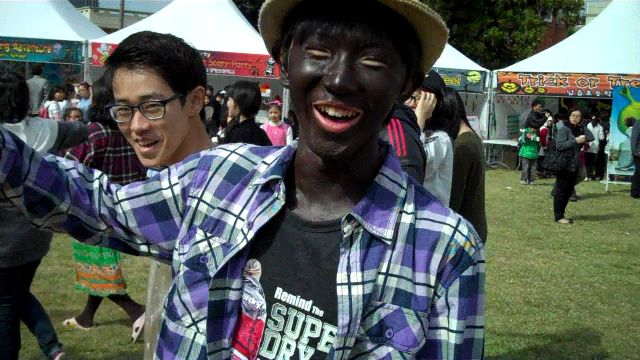
[caption id="attachment_2232" align="aligncenter" width="412"]Blackface is still common in Korea. Mainstream medias still portray blackface for entertainment. Blackface is still common in Korea. Mainstream medias still portray blackface for entertainment.[/caption]

PDA (Public Display of Affection) – How does it differ in Korea and America?

Jaye: "Korean couples are very lovey-dovey and personal. Also, they can be annoying on public transportations like the subway. I was trying to get through the door, but they were blocking the door and I just have to push through them. Sometimes on the street, they’re holding hands and just kind of creating traffic for the other pedestrians.
American couples are more carefree and they’re very playful. They’ll just flirt a lot."

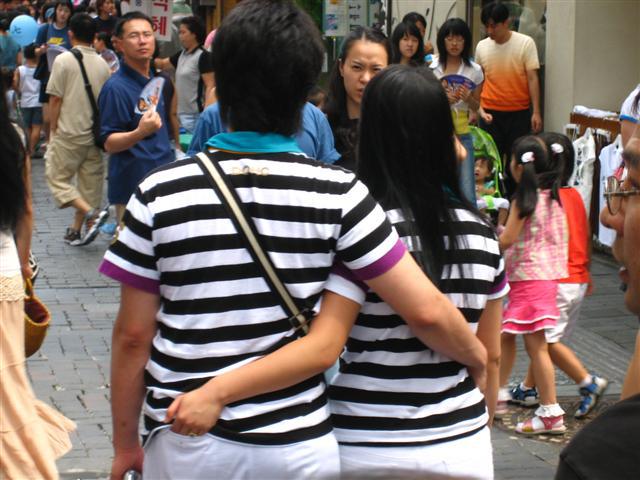
[caption id="attachment_2235" align="aligncenter" width="409"]Korean couples often wear matching shirts or sometimes entire outfits to show their affection to the entire world. Korean couples often wear matching shirts or sometimes entire outfits to show their affection to the entire world.[/caption]

What would you expect from dating a Korean guy compared to an American guy?

Jaye: "I have no expectations of dating a Korean guy. They won’t want to date a black female because of disapproval from parents and the norms in Korean society. But if they were to approach me, I expect he will try to be assertive and play out an image of being hip hop.
For American guys I would expect they would automatically expect me to accept their proposal because there are so few black people in Korea."

[caption id="attachment_2234" align="aligncenter" width="241"]G-Dragon is one of the most popular Korean male figures. G-Dragon is one of the most popular Korean male figures.[/caption]

How open would your family be to interracial marriage?

Jaye: "They would be very open to it. They are totally cool with that. They already knew that I was an open-minded person so they would really expect it. They wouldn't mind at all. Race doesn't matter at all. Even in America I would date men other than my ethnicity, and they've grown accustomed to my dating preferences."
black-woman-asian-guy

How well do you think other black Americans would adjust to life in Korea?

Jaye: "They would adjust very well. The cultures may be a little different, but black people, like Koreans, are raised to respect their elders. However, don’t expect Koreans to jump into a relationship with you. It’s easier for black males to pick up Korean women, but it’s not as easy for the black females to date a Korean guy."


[caption id="attachment_2233" align="aligncenter" width="449"]Night life in Gangnam Night life in Gangnam[/caption]


Being a foreigner in a different country can be difficult, especially if the people of that country have little knowledge of the foreigner’s cultural background.
It’s important to know the culture of the nation you’re visiting, but it’s also important for that country to be accommodating of your culture as well. Learning culture is neither unilateral nor bilateral. It is multilateral, and the more you learn, the wider your perceptions of life.
The next time you see someone foreign to your country; don’t simply rely on the rumors of others. Instead, open a line of communication and maybe you’ll learn a thing or two about a culture you have never had the chance of knowing before.

Jaye Wyn is an English teacher who has lived in Korea for four years. She enjoys not only hip hop but also Korean music. She also enjoys traveling throughout Korea in her free time.


Saturday, August 16, 2014

Loving Abroad #2: Overcoming the Language Barrier

[youtube http://www.youtube.com/watch?v=4Gp8euVvINw]

I ventured onto another blind date with another woman from China. And once more, the date was held on Google Hangouts on Air. For those that haven’t seen our first show (Loving Abroad #1: Korean American guy meets a Chinese girl), the objective of our show is to explore the diversity of cultural dating (and perhaps to find myself a soul-mate?).
For this show, we decided to speak in our native languages. I spoke English and she spoke Chinese throughout the date, and we barely understood each other. Watch us try to overcome language barriers with drawings and hand gestures.

Verbal Communication
I spoke English and half the time she understood what I was trying to say. However, during the other half, I had to resort to hand gestures and drawings to get my point across. As you can probably guess, I understood nothing when she spoke Chinese. The only two words that I understood were: bu and sheur (no and yes).
I had difficulty trying to get my point across with words alone. Though we eventually understood what the other was trying to say, it took a lot of time.
COMMUNICATION: 50%


[caption id="attachment_2195" align="aligncenter" width="429"]Not sure if she's smiling because she understood me or if she's just feigning it. Not sure if she's smiling because she understood me or if she's just feigning it.[/caption]


Gestures
Everything I said was accompanied with my hands. I felt like I was trying to communicate with the students at my 학원; hagwon; cram school.
My hands waved around the screen pointing at her, me, and some imaginary people. I can’t tell whether or not she understood all of my gestures, but accompanied with my quizzical facial expressions, she seemed to comprehend the nature of my questions.
Mengshen didn’t use many gestures, and this may be due to cultural differences.
In America, many people use their hands to express their words and meaning across, but in Korea or China, not many people make hand gestures.
COMMUNICATION: 35%

[caption id="attachment_2190" align="aligncenter" width="439"]Thumbs up: universal gesture for "good" Thumbs up: universal gesture for "good"[/caption]

Visuals
When nothing else worked, we both used pictures to get our messages across.
This worked surprisingly well. When she was trying to tell me what she thought of Korean men, she drew a handsome looking character. At which point I thought she believed all Korean men to be as dashingly good-looking as me. However, upon further interrogation, she drew for me a chart.
For some odd reason, she thought I didn’t belong to the 75 percentile range, where the Korean men are handsome. Instead, she thought I was “okay.”
Despite the differences in our opinions about my physical appearance, we communicated well through visual mediums.
COMMUNICATION: 90%


[caption id="attachment_2184" align="aligncenter" width="441"]Visual mediums: helpful in showing where I stand among men Visual mediums: helpful in showing where I stand among men[/caption]


Despite the language barrier, Mengshen and I had a good time on our online date. Regardless of language, culture, or nationality, it’s important to try to communicate with people around the world.
Don’t give yourself excuses like, “Oh, we don’t speak the same language.”
If you try, the other recipient will eventually understand your thoughts and messages. Let’s get out there and communicate with one another. After all, in this day and age, communication is key when it comes to understanding those around us – near or far.

Menghen Hu is a 21-year-old Chinese national from the Anhui Province. She is in Korea studying film at Konkuk University, hoping to be a successful actress someday.

Saturday, August 2, 2014

Loving Abroad #1: Korean American guy meets a Chinese girl

[youtube http://www.youtube.com/watch?v=sWi9u-Q6IdU]

I went on an online blind date with a Chinese woman. Why over the internet you ask? The point of the blind date is not about simply meeting new women. It’s about meeting new women – from around the world.
The show is to learn about the dating differences from other cultures. We welcome you to the first show (as embedded above). For those that don’t have time to sit through the entire date (which was held through Google Hangouts on Air), here are some of the things I learned about dating in the Chinese culture. And now, without further ado, we present to you the blind date between Isaac Kim (Korean-American) and Qu Zhuo Lei (Chinese).

At what age do women begin dating?

China
According to Zhuo Lei, aka Xiya, most Chinese girls become independent of their household at around 18. That’s when they head off to college and learn to live on their own. Their newfound freedom gives them to chance to explore the world and experience new trials, including dating.
The majority of Chinese society frowns upon its underage youths dating one another. But once they become of age, they have nothing to hold them back from finding love.

Korea
There is no strict age when it comes to dating in Korea. I see kids in primary school going on dates with their boyfriends or girlfriends while some people in their 20s have never been on a single date their entire lives. However, although Korea society doesn’t necessarily look down upon minors dating, women (that are yet unmarried) are subject to living under their parents’ supervision until they tie the knot.

Are men expected to pick up / drop off their dates on the first date?

China
Never. That’s the quick answer.
Usually, a man picks up their dates from their parents’ house if the girl wants to introduce him to her family. By introducing him to her parents, the intended meaning is “we are getting married.” So be careful if your Chinese girlfriend ever wants you to meet her parents. You may think it’s just a quick meet and greet, but for her, it means marriage.

Korea
Once again, never.
In Korean society, it’s quite rare to see men pick up their dates. The two of them decided upon a location to meet at an appointed time. For couples that have been in a relationship for a long time, you can sometimes see men dropping off their significant other, but most of the time, girls find their own way back home after an evening of romance.

What do women look for in men?

To answer this question, many things have to be considered. There are those that are after money, those that care about appearances and height, and those that look for a man who will truly and deeply care about them. These are universal truths for both men and women, regardless of culture.

China
As mentioned above, some Chinese women look for men that are tall or good-looking. It all depends on the individual woman. In some cases, men (rich men) would pour everything they had to capture the heart of an especially beautiful girl. In other cases, two people would meet and have an enduring relationship based on the feelings they had for each other. Like most cultures, it’s really hard to pinpoint exactly what women want.

Korea
A lot of Korean women (as well as their male counterparts) have really high standards when they look for a partner. The most common among those high standards is height. Now I’m not saying all Korean women are interested in height, but most would add that trait to their list. But once again, it really depends on who you’re trying to woo.

And finally…

How long before sex?

China
This can be anywhere between the first few dates to a year. However, not many Chinese women tend to give their mind and body to a man they won’t see again after sex. Women want to know their man before they can be comfortable enough to lay with him. If a girl sleeps with a guy too quickly, others will judge her to be weak. Thus, they try to be careful about engaging in sexual activity.

Korea
Similar to China, Korean women won’t easily get into bed with a man. Sure, there are the occasional hook-ups and one-night stands, but when it comes to relationships, the sex part may take longer. Korean society (usually the older generation) often negatively portrays women if they have sexual intercourse before marriage. Many Korean men want their future wives to be virgins, wanting to be the first to bed their wives. With such a mindset among much of Korean society, it’s hard for women to indulge and divulge their sexual relationships with others.
For the better part of an hour, I learned much about the dating culture and customs in China. However, that doesn’t make me an expert on the subject of dating in China. It was a great way for me to look into the Chinese culture. And please don’t expect everything in my article to be 100 percent accurate because dating customs may be different in different parts of China. But do please take a look at the similarities and differences that you may find. And now that you have learned (or so I hope) something about the Chinese dating culture, you have more resources to find yourself a romantic partner in a different part of the world!

Qu Zhuo Lei (Xiya) is a 29-year-old Chinese expat living in Korea. She is receiving her Masters Degree in Special Effects in Film at Chungang University. Her interests include hip-hop, CG, and her cat, 흑백; Heukbaek; Black and White.

Tuesday, May 13, 2014

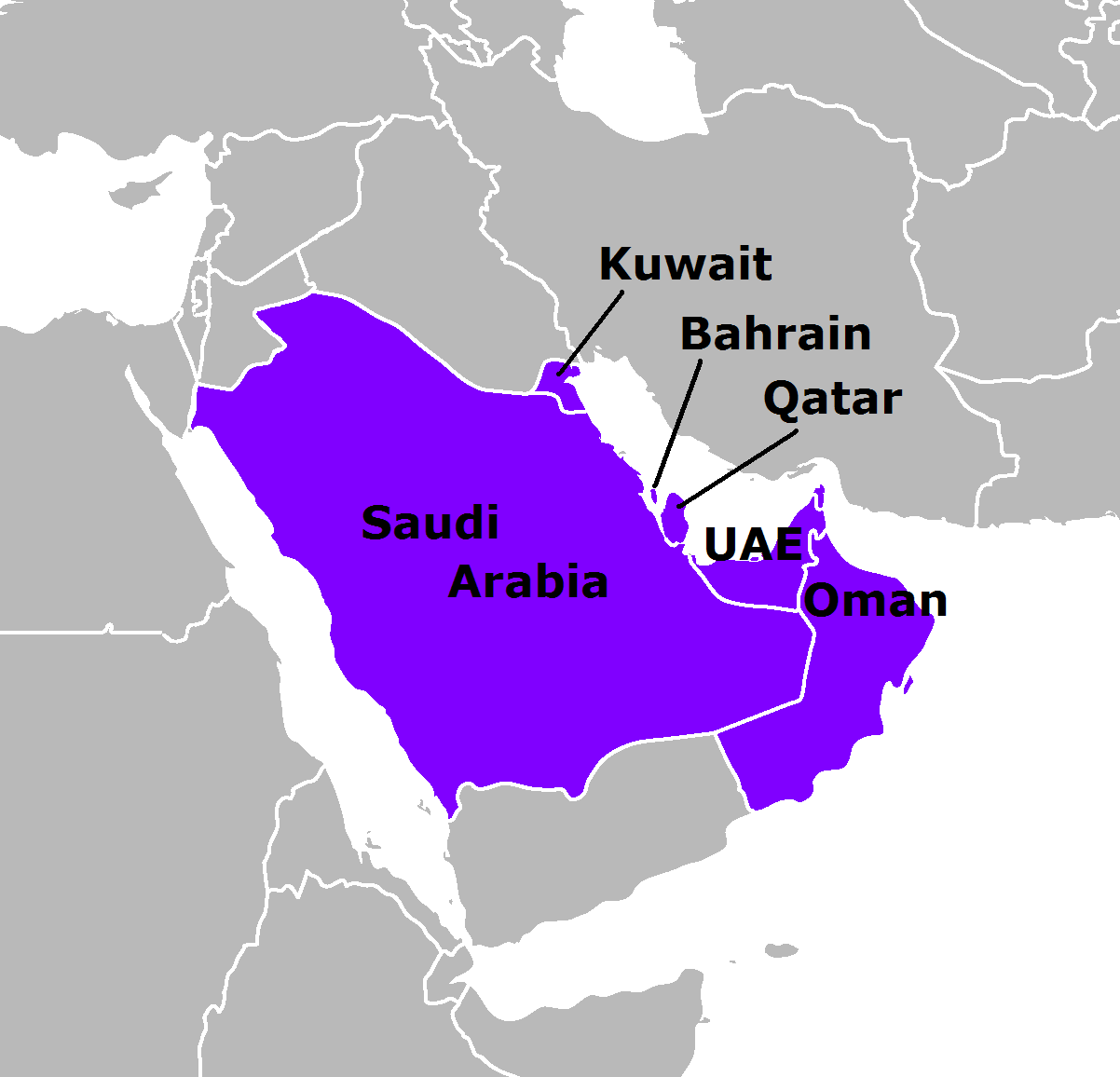
8 Differences between Korea and Oman

These days, word around the ROK is that the EFL field is not what it once was. Foreign teachers are less in demand as there are now so many of them there, and schools can be much pickier about whom and how they hire. Many Korean schools now prefer to hire only those with at least an F-4 Visa, teachers who speak both Korean and English, and teachers who were born, raised and educated in Korea rather than overseas. In short, it seems the golden days for the foreign EFL teachers have come and gone. Granted, many expat educators still have great positions, but for any newbies coming in, they will be hard-pressed to find a job, let alone one that pays more than 2.1 after taxes. Other expats have found themselves pushed out of lucrative positions, and are disheartened to find that they must start at the bottom rung once again despite x amount of years of experience teaching in the ROK. More and more, we see people turning to the Gulf States of the Middle East as another option. The UAE, Oman, and Qatar have been popular choices.

Persian_Gulf_Arab_States_english

Many conscience-minded expats are discouraged from working in Saudi Arabia, however, as their laws are seen as barbaric and their treatment of women is medieval. Purely from an ethical standpoint, no matter how good the money is, should you really support a society that still has weekly public beheadings? All too often the victims are innocent girls from poorer countries who take jobs as domestic servants. They may be assaulted by the man of the house, and if the girl presses charges she could be charged with adultery and face public execution. So yeah, maybe stay out of Saudi Arabia until they become a  little bit more enlightened. This may sound harsh, but talk about harshness after visiting Deera Square (A.K.A. “Chop Chop Square”) on a Friday after prayer.

phonot

Oman, on the other hand, has earned a fairly solid reputation towards its treatment of people, and so many expats are now turning their eyes to the oases, wondering what it would be like to work in the Sultanate of Oman. Lest I beat the subject to death, let me first say that this will be my last article regarding Oman. Still, before I close the subject for good, I thought some might be interested in learning the 8 Big Differences between being an Expat in Oman as compared to Korea. Let's start with the most obvious:

8. The Jobs

EFL jobs tend to differ from country to country and culture to culture. In Korea, you will most likely work Monday to Friday, and quite often be asked to work a few Saturdays as well. You may find yourself working at any end of the education spectrum, from kindergarten and elementary to universities and adult language institutes, depending on your qualifications and the employer’s immediate needs. Your salary will most likely be somewhere between 2.1 and 2.6 million won ($2000-$2500) per month, before taxes. Housing and fifty per cent of your medical are also usually provided, plus a month’s severance pay at the end of your contract. Vacation days vary from 10 days for hagwons (private schools) to two months for some universities, although you may have to work summer and winter camps during that time. If you do, you will be paid extra. Also, some schools provide at least part of your airfare.

In Oman, most EFL jobs are at the collegiate level, working either for the Ministry of Higher Education, a recruiter, or the military. Your salary will range from 950 rial to 1400 rial ($2400-$3600) per month. If your salary is in the lower end of the spectrum, housing will be provided. If you land a job with a salary closer to the higher end, you will most likely be expected to find your own place, but rent is cheap. The apartments are spacious (the one I am in now has 2 bedrooms, 2 bathrooms, living room and a big kitchen) and rent for as low as 200 rial. You may also need a car, as public transportation in Oman is not nearly as reliable as it is in Korea. You can rent little economy cars for as low as 160 rial a month, or buy your own car. You can buy new, but used cars are usually more popular with expats. Smaller used cars may cost as little as 300 rial, and larger four-by-four vehicles – such as a Jeep – will run you around 1600 rial. The latter is much more fun for driving in the mountains. Most expats who choose to buy a car will sell it when they leave to make most of that money back. More good news: All of your health care is paid, with the exception of a small co-payment that is usually no more than 500 baisa ($1.30). Also, gas/petrol is extremely cheap in Oman, and there is no tax, so you get to keep every bit of your salary. As far as jobs go in Oman, there is a saying: “They pay what they say, and they pay on time.” The paperwork is not nearly as frustrating and time-consuming as it is in Korea (at least not yet) as no criminal background check is required, and only copies of your degrees need to be submitted, no apostilles necessary. Also, your employer pays for your airfare both ways. When you leave, you tell them where in the world you want to go. If you plan to return for another contract, they provide you with a round-trip ticket. This may sound sweet, but you will need at least a Master's degree... but Korean jobs are demanding likewise these days. The working week in Oman is slightly different: Sunday to Thursday, with Friday and Saturday as your weekend. At the completion of your contract, you will receive severance pay and two month’s paid vacation. This is because no one wants to be in Oman for July and August. Why?

7. The Climate

It is hot here. I mean, it is HOT. I know, Korea gets hot and humid in the summer months, but Oman is a desert. A desert that is still really, really hot at night. When I first stepped off the plane here last August, the heat was like a punch in the face. I got sunburn just walking to the terminal from the tarmac. It took a couple of months for the temperature to drop a little bit and for things to cool down to a more comfortable temperature. From November until March, the average temperature is around 28 degrees Celsius (82 F), which isn't too bad. But from April until October, you will experience temperatures as high as 54 degrees Celsius (129 F). Bring sun block and light clothing, and drink lots of water. Don’t drink the tap water, as I am not sure how clean it is, and even if you did want to drink it, in the summer you only have two temperatures of tap water to choose from: Very warm and hot. Sunglasses are a necessity as it only rains about 5 times a year here, and it is rarely cloudy. Sunglasses also keep the dust out of your eyes. Due to the lack of rainfall, it is a very, very, very dusty country. In the summer, the ground is baked to a rock-hard surface. It is very hard on shoes, so you will want durable footwear. In my first weeks here, I had a pair of dress shoes melt. Literally melt. In the rainy months in the spring, it floods at least once because the ground cannot absorb water. By far, the hottest months are in the summer. You must have air conditioning or you will die. Well, maybe not die, but you will wish you did. It is highly recommended that you just get out of the country for the summer and head someplace a little cooler for your summer break. To cool off here in the Sultanate, there is no shortage of beautiful beaches and resorts with swimming pools, but the water will always be warm. And the sun is relentless, so you will burn. The winter months are actually quite pleasant, and Oman even sees snow occasionally up in the mountains, like Jebel Shams.  The summers, however, are absolutely scorching.

[caption id="attachment_1865" align="alignnone" width="300"]Jebel Shams: You will never find a more wretched hive of scum and villainy... No, it's really quite striking. Jebel Shams: You will never find a more wretched hive of scum and villainy... No, it's really quite striking.[/caption]

6. Religion

I will let you in on a well-kept secret: Oman is an Islamic country. Most of the population is Muslim, and there are mosques everywhere. Korea, from what I recall, is largely Christian with quite a bit of Buddhism sprinkled in to make it interesting. Before you get the wrong idea and go all Fox News in your head, Islam is actually not the terror that some might suspect – certainly not here in Oman, anyway. In fact, Sultan Qaboos has even donated some of his own land holdings to other religions so that they can build churches. Many Westerners here attend Christian services in Muscat, and there are many services to choose from. Services are performed in English, Arabic, Malayalam, Spanish, Tamil, Hindi, and several other languages. Unlike Saudi Arabia, you can be openly Christian in Oman and sport whatever symbols you like. However, it is recommended that you give all religions the respect they deserve. If you are of the hard-core Atheist set and you enjoy denouncing religions, Oman may not be a good fit for you. Religious tolerance is widely practiced here, but debate about the existence of God will make you some enemies, and it may even land you in jail depending on how far you push your argument. The Islamic tradition is very much predominant, and is, of course, a very big part of the local culture in every respect.

[caption id="attachment_1866" align="alignnone" width="300"]Rustaq Mosque Rustaq Mosque[/caption]

Many of the mosques here are very beautiful, and so is the religion that built them if you look at it with an open mind. Omanis are some of the kindest people you will meet, a statement which brings me to my next point.

5. Politeness

As many expats already know, it's always the little things that stand out when you are traveling from country to country. When I was in Korea, I often heard people talking about – and experienced first-hand – the bali-bali (hurry, hurry!) culture of Korea. Koreans move very fast and everyone is in a rush, as opposed to the Omanis, who do everything (except drive) very slowly. Whereas the key phrase in Korea is bali-bali, in Oman it is shway-shway, which means "in time" or "gradually; eventually." Or, if you want to really hit the nail on the head, try enshallah, which means "God willing." Use it in conversations like this:

A: Will we get into Muscat by 6:00?

B: Enshallah.

The Omanis are much more laid back and in no particular hurry, which makes dealing with them in crowded shopping malls a treat. If you have ever been pushed out of the way trying to get on a bus, subway, elevator, or escalator in Korea, then this Omani attitude will be one of the first things you notice when you arrive here. Omanis will step back, smile, and gesture "Please, you first" in these situations. After six years in Korea, it kind of caught me off guard.

[caption id="attachment_1867" align="alignnone" width="300"]A wadi (natural pool) A wadi (natural pool)[/caption]

4. Drinking Culture

As I have mentioned in previous articles, alcohol is legal in Oman despite the Islamic prohibition of spirits. Even some of the Omanis enjoy taking a drink, but do not ask them if you can take their picture when they are imbibing as most of them like to keep it on the D.L. When in Oman – or any Muslim culture – if you have a predilection for alcohol, keep your predilection quiet. Whereas public intoxication is widely seen in Korea, it is heavily frowned upon in the Middle East. In Oman, it can get you a 48 hour layover in a jail cell, and it can cost you your job. Nonetheless, you can go to any number of hotels and pubs in Oman – usually around Muscat or Sohar – and drink to your heart's content. Just make sure you have a reliable way home that will draw little attention to you in public. As always, NEVER drive if you have been drinking. Drunken driving is treated as a serious crime here in Oman just as it should be anywhere else. If you don’t trust yourself to keep your composure in public, you can always get a liquor license, which will allow you to buy a certain amount of alcohol at discreetly located "catering shops" for personal use at home. In Korea, drinking together is often seen as a trust-building exercise, as you never really know a person until you've seen them inebriated. Here in Oman, they don't share that perspective as they tend to believe a drunken person is not the actual person, but a person possessed. Drinking is mostly left to the tourists here, but there is no reason a person living in Oman can't blow off some steam as well – just keep your wits about you and never forget where you are. You may end up with some hefty fines at the least, and according to Omani law, you cannot leave the country if you owe money to the local businesses or government. That is a good thing to keep in mind as well.

[caption id="attachment_1871" align="alignnone" width="300"]Camel rides. Camel rides.[/caption]

3. Dating

This is an interesting topic in any culture. In Korea, there is a lot of cross-cultural dating going on, and more power to it. Here in Oman, it is a different story. Women can date anyone they choose, but they may have to expect a certain amount of disapproval from an Omani man's family – and this could include his wives. Polygamy is A-OK here, so even if a guy tells you he is single, he may just mean that he is available, and you may be eligible to be his first, second, third, or fourth wife. Non-Muslim men, however, are not allowed to date Omani women. The women here are very heavily protected. They enjoy much more freedom than women in other Islamic countries, but they are not allowed to see a man without their family's permission, and not without an escort. There are a lot of Filipino and Chinese women here, but you will certainly not have the options you may have had in other countries. Before I came here, I asked a friend of mine who was already here, "Will I have to live like a monk while I am there?" His answer: "Yes." While this answer is much more one-sided than the actual truth, it is really not far from the mark. There is definitely a shortage of single women here. It is a good country to come to if you are married and like extremely hot weather. Still, there are more and more female expats each year, so don't give up all hope. Getting back to the women's perspective, while you will have more opportunities than your male counterparts to meet someone, there is still real reason for caution. Men here tend to come on very strongly when they encounter a single female – sometimes more strongly than anyone would care to discuss. In short, it is always a good idea to travel with a friend.

[caption id="attachment_1868" align="alignnone" width="300"]Dune-bashing in a 4x4 Dune-bashing in a 4x4[/caption]

2. Activities

Aside from the common weekend activity shared by both Korea and Oman – drinking – there is a lot more to both cultures than just that. In Korea, there are concerts, ski resorts, beaches, boat rides, camping (or as some Koreans like to call it, glamping, or glamorous camping), movies, etc. Oman is no different, and there are a lot of spectacularly fun activities you can do here that you may not get to do in other countries. Oman has miles and miles of beautiful beaches, 5-star resorts that offer everything from boat tours to snorkeling and scuba diving, spectacular mountains for hiking, thousand-year-old forts for exploring, spectacular caves for spelunking, and wadis (natural pools in the mountains) for camping. You can even attend camel races, or go on desert excursions and ride the camels yourself. Here's a funny fact: At the camel races, no one actually rides the camels. They have robots – little machines that are attached to the saddle and hit the camel with a riding crop, and the speed is adjusted by remote control. Picture that in your mind's eye.  It looks like MST3k's Tom Servo is the jockey.

[caption id="attachment_1869" align="alignnone" width="300"]Robot camel jockey Robot camel jockey[/caption]

The majority of activities in Oman take place outdoors, so it is good to remember the heat in the summer months and to dress accordingly and be prepared with lots of extra water and sunblock. The ocean here is very pristine, and pristine oceans are becoming a thing of the past. In Korea, the preferred local vacation spot is Jeju-do. In Oman, it is Salalah, which is to the south near the Yemeni border. Salalah is apparently nice in the summer months, as it remains very green. However, if you prefer something a bit more automotive, try dune-bashing or the popular Omani sport of "drifting."

http://youtu.be/cvCpBr8zxF8

  1. Food


This last one kills me, because I must say that I really miss the cuisine in Korea. When I was in Nepal a little while ago, I made a point of going to a few Korean restaurants. I have found one Korean restaurant here in Oman, and it wasn't very good. When comparing Oman and Korea, Korea has definitely won the food category for me. I miss galbi and samgyupsal, the all-you-can-eat meat places, manduguk, kalguksu, doenjang jigae . . . the list goes on.  Also in Korea, there is no shortage of western-style foods, including many great Italian and Mexican restaurants. In this regard, Oman simply cannot hold a candle to Korea. Larger cities like Muscat and Sohar have a lot of western-style restaurants, including T.G.I. Friday's, Chili's, Subway, Pizza Hut, and, of course, McDonald's and Burger King. In fact, the version of Pizza Hut that Oman has is much more akin to the American version, which I like, but generally speaking, I prefer the food selections of Korea. Even the grocery stores in Korea have a better selection. Although you can get good food in Muscat, when you live out in the rural areas of Oman as I do now, there really isn't anything good to eat. You get sick of the limited selection within a month as you can only take so much curry, chicken and rice. All of the food at the grocery store is frozen and heavily processed, although the produce is good if you get there after a fresh delivery. The food out here on the perimeters is generally not as healthy for you as the food you can get in Muscat, and it is certainly nowhere near the variety and deliciousness that you can get in Korea. In Oman, T.G.I. Friday’s is the closest you will come to a four-star restaurant, at least as far as I have seen.

[caption id="attachment_1870" align="alignnone" width="300"]I miss this. I miss this.[/caption]

I hope this lengthy article has helped to illustrate some key differences in the lifestyles of these two popular expat destinations. As I promised, this is the last article about Oman I plan to write. If you have any other questions, you may contact me directly at this site.

Thursday, February 13, 2014

Fifty shades of Gay.

http://www.youtube.com/watch?v=FqoMomj3QtE

50 Shades of Gay: Perspectives of Gay Korea


A Tale of Two Emotions


“You’ve never been to West Hollywood’s Pride, but you’re from LA?” James asked incredulously, almost as if there were no possible way. “Yeah,” I explained equally shocked, but was then quickly distracted by an incredibly sweaty and muscular duo in matching hipster summer tanks. We continued wandering in the plaza looking at the parade and trying to seek refuge from the sun. It then dawned on me; I only participated in gay events here in Korea. I’ve always been politically active, so much so that I staged a one man protest in high school. Yet, despite being so outspoken on many things, I was in the closet back in the United States.  Maybe it’s because I’m older now? “What about you?” I figured that I would flip the question around. “Yeah it’s my first pride,” my friend said in between sips of now Luke-warm Cass. Possibly Korea, had something to do with wanting to become politically active or at least show solidarity in the fight towards equality.

Korea officially has no laws against homosexuality. While many Western progressives cheer at this, the reason is actually pretty hurtful. Korean culture does not believe such acts would exist on the peninsula. So the rationale is, why legislate on something that would never happen? Thus attitudes, as surmised by a Korean friend of mine, are somewhat prevalent.   “Bummy, that’s way too much money to spend on your girlfriend,” I downed my drink while thinking about the staggering price he stated for a romantic getaway. “Well, how much would you pay for your girlfriend?” He stated. Fair point, I thought.  “Not 900,000 won ($850) a night.” Soon a few other friends joined into the conversation. Jokes about prostitutes, nuns, and cucumbers abound.  Then, as if some divine edict of comedy actually exists, the obligatory gay joke. “Okay, let’s say that a guy paid you 900,000 won ($850) instead of you paying for a room. Would you do it?” I looked at Myra and looked at Bummy. A plastic smile was hiding the intense anxiety of how he would respond to Myra’s seemingly innocuous question. “I don’t understand.”  I knew what that meant; it meant that he did understand the words, but not the concept. “Would you sleep with a man for 900,000 won ($850)? Doesn’t have to be sex, but a blowjob or you know, messing around?” “Fuck no. I don’t like the gays.” The plastic smile I wore intensified into more of a Kevlar protected shield to try to cover any insecurities and insinuations about me.  I expected the response ‘I’m not gay’, or ‘I’d never do that with a guy.’ However, I didn’t expect the level of vitrol that he had. I am gay. Thus, he doesn’t like me. Myra looked at me smiling awkwardly desperately wanting the conversation to go back to its debauched joviality. A few months later, as I came out to him, he made me choose between him and my boyfriend. Well, I choose the later. Thankfully, I don’t  often have to make a choice between my friends or my boyfriend.

It is important to note that attitudes are changing. A recent Pew survey showed 71% of Koreans aged 18-29 believed that homosexuality is not wrong. This contrasts with 16% of Koreans 50 and up. Currently 25% of Koreans support gay marriage, while 67% of Koreans oppose it. 8% do not know1. Obviously, the majority of my peers would be accepting and tolerant.  Things are definitely changing for the better in this regard.

“I envy you!” It’s funny how often that word is used. “Why? I mean you make more than me, travel more.” Yeah, there was a twinge of jealousy in my voice as looked around the stark and utilitarian space otherwise known as my kitchen. “You and Andy have not fought” Hyung Min looked a little dejected as slumped into a worn dining room chair. We continued eating pizza and drinking beer in my humid apartment. “Of course we have. He cheated on Call of Duty once,” I said this in all seriousness, which prompted me to look around my apartment. A skateboard, PS3 and X-Box, a beer pong table. Well, you can take the man out of the fraternity, but not the fraternity out of the man. Hyung Min wryly smiled. “Amanda and I… I don’t know.” What was odd was that it was one of the few moments that I shared with a straight person talking about relationships on an equal level.  Andy and I were not a sideshow, but rather people in a relationship. It transcended cultures as well as sexuality. However, unfortunately, such solidarity and support is not always found in homosexual Korea. Especially when dating.

Two Gays, Another Gay, and a Coffee Shop


 It would be a lie to say that I was sober at 5am on Sunday. Well, not so much a lie as an exaggeration of the truth. Regardless, I ran into James and his friend Tom. They both stumbled out onto the street as bleary eyed as I was. “Going to the Hill?” Aw, the obligatory question of every homosexual in Seoul. “It’s 5am. I’m going home. I’ll see you at noo-make it 1pm,” I said trying to hail a taxi with little success. At this point the other group of guys that I was originally with was more enthralled at street vendors selling shawarmas than the barrage of women exiting the bars and clubs. Personally there is something a little sad when a guy, or girl, has hopes of finding another person and ends up buying a burger instead. Dejected, they entered the cab after not finding their proverbial Cinderella, if only for just one night.

In Korea dating is hard. Competition is stiff for heterosexuals who are not only expected to maintain a high beauty and income standards as well as fulfill the wishes of both significant other and their family. Currently the largest market for male cosmetics in the world is in Korea, in terms of per capita usage. Thus, men are feeling the proverbial heat just like the women.  Just as important as beauty are income and societal ideals. The pressure to get married propelled Korea to have the second highest rate of marriage in the OECD2. Mate selection, however, has driven the median age of marriage to roughly 30 years old, about 3 years older than the OECD average. Much of this is due to the high cost of living in Seoul as well as ever increasing university fees which is causing a rise in debt. The takeaway is that it’s hard and stiff in Korea for heterosexual males to get hard and stiff regularly.

It’s just as “hard” and “stiff” for homosexuals too. Legally, gay marriage is not allowed. Ceremonies are performed, but much to the ire of the general public. The first publically performed gay marriage ceremony (non-legally recognized) in 20133 was met with more consternation than ecstasy. In terms of dating, the level of conservatism creates a maelstrom of emotions and misunderstandings with, albeit, sometimes hilarious and awkward consequences.

“He just tongue darted in and out my mouth and squeezed my junk,” James said in between sips of his latte. I met them both promptly at 1pm in Gangnam later the same day. “I’m like does that seem like it would feel good?’” I didn’t know how to respond. Not to brag, but I feel really happy my sex life is less like the blooper reel of “Freaks and Geeks” and more like the director’s cut of “Queer as Folk”. About 10 minutes later, after eating an overpriced sandwich, I asked whether or not his parents knew that their son was having sex with James since James would stay the night. “No. I mean they thought it was normal that we took showers together, slept together. Dude, It’s Korea.” I guess in the West, the equivalent would be wrestling half naked with your bros. Nothing sexual, but genuine male bonding before marriage. What then occurs, according to Tim is that “(Gay) Koreans are quick to love.”

That was one common complaint I heard over and over. Personally, as a romantic, I find it endearing. The idea of waiting in the rain for your love, and then proposing to them in a grand gesture, appeals to me. However, hearing other perspectives of how after one or two dates, baby names and country selection debates become the topics du jour paints a picture of how juxtaposed Korean gay culture is. On the hand, it’s liberal and taboo with Homo Hill best described as a “Hot Mess” according to Tim. On the other, exhaustive and quick planning to such an extent that even the psycho girlfriend meme could not capture the awkwardness and eccentricities that exist in gay dating in Korea. Much of this does go with the cultural expectation of love and marriage. Gay males in Korea are still socialized as Korean, thus it would only seem natural that the same mate selection pressures would apply to a certain extent. However, since gay marriage is illegal, what occurs is something akin to America in the 1970s-1980s, the gay party scene, which is a stereotype rooted in some aspects of reality.

I left the sandwich shop about 20,000 won lighter and not as full as I would have liked. As my wine hangover with hitting its zenith, I decided to follow up with Su Min to see if he finished the survey.

Lovers in a Dangerous Time: Gay and Korean


            I first met Su Min when I was seeing John. John is extremely attractive. He doesn’t seem to think so, but any guy with six pack abs, a strong chest, and a cute smile generally qualifies as attractive. Being new to Korea and to the gay scene, I fell for him. The problem was that Su Min, fell more for John than I had. An awkward friendship arose with the occasional sexual escapade.

Staying at Su Min’s house was initially like living in a SoHo loft with Artists coming in and out at all hours of the day and night. The stark walls and floors added to the minimalist bohemian feel. Not to sound overly cliché, or to use too many word play devices, but I did see the depths of Seoul’s soul while staying there. It was there I asked what Su Min wanted from his family. He had no plans to tell them. In fact, he considers that his greatest challenge of being gay. After 7 years of coming out only to close friends, I found it odd that he wasn’t out to his parents. I mean didn’t his parents ever wonder why a talented, attractive young singer never mentioned a girlfriend?

With that I could empathize. I accidently came out to my very Ivorian mom on April 1st. I should qualify that the accident wasn’t coming out; it was the terrible date selection. I’m not good with time zones. I digress. Yeah, I grew up in California, but I always have a part of me that remains rooted in Africa.  In some strange sense of solidarity, being gay in a conservative culture, I maintained contact even after awkward sexual encounters and bits of jealousy.

While for him the greatest challenge about being gay is adhering to what is expected of him in Korea and not telling his parents, things are changing. Another friend of mine, Don, mentioned about a high school girl that was openly gay at the place where he used to work. You could attribute it to personal strength, however, the statistics corroborate with the notion that indeed the times are a changin’.

Letters of Love and Hope: The Future and Beyond


            Currently, as I’m typing, I’m staring at my own fears of moving back to the US. The air conditioning is fanning the insecurities and irrational fears I have concerning the future. Torrential downpours serve as a tangible symbol of the inner emotions I’m repressing regarding leaving Korea. However, with that, as my friend said “The past is of no significance.” This isn’t to say that we don’t stand on the shoulders of giants, but rather we should look towards the future instead of rely on conventions and situations that no longer pertain to the current.

The first gay film festival in Korea was held in 1997 with considerable outrage. Local officials threatened to cut the electricity and tried to thwart the event the following year. Despite such efforts, the festival and ensuing parade survived and, well, thrived. In 2000, there were 50 participants. In 2009, there were over 1,500 participants in the parade and festival4. This is not to call Seoul the next San Francisco or Amsterdam, but it demonstrates that just the extent of how homosexuality is changing and is gaining more acceptance in part by challenging archaic beliefs. Yes on a macro-societal level, that’s great and all, but what does this all mean regarding what people want for their personal futures?

When I first started this article, one of questions I asked was where do you see yourself in 5 years. The overwhelming response was married and with a family. One such answer seemed almost as if it were a liberal lesbian interpretation of Rockwell’s America. She wrote that she wanted a small farm, children, and her wife. As I prepare my own adventure across the Pacific, I realize that’s what we all want. Okay, maybe not small farm or, in my case, a wife, but a very simple and comfortable life. A life that is free from reproach and castigation, but a life ebullient and brilliant that elevates the most morose of souls. We should follow the advice of Quintus Horatius Flaccus as to seize the day and look towards the future regardless of what it holds. I guess in more succinct and contemporary terms, YOLO. It’s time, the future is not only mine, but yours too, let’s seize it together.

Sources:


  1. Pew Research. The Global Divide on Homosexuality: Greater Acceptance in more Secular


and Affluent Societies. Washington DC: Pew  Research, 2013.

  1. OECD. Family Database. Paris: 2012.

  2. Kim, Christine. “Gay South Korean film director to marry in bid to pry open closet.” Reuters.           15 May 2013.

  3. Kelley, Matt. From 50 to 1,500: “Korea Queer Culture Festival turns 10.” Fridae.


15 June 2009.

Friday, January 3, 2014

The Love That Some Love to Hate: Aegyo

http://www.youtube.com/watch?v=pNWQP3s6TJw

Does this warm your heart? Or make you sick to your stomach?

aegyo (애교) /āgyō/ (noun): The act of being overly cute [1]

Several Korean friends have asked me how one might translate aegyo into English, and I have never been able to give them a satisfactory one-word response. The easy answer is “cuteness,” but this barely scratches the surface of the complex expression of childish charm and effeminate grace that aegyo actually constitutes. The closest single word to aegyo comprehensible to the average English speaker seems not to be homegrown English at all, but a loan word from Japanese: kawaii, literally 可爱, able to be loved. For many, “kawaii,” unlike simply “cute” or “adorable,” may bring to mind images of pigtailed girls holding up double V signs and grinning like Cheshire cats. This at least more accurately expresses the negative side of aegyo so often reviled by foreigner and Korean alike than does the concept “cute,” but the hitch here is that aegyo is most properly understood as a noun, while 可爱 is usually an adjective in both Japanese and Chinese.

Even though the concept is hard to cleanly translate into English, it can still be understood in its own right through an examination of its composition and usage. The first character ae (爱) means “love,” while the second character gyo (娇) can be applied to a number of concepts, including “beautiful and adorable,” “pamper with affection,” and “precious.” [2]Some semantic mix of “loving” and “precious” might indeed be a correct first step to understanding this term, as a Korean blog [3] and Urban Dictionary [4] alike describe the concept as “a manner of speech or behavior that elicits the favorable interest of others“ and “winsome… ‘generally pleasing and engaging often because of a childlike charm and innocence,’” respectively. The origin of the Korean compound word aegyo is unclear, at least to me, but according to the Chinese Wikipedia Băidù Băikē (百度百科), an early mention of the term is found in a 1932 Chinese work by fiction writer Máo Dùn (茅盾, meaning “contradiction,” the pen name of Shĕn Déhóng 沈德鴻) 《字夜(Zì Yè)》 [5] in which a character’s grandmother is described as having “a gaze still so full of radiance and lively movement, each glance shining with infinite wisdom, infinite aegyo.” [6] So it seems that in 1932, at least the Chinese understanding of aegyo justified its use to describe the radiant wisdom of an elder woman, hardly the cutesy affectation with which we might associate it today.

Aegyo is generally understood to be most appropriately expressed by females. Females delicately covering their teeth while they laugh [7]. Females praising their male friends in elaborate language for performing an act that they are seemingly too helpless to do themselves, like opening a soda can [3]. Females with pouting lips and impossibly wide eyes snapping selfies in the coffee shop. And, of course, females begging their oppas for ice cream [8]. Girls, however, hardly have a monopoly on this trait.  Males can and do use it too, and while they generally confine their expressions of aegyo to baby-talk with significant others, a close Korean friend once informed me that she has met a number of Korean males who use aegyo in other contexts as well. Some, she reported, even go as far as to pronounce the conjunction go (고) as the more childish and presumably more endearing gu (구) (a behavior usually restricted to female speech patterns) and reference older female friends as eonni (언니), the Korean title for “big sister” used between females, instead of the ostensibly more gender-appropriate nuna (누나) expected to be used by males (funnily enough, I encountered my first such male on the subway not four hours after this conversation; talk about our propensity to filter out what we do not fully understand). Not only is aegyo not gender-specific, but it is apparently also not the exclusive purview of humans. Type the search term into Naver.com and be prepared for a barrage of puppies [9], kittens [10], rabbits [11], and, my personal favorite, a group of curious wild seals [12] declared to epitomize the elusive trait.

Multiple online sources, foreign and Korean alike, make a distinction between “natural” and “fake” aegyo, with the implication that the latter is somehow less praiseworthy than the former. While I will not deny that aegyo, like any behavioral expression that may call extra attention to oneself, can be abused with an intent to manipulate, the black-and-white distinction between “real” and “fake” aegyo and their respective associations with “good” and “evil” is precisely the kind of misunderstanding that I hope to correct. For even though aegyo can be unnatural and affected, it can still express genuinely benevolent intentions. In other words, not all so-called “fake” aegyo is “bad” aegyo.

As an example, every night my roommate comes home from her office job she walks past my room and emits a high-pitched “Kaelli an-NYEONG!” while striking an extravagant girlish pose that all but beams unicorns and rainbows into the rose-scented air around her. At first, I tended to feel perplexed, and then ever-so-slightly miffed, at this action, for I felt that she was greeting me as though she would a child or house pet rather than the self-aware human adult that I consider myself to be. And, according to some written and filmed material on Korean aegyo, I might have been justified in my frustration. My roommate’s behavior took calculation and effort, and was therefore, affected, artificial—the sort of fake aegyo that others might teach us to revile or mock. But isn’t the calculated effort behind this aegyo its very purpose in our interaction? Even after a grueling twelve-to-fifteen-hour day at the office, my roommate musters up the thought and energy to slip on an exaggerated smile and crow a happy greeting into my room. Should it really matter that this thoughtfulness happens to take the shape of a cloying, childish, fake manner that, all told, probably results more from her natural absorption of the images with which she is daily presented in the media than from any malicious desire to put on a manipulative one-woman show? Her nightly performance is the epitome of so-called “fakeaegyo,” and yet one would not be justified in condemning her for it.

I Dig Culture’s raison d’être is to bring diverse people together in mutual understanding. As such, we do not stop at attempting simply to purvey a body of objective knowledge about various cultures, which may be perniciously interpreted in ways counter to our final goal of human connection. Instead, we strive in addition to unpack and underscore the mutually intelligible logic that stands behind the wildly different cultural practices on which we report. In this way, we hope to provide evidence for our shared humanity rather than just create a spectacle of our surface differences.

We hope that our treatment of the Korean concept aegyo (爱娇) is no exception. As a type of behavior that might stand counter to standards of mature social intercourse in some other countries, it serves as an apt example of a cultural phenomenon that can be, and often is, misunderstood and/or interpreted in an unnecessarily negative light. We hope, therefore, to provide a more positive spin on aegyo, one that highlights the rational and universally comprehensible motivations behind its practice in Korean society.

So we may have a love-hate relationship with aegyo, one that might weigh more heavily toward the latter in the case of those for whom aegyo is an ambiguous and foreign concept. However, as with any human behavior, especially one that might stray so far from one’s own approach to social interaction, it is important to grant others the benefit of the doubt. So whether it is wrapped up in the endearing smile of a shy male friend or a girl in combat boots and a leather miniskirt who drops her cigarette and bottle of soju to emit porcine squeals at her approaching oppa, let’s not forget that an important component of aegyo is 爱, the elicitation and expression of love, an emotion that we can all understand and share.