Showing posts with label Globalization. Show all posts

Saturday, May 2, 2015

What Did You Take for Granted Until Living Abroad?

"We shall not cease from exploration, and the end of all our exploring will be to arrive where we started and know the place for the first time." ---T.S. Eliot

For what is it that some of us choose to drop it all and leave? To cauterize the ends of possible career paths and budding friendships, shell out hard-won cash and limited emotional energy to jet-set out of one's comfort zone into a land of strangers?

Is it the draw of afternoons spent on balmy beaches, of evenings brimming with unpronounceable drinks and oddly spiced foods? The thrill of venturing through fragments of exotic architecture, stumbling through bursts of elaborate foreign syntax, or losing oneself in a crowd of novel strangers? Should we peel away the layers of our attraction to new environmental, culinary, and intellectual challenges and opportunities, what core motivation will we find remains to drive it all? Is it, truly, the push to explore the other? Or is it, in at least equal measure, the belief that, in exploring the other, we will actually come to understand ourselves? 

In this discussion, we will explore the latter possibility, in investigating how travel to other countries allowed us to realize what we had heretofore ignored in our own. 

[caption id="attachment_3530" align="aligncenter" width="800"]IMG_1566_bike path_resized The path unknown might just be the one back home.[/caption]

Brian: This might be a really superficial way to start what could be a deep discussion, but I didn’t realize that raccoons are only in North America. They’re kind of like the panda of North America. I realized this at the Beijing Zoo while on a trip to China.  They kept on talking about how pandas are one of the most amazing and rare animals in the world. Then I saw a raccoon at the zoo and realized that I saw them all the time in North America, which is the only place they’re found naturally. They’re really smart and famous for their prehensile hands. When I was a kid they always tore apart our trash.  I kind of miss them now.  Really fascinating animals. Have patches on their eyes and look like robbers.

Kelley: It took moving to a huge metropolis like Beijing, and then Seoul, to make me realize how much I had taken for granted the natural world. Blue skies. Birds in the morning and crickets at night. Thunderstorms with lightning, and rain that comes down in big droplets that leave the smell of spring. These are generally not features of big cities, regardless of what country they're in. So it was almost a bigger shock to adapt to urban versus suburban/small-city life than it was for me to get used to the more distinctly Chinese or Korean aspects of my new societies.

Maur-Anne: I took for granted that everybody had an opinion about everything. French people keep asking “What do you think about that?” Koreans often answer “I don’t know; I’ve never thought about it.”, and it tends to annoy me. A good example would be one video I saw of Obama giving a talk in Seoul; at the end of the speech nobody asked any questions except for some Chinese guy. French people do have an opinion about everything because French people expect you to have an opinion about everything. Otherwise you’re not showing consideration. Even if you’re not sure about what you think, you’re supposed to think about it and show a little bit of effort. It’s also because French people have kind of a fear of being manipulated by society; they enjoy showing that they have critical thinking skills.

Kelley: Really? Are you sure that you’re not talking about Americans? I’ve always thought of that as being a very strong characteristic of people from the U.S.

Maur-Anne: Maybe France even more than elsewhere.

Brian: Yeah, the West has been heavily influenced by French philosophy.

Brian: That’s one thing that I appreciate about Korea. I don’t have to hear strangers’ opinions about things I don’t care about. People will just talk to you and not stop talking to you, unless you’re rude. Like waiters.  I guess there is some charm though to being able to talk to strangers naturally which is not really common in Korea.

Maur-Anne: In France we contain our opinions to lively conversation and socializing.

Brian: Waiters, guys fixing things at your house. They’ll just talk to you for like an hour.

Maur-Anne: Social security and health care system; I always thought these things were normal. As a kid, I always had one free dental consultation a year. Most of the medicines are reimbursed. So I thought it was normal.

Brian: But it’s pretty cheap in Korea too.

Maur-Anne: Well say I want to take a blood test in Korea; I have to pay a lot of money.

Brian: Well, you’re not on the national insurance.

Maur-Anne: I have international insurance, and it’s still expensive. Also, cheese. I took cheese for granted.

Kelley: This might be sort of random, but I really miss being able to make friends with minimum effort. When in Beijing and Seoul, I feel extra barriers of language, culture, and the general sense of my status as an outsider boosting the activation energy required for new relationships. In some ways this makes my Chinese and Korean friends more special---as, to me, they have been more hard-won---but as someone who is already on the passive side when it comes to initiating and maintaining social bonds, I often feel a bit more lonely here than back in the United States. I never realized how easy it could be, in theory, to just strike up a conversation and find common ground with somebody---because I had never experienced before just how hard it might be in other circumstances.

Brian: Sometimes I just like being left alone.  Leave me alone, guys.  I'm leaving.  (Brian leaves the room)

Maur-Anne : Wait, don't go!

Kelley:  Just let him go.  He's a grumpy Brian (laughs).  Also on the topic of people, living in China and Korea has made me really miss the full range of racial and ethnic diversity we see back home. I remember my first time back to the U.S. after a two-year stretch in Beijing. I landed in New York and just found myself transfixed on the subway at the tapestry of humanity around me. I had never fully appreciated the cultural and aesthetic value added to my life by random strangers on the street, but now I see it as stunningly beautiful. That's not to say that I can't enjoy diversity of style, manner, and personality in either Beijing or Seoul---it just takes a bit of people-watching to find that I can. But the ethnic diversity here is certainly of a different character and range.

Maur-Anne: People who look at me on the subway and hold their bags like I’m going to steal them made me realize how much I took for granted living as a member of the racial majority in my own society. My white friend said that people have given her the finger in the street. One time, another French girl was with me, and Koreans started speculating about how maybe she’s a prostitute who works in Itaewon. At the same time, it’s a very good experience to live somewhere as part of a racial minority. It teaches you humility.


(Featured image credits.)

Saturday, December 27, 2014

Globalization Will Kill Black Pete

Every November there’s a good chance that you’ll hear a conversation in the Netherlands that goes something like this: "I just came back from the store and they already sold Christmas decorations! Really? Sinterklaas didn’t even start yet! Every year they start selling the Christmas decorations earlier. What a shame!"  It’s no wonder that stores are selling Christmas decoration so early, given the rising popularity of Christmas over our own local holiday Sinterklaas. Already for many years, many people have not been celebrating Sinterklaas anymore, and the blame is put on globalization, or, to be more exact, Americanization.

Sinterklaas (a traditional figure based on Saint Nicholas) is celebrated annually with the giving of gifts on Saint Nicholas Eve (5 December). He traditionally arrives by steamboat from Spain each year in another city on the first Saturday after 11 November. He then parades through the streets on his white horse, welcomed by children cheering and singing traditional Sinterklaas songs. His Zwarte Piet (Black Pete) assistants (white men in blackface with a wig of black curly hair and dressed up like a 17th-century page in colorful attire---more on that later) throw candy and pepernoten (small, round, gingerbread-like cookies) into the crowd. All of this is televised on national TV. In the period between Sinterklaas' arrival and Saint Nicholas Eve, children put their shoes next to the fireplace (or when you don't have one of those, under a small open window or any other place your parents let you believe a full-grown man can crawl through) before going to bed and singing a Sinterklaas song. My sister and I would also leave some carrots with our shoes "for Sinterklaas' horse," of which only the stumps would remain in the morning, because my father had eaten them all after we went to bed to make it even more believable that Sinterklaas really visited our house. We would also find a small present or candy in our shoes, which was of course the reason we would be awake much earlier than usual.

[caption id="attachment_3463" align="aligncenter" width="367"]Sinterklaas in Schiedam (2009) Sinterklaas in Schiedam (2009)[/caption]

In the Netherlands, a nation with Christian roots, Christmas has been around as long as Sinterklaas has. It has always been celebrated (reluctantly) one day with your family and one day with your in-laws (yes, we have two Christmas days). Fights would (and still will) break out about which family you would visit on the first day, but there isn’t much gift giving involved. That was reserved for celebrating Sinterklaas, and not only for children, but for adults too. Adults write each other snarky poems and/or construct surprises (pronounced as the French surpris, not the English way), a very creative way of gift wrapping by making something out of cardboard or other solid materials, which contains the gift and some substance as disgusting as possible (usually syrup and Styrofoam, or any other sticky/disgusting combination). However, with Hollywood movies came the commercialization of Christmas and therefore the decline of celebrating Sinterklaas in favor of Christmas. As soon as the children don’t believe in Sinterklaas anymore, the family usually shifts the celebrations to Christmas and puts the gifts under the tree. The poems are sometimes still there, but  the surprises have disappeared. This makes a lot of people in the Netherlands feel sad because they think we're losing a tradition, while in fact, they are the cause of its disappearance.

Is losing a tradition like this always a bad thing, you may ask? Not necessarily. Holding too much onto one's traditions causes a lack of progress in society. Not marrying outside of your religious circle, pulling the head off a live goose for entertainment, and football matches available for men only are examples of traditions that have vanished when society thought they were outdated and wrong. Even our beloved Sinterklaas celebration has something outdated in the form of Zwarte Piet (Black Pete), Sinterklaas' helpers that help him to get all the presents to the children. Although as a child I loved Zwarte Piet for being so funny and throwing pepernoten at my face, as an adult I can't see past the colonial relic of the white man wearing blackface acting like fools while poorly emulating a Suriname accent (Suriname is a former Dutch colony in South America where we used black slaves to work on our plantations).

[caption id="attachment_3461" align="aligncenter" width="650"]Two women in "Black Pete" (2009) Two women in "Black Pete" (2009)[/caption]

I didn't always think like this. I never stood still by the fact that Zwarte Piet may be offensive and racist to some until 2013, when the discussion about the controversial figure of Zwarte Piet started to intensify. Before that it simply didn't concern me; I never considered that the black make up that people would put on their faces was in fact blackface. I never saw race when I saw Zwarte Piet, and I was convinced other children wouldn't see that as well. Change never comes from those who are unaffected. However, when the discussion flared up in 2013 I started reading interviews with black people and started listening to what they had to say. They told stories about how they hated the Sinterklaas celebration because people (children and adults) would call them Zwarte Piet and make racist remarks. They were told this by their classmates in elementary school or while playing on the street, which I think must have been very traumatizing. As adults, the abuse continued by children calling them Zwarte Piet. For them it didn't feel they were included in this big children's celebration. When I heard those stories I knew I was wrong and felt ashamed that I hadn't figured it out sooner. Although not black myself, I'm part Turkish. Knowing the amount of racism Turkish people have encountered when they started to settle in the Netherlands as immigrants, I feel I should have known better.

Now the celebration of Sinterklaas in 2014 has come and gone and I'm more convinced than ever that something has to change. Slowly more people are waking up to see that Zwarte Piet is in fact racist, mainly due to the racist slurs of the defenders of Zwarte Piet. The awakening of these people was touched off by events within the Netherlands, but are certainly influenced by globalization. The way the international community speaks with shame about our tradition and that many people still defend that tradition also reaches the Netherlands and has an influence on people's behavior. This happened before with the famous number 39 with rice incident, where a judge on Holland's Got Talent made racist remarks to one Chinese contestant, asking him if he was going to sing number 39 with rice (a reference to an item on the menu of a Chinese restaurant and basically stereotyping all Chinese people in the Netherlands). It initially didn't cause a stir in the Netherlands until a clip of the TV show showed up on reddit and being criticized by commenters all over the world. Subsequently it reached other foreign media as well and from then on a huge debate broke out in the Netherlands about whether it was an innocent joke or pure racism. The same is happening with Zwarte Piet, where people on the Internet and foreign media are criticizing the fact that we still keep him around in the Sinterklaas celebration. The effect is that in 2014 there were already changes made to Zwarte Piet's appearance in some places. Although still not acceptable and not nearly enough, it is a start.

This is the real power of globalization. Because we are more interconnected we see more quickly what's wrong in other people's societies and have the ability via the Internet to let them know. Some might say mind your own business because you don't understand the culture, but as a man with experience with many cultures, I say we must be able to criticize and debate with each other to come to a better world for everyone. Many defenders of Zwarte Piet often say that foreigners don't understand our culture and therefore can't claim that Zwarte Piet is racist (Click here for an excellent article about the 10 most common excuses Dutch people make to defend the racist tradition of Zwarte Piet). However, we must stop playing the culture card when racism is involved and be able to admit our own mistakes. Only then will globalization be a positive thing instead of metaphor for a bunch of Western multinationals taking over the world. So people of the world, please criticize those that still defend Zwarte Piet. We can keep our tradition of Sinterklaas, but the Zwarte needs to go out of Piet.


Is English a Threat to Linguistic Traditions?

As a native speaker of English, I revel in a fantastic luxury when I travel. Wherever I go, I can assume that the language of business is English. No matter where I am or what I need, if I don't speak the local language, I can always use English. In fact, if the exchange goes poorly, the person I am speaking with will often apologize for his or her lack of ability in my language rather than scold me for my poor knowledge of the local tongue. I have met many people who berate themselves for their inability to progress in English. These people often lament the pressure they feel to learn it.

“Why should I have to learn their language? This is Italy; they should learn Italian,” my Italian friend might say (if I had any friends).

People like my non-existent Italian friend are living representatives of the mixed feelings many people feel when they think about the role of English in their lives. There are many reasons for embracing English as a global language. Likewise, there are many reasons for rejecting it. Today we ask the question: can the influence of a foreign language on a culture degrade that culture's linguistic traditions?

We know that living languages are constantly evolving. Speakers of English are rampant thieves; we've “borrowed” heaps of words from other languages. We say “borrowed” as though we intend to give them back, but if we're honest with ourselves we can admit we're not giving them back. While we know that living languages are always changing into something new, we also know that languages are dying out completely. As cultures come in contact with one another, sometimes one language becomes dominant, and eventually the “weaker” language can die out.

[caption id="attachment_3442" align="aligncenter" width="616"]burglar An English speaker[/caption]

However, it might be possible for a culture to retain its language while simply picking up the new one instead of replacing it. If this is possible, it might mean that the influence of a second language could develop independently from the original language of the culture. Therefore, the original language would not be very much affected and the culture's linguistic traditions would not be threatened.

Generally, as language groups come into contact with one another, there is some exchange. Does this mean that one or both of the languages is being sullied or damaged in some way? Not necessarily; the richness of English comes from the fact that it has so very many borrowed words in the first place. Without exchange, we would not have this depth and richness.

From time to time in the United States, a debate arises surrounding whether or not help should be provided to residents in languages other than English. Usually, it is a question of whether or not important documents should be provided in Spanish. There are many people who are against this. “This is America; speak American!” has been part of the debate. Why should we not make things easier for people who are learning English? Opponents of this idea say that it would be too expensive to provide translations. Is that the real reason, or is it rooted in xenophobia?

[caption id="attachment_3465" align="aligncenter" width="630"]So welcoming. So smart. So welcoming. So smart.[/caption]

Throughout history, languages have been suppressed in one way or another. In the United States, Native American children were sometimes put into schools where they were punished for speaking their mother tongues and forced to assimilate to the cultures of their oppressors. During the Japanese occupation of Korea, Koreans were encouraged to take Japanese surnames and Korean-language newspapers were forced to quit publishing. During the Japanese occupation of Taiwan, the Taiwanese were forbidden from learning Taiwanese Chinese in school. Today, radio stations throughout the world have quotas related to language. In both France and South Korea, 40% of all content must be broadcast in the official languages of those countries.

In order to decide whether or not suppressing language means that cultural traditions are threatened, it's important to think about the motivation for this suppression. Why have people decided to place a limit on how much content can be broadcasted in English or other languages? Maybe this means that other languages are a threat. If so, how? Why are populations often forced to learn the languages of their oppressors? Is it because stripping them of their language removes a part of their identity?

Is language so strongly linked to culture that one cannot survive without the other? What do you think?

Friday, December 26, 2014

Globalize Your Traditions

Tradition vs. Globalization

My father’s family moved from Latvia to the United States in the 1940s. With them they brought a vast array of traditions and beliefs and one of my favorite things about this life is being able to participate in some of them. I have always loved listening to Latvian folk tales, making perogs and pastries with my ‘Vecmamin’ (Grandmother), and  wearing some of the older fashions to school. I still love dancing traditional Latvian dances to traditional Latvian songs at family gatherings and weddings. And yet, although my cousins and I have tried our best to continue appreciating all of these special traditions, we are failing at being exactly like our elders.

[caption id="attachment_3500" align="aligncenter" width="500"]The Indans Family arriving to America from Latvia circa mid 1940s The Indans Family arriving to America from Latvia circa mid 1940s[/caption]

In college, I attempted to tackle this issue of family traditions in peril in a short documentary film. The danger of lost tradition appeared to stem from two main culprits: intermarriage and personal lack of consideration. Particularly the intermarriage, appeared to contribute most visibly to the loss of tradition, but a closer look suggested that the story was perhaps more complex than that. Intermarriage brings together the disparate families and traditions of two individuals from different backgrounds. Traditions may be consequently lost to this new pair, but this does not mean that all traditions are. If anything, intermarriage simply enables one individual to choose among more traditions than she or he might otherwise have in her cultural armamentarium.

A very close friend of mine whose family originates from Venezuela is to be married to an American next summer. Traditionally in Venezuela, the woman keeps both her original last name and also takes on her husband’s last name. Now, living in the United States, she will take on her fiancé’s last name. Even though the situation irks me, as I am annoyed that women ‘have’ to take a man’s last name, there is a beauty in the transition of one’s tradition into a new one. Simply, my friend slipped into another’s line of transmission.

Globalization may be seen as a much more extended, version of intermarriage. Throughout the processes of both Globalization and legal intermarriage individuals experience interaction and integration, making deals or promises, trading and investing. Just like intermarriage, sometimes globalization is looked upon as an imperialistic approach to conform everyone’s culture; to ‘advance’ it. There is some bad to this, some truth; but, there is also some good to focus on.

Because of globalization, now it is not just the United States of America that might be considered a melting pot. Countries all over the world are exchanging their traditions and beliefs with each other at a fever pitch; we are arguably all connecting a little bit more than we used to. And it makes sense that we would. In a world that is constantly evolving, in which new technologies and jobs are being created every day, won’t we have to find a way for tradition and globalization complement each other? Isn’t that a whole tradition in itself: Humans working together and connecting from around the world? What is tradition anyway, and what makes it anathema to globalization – or vice versa? IS the continuance of tradition simple to “Stay Pure” or “Create a Rarity”? Why the versus? Can’t the two complement each other? I vote yes!

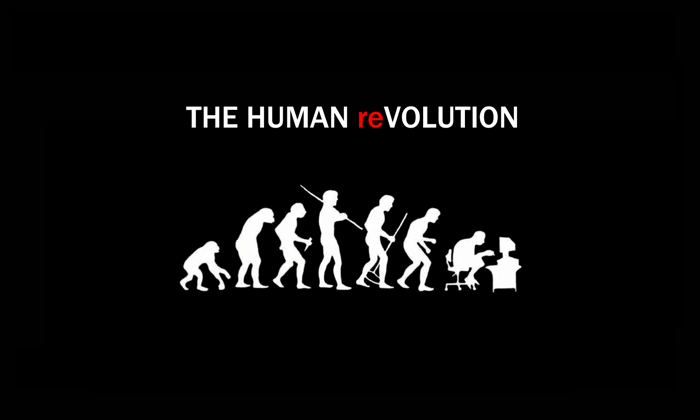
Doesn't the ability of traditions to evolve make them even more special than their oddity or exoticism in their original forms? Just like the evolution of humans, cultural beliefs and customs evolve and twist and turn, and future generations will look back on it all and probably wonder what the big deal is to everybody now. Globalization at its finest, incorporates and appreciates all cultures. The humans working for international trade and investment companies are hopefully taking that to heart.

Friday, December 5, 2014

Glocalization: Taking the edge off Globalization


- Do you know what they call a Quarter Pounder with cheese in France?
- They don't call it a quarter pounder with cheese?
- Hell no, they got the metric system. They don't know what the fuck a quarter pound is. They call it a royale with cheese.


The term globalization is becoming increasingly common around the world. For some it represents the future and how the world may change to become more equal, with merging cultures, ethnicities, economic systems, social justices and political ideals. For others, it is a pernicious force that poses a danger to local markets, domestic culture and unique customs. Either way, no matter what you think, it is happening.

Sometimes, foreign customs may seep into a culture naturally. When something is practical, it makes sense to follow suit. For example, using knives and forks began somewhere and spread throughout the Western world and eventually spread overseas and across distant continents. Actually it is thought that forks were developed in ancient Egypt and knives were a product of France, yet this perfect couple met somewhere along the lines of history and we take their practical use for granted.

On the other hand, global trends may barge in on a culture regardless of their ultimate use. Think of the McDonalds and Starbucks around the world. We see them everywhere whether we want to or not. Franchises are not always welcome and small Italian city showed this when locals opted to continue eating local goods back in 2002. After opening in 2001, the McDonalds restaurant in Altamura shut its doors in only 2002 (1).  In light of the various attitudes regarding embracing globalization or protecting traditional heritage, there is one thing that helps bridge that divide: ‘glocalization.’

Glocalization is, as the name suggests, the mix of both globalization and localization. This process involves localizing a foreign ‘product’ to keep local elements intact. Glocalization takes the edge off the product and makes it more palatable for native mouths, eyes, ears and minds. The most common place we see this is in food. Let’s go back to McDonalds and Starbucks, two experts in glocalization. South Korea is home to the Bulgogi Burger, the Kimchi Burger and the Shanghai Spicy Chicken Burger (2). In Thailand, Ronald McDonald is seen bowing down to local customers, as is local custom (3). Going one step further, McDonalds in France got rid of poor Ronald and replaced him with Asterix, the well-known French kids cartoon character (4).

[caption id="" align="aligncenter" width="500" class=" "] Glocal goodies await inside![/caption]

Similarly, Starbucks is another fox when it comes to entering foreign farms. Living in Korea, I have noticed that Insadong in Seoul is a major tourist zone, bustling with traditional arts, crafts and food. When Starbucks tried to set up shop here, local residents and store keepers were greatly annoyed, as referenced in this. In order to succeed, the store name Starbucks has been written in the Korean script hangeul. The interior also matches the local mood, with Korean rice cakes (deok) and lemon teas on sale inside.

On its latest expedition, Starbucks also made a foray into the Muslim world but angered locals in Saudi Arabia with its smiling mermaid logo. As local residents have strict views on the role and place of women in soceity, the logo has now been edited with the mermaid removed (5).

Starbucks has even managed to set up a store right in the Forbidden City, Beijing, China. Starbucks attempted to adjust smoothly by making things appear somewhat local, however this particular example shows how glocalization doesn't always succeed; Starbucks eventually shut up shop after intense protests from Chinese locals.

[caption id="" align="aligncenter" width="420" class=" "] Fobidden City. Forbidden Cafe? Nope[/caption]

 

Glocalization is not only limited to food. In the music world, South Korea, which for me is majorly over-globalized, is another expert at localizing foreign products. The success of Korean pop, or K-pop as it is better known, has spread to other Asian nations like Vietnam, China and Taiwan. The spread of K-pop brings economic and cultural advantages for South Korea but undermines local talent elsewhere.  In fact, due to K-pop, which is supposedly Korean, is being limited in China as it is bringing in Western fashion styles, music and consumerism with it. However, clever marketers in Korea saw a perfect chance to seize upon; EXO - the Chinese/Korean boy group (6).

Moving onto the film world, Hollywood also smartly conceals localized content in its films to boost worldwide sales. For example, it may be hire a Korean actor in a Hollywood blockbuster to shore up sales in Asia. The actor may not be the best for the position, but it will guarantee big cinema attendances in Korea (7).

Even if you have watched the same movie, drunk the same cup of Starbucks’ coffee or had the same Mcburger in two countries, perhaps you could see that not every aspect of your experience was identical in both. Glocalization may seem like something sneaky that is used to make more money, and yes it may be. But like the knife and the fork, new things can be practical for us and we need to embrace them. As globalization increases, I think we should enjoy watching how a product or service adapts to local needs.

Saturday, November 15, 2014

If I Were an Outsider, What Would I Say About Mass Media?

[caption id="attachment_3207" align="aligncenter" width="450"]What's so much better about the flat black dog than me? What's so much better about the flat black dog than me?[/caption]

If I were an outsider to our "modern" and "connected" society---perhaps someone hailing from a community where mass media and the quick distribution of information never existed---what would I think about our increasing submersion in online virtual realities? I’m sure I wouldn't be worried about the world’s richest R&B couple, that enormous pet rabbit over in Scotland, or even the latest mid-term elections in North America. Without mass media in my life, I wouldn't be constantly surrounded by flashy images in digital or print which tend to provide false ideas of how a person should be living. I can only imagine that if I were indeed a person who lived in a community where the use of mass media and easy information dissemination never existed, I would think more often of the others around me; I would work more on myself and my faith; I imagine that I would feel a lot more at peace.

If I were to be alive one thousand years from now, what would I contemplate about mass media and its long term effects? I’m sure I wouldn't care about the countless millions of "Selfies" taken daily; I’d hardly be able to read through the billions of blogs and websites to find an exact answer to a question. Despite my hypothetically cynical and senile sour take on it, could the exploration and distribution of mass media someday become a custom and folk tradition during those years from 2014 to 3014? Or would I be stuck naively believing, “Hundreds of years ago, everyone and her Mom would, after suppertime, forgo conversation and community to go into separate bedrooms to hunch over computers and watch videos of others and even themselves.”? I fear that a thousand years from now, if I were to be alive, I’d be looking back on all of the isolation that humans endured while putting mass media first.

The reasons I might feel bitter: There are times I find the information age distracting, annoying, and even at times downright exhausting. It seems at times that everyone who advertises online, through print, and on billboard, is in constant competition, all attempting to become famous in one way or another. I also wonder why everyone has become self-involved to the point of missing out on real-life human connections. People spend significant time sharing their personal stories and opinions about their family, their pets, their friends, and their ideas by using their photos, their blogs, their voices. It seems tiresome and tremendously difficult to live up not only to the ideal physical, emotional, and mental but now even digital way of living in a modern pop-culture world. For one to become not just a great family man/woman, boss, and weekend gardener but now also e-mailer, media blogger, political idea-generator, and assiduous liker of friends' gym photos all at the same time seems much too exhausting. Wouldn't life be more simplistic and meaningful if we had only each other?

[caption id="attachment_3205" align="aligncenter" width="400"]Maybe Keanu has a point. Maybe Keanu has a point.[/caption]

That is all, of course, if I were an outsider or living a thousand years from now. But I’m not an outsider to mass media in the least, and I definitely don’t know what life looks like in 3014. Alongside everyone I personally know, we are all a living, breathing culprit of the world's mass media crime. I read articles and view videos online. I post articles and videos online. I distribute teachings and facts that I've learned. I distribute personal feelings and ideas. I distribute some things to the outside world, hoping that in some way it can reach another person in an academic way. I can’t waste time hating mass media; I choose to embrace it in a balanced manner.

So, I ask myself again: What if I was an outsider or future historian---but one who could find a beautiful thing or two about mass media and its effects on pop-culture? What if I found that while it distributes many forms of information to regions all over the world, it continues to create space and inspirations for new ideas, opinions, attitudes, beliefs, and even a few psychological needs? Mass media is provided electronically and digitally, through print and big, crafted signs. It may even be provided vocally with the art of public speaking. In the modern worlds that thrive on pop culture, all forms of information are accepted and discussed. The people working within mass media provide wonderful sources of information by either addressing problematic issues or brainstorming multiple solutions. There is an ever-growing platform for creative expression. Mass media may cause isolation for some, but it also brings people from all over the world together---a sense of "interconnectedness." Maybe mass media isn't so bad after all.

Some communities that choose to stray from mass media are happy in their own version of what life should look like. In fact, many individuals who have been surrounded by mass media all of their lives take to the mountains with rucksacks, creating a new version of what life should be. Mass media and the ever growing distribution of information are not for everyone. But I have to be grateful for all that it has done for me, and everyone I know. Perhaps I won’t win a YouTube nomination for Best Music Video, and perhaps in the end, we will all become egotistical, isolated, human beings---but what an interesting change in sociology we've made so far.

Saturday, November 8, 2014

What Good Is Cultural Diversity, Anyway?

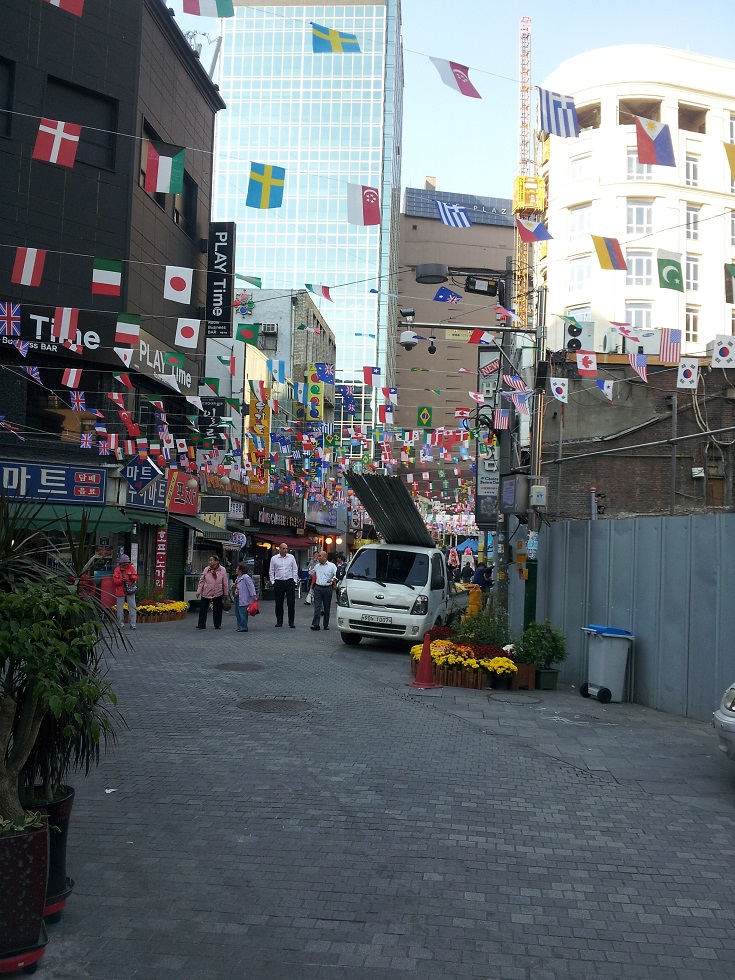
[caption id="attachment_3187" align="aligncenter" width="375"]Why should we have all these flags when just one would suffice? Why should we have all these flags when just one would suffice?[/caption]

The human race now possesses the ability to share ideas among a more culturally diverse range of people than has ever been possible in the entire history of our species, thanks to the Internet. Pretty big, right? Well, maybe not. As I argued in last week's post, the numbers suggest that we're not actually putting the theoretical globalizing power of the Internet into practice, in that we still tend to organize our online communities around shared geographic and cultural identities.

But is this really a problem? We're already inundated in information, and the brain can only process so much. What does it matter if those data come from sources within or beyond our so-called cultural groups? In short, what's so great about diversity anyway?

Well, why don’t we ask the first single-celled organisms that figured out how to exchange genetic material with their neighbors--or, better yet, the antibiotics slowly being rendered obsolete by their promiscuous, rapidly evolving descendants--about how important diversity in possible reactions to the environment is for the fitness of an organism in our ever-changing world. And let’s accept for just a moment Richard Dawkin’s model that certain tenets of culture, like the genes carried by living things, might be represented as “memes” that spread throughout a population with differing levels of fitness and virility [1]. Given the experiences of our unicellular friends, wouldn’t it be the case that the ability to draw material from a variety of diverse sources, like a conjugating protist or transducing bacteria, is beneficial for the fitness of an idea or, by extension, the society that absorbs it? A forest of Dutch Elms might have a certain charm that a forest of mixed maples, beeches, pines, and elms doesn’t have, but when that epidemic of Dutch Elm disease hits sooner or later, I know which one I’d rather build my log cabin in.

Okay, fine. Maybe diversity and sharing are fine for the world of high-school biology case studies, but we’re neither single-celled organisms nor plants. Except that an examination of several societies throughout history supports the theory that those who thrive are those who borrow, so all hail the supersymmetric tree of life. For example, the Tang dynasty is often recognized as the heyday of the nation we currently call China. From 618 to 907 A.D., the Tang boasted the most populous city in the world at its capital Chang’an, the invention of gunpowder and woodblock printing, and several dozen drunk poets good for a few exam questions in college Chinese literature classes. Interestingly, the Tang also saw the rise of the Indian religious philosophy Buddhism and consequent migration of monks from south and central Asia into China, intermarriage between Chinese nobles and nomadic peoples of the western steppes, and the increased tolerance of outside cultures that ensued [2]. Coincidence? Perhaps, of course; correlation absolutely does not equal causation. But, also, perhaps not. (This is sort of why I prefer lab science to history.)

The evolution of Japanese-Korean relations up through the sixteenth century also stands as testament to the upper hand afforded by cultural borrowing. For much of history, Korea occupied a privileged position as the transmitter of borrowed Chinese culture to Japan: Chinese characters, Buddhism, and even Japanese history texts flowed through the peninsula from the mainland, and, by some accounts, Korea maintained a largely amicable relationship with the islands [3]. But, as the anecdote goes, from the time that the Japanese emperor Tokitaka saw a Portuguese adventurer on board a Chinese trade ship shoot a duck with his arquebus one day in 1543, “the gun enters Japanese history.” [4] And Korean history as well, for not fifty years later, an army of Japanese entered the country as not quite polite robed scholars kowtowing to the intellectual might of the Chinese-supported Korean academic establishment but as well-armed conquerors eager to play with their new assimilated toys. With about 40,000 matchlock-carrying soldiers among their initial force of 160,000, the Japanese invaders made short work of the Koreans in the beginning, despite the latter’s own light artillery technology, itself borrowed from the Chinese. For all its technological handicap, however, Korea did eventually win the war against Japan---once it opened its doors to Chinese military allies [5].

[caption id="attachment_3188" align="aligncenter" width="945"]This real estate company is using the presence of American soldiers as a selling point for their apartment complex. Should potential buyers be running instead? This Korean real estate company is using the presence of American soldiers as a selling point for an apartment complex in Seoul. Should potential buyers be running instead?[/caption]

And what, exactly, was so great about Peter the Great? He turned Russia from a backwater of greasy-bearded bear hunters into a world power in the mid-eighteenth century. How? Maybe his affinity for borrowed culture played a role. By multiple accounts, Peter looked to Europe as a social and aesthetic model for his own nation. He modeled elements of his new capital St. Petersburg after the canal systems of Amsterdam and the gardens of England [6], required court nobles shave their beards after the French style and adopt French dress, and decreed that henceforth women as well as men were to participate in courtly entertainments---as long as they were dressed after the English or Dutch fashion. [7]. In doing so, he was hoping to emulate the successes of a region whose accomplishments in technology, politics, and culture he admired. And, judging from his hard-won military victories against Sweden that earned Russia some new territory and himself the title of “Emperor of all Russia,” his eponymous capital city, and, of course, a place in history as “Peter the Great,” he clearly succeeded at emulating someone’s success [8].

So natural as well as anthropological history offers examples of successful biological and societal organisms characterized by readiness for outside exchange. But what about societies with closed ideologies---those stuck in an evolutionary rut, if you will? Well, the modern world offers, among others, the convenient example of North Korea, a communist dictatorship with high-level political, social, and economic barriers shuttering in a society into which even the Internet has very limited penetration. Its biggest exports these days seem to be angry nativist rhetoric, failed missile launches, and hungry defectors. Not quite the steps a nation might take toward a glorious historical legacy.

Cultural borrowing does not just confer benefits upon the borrowers but upon everyone with the capacity to enjoy the results. Those who borrow are able to take advantage of their superior vantage point as an outsider to cherry-pick and develop the best aspects of a certain cultural phenomenon, thus improving upon the original; as the Chinese proverb goes, 旁观者清 (outside observers see the most clearly). For example, African slaves and their descendants in America borrowed from the tradition of European-American Christian hymns to develop their own brand of spirituals, which we know today as black gospel music. Anyone who compares the version of “Holy, Holy, Holy” by the Black Soul Gospel Choir (the members of which, I might add, hail from a diversity of backgrounds, further legitimizing “black gospel” as a musical form distinct from the original tradition from which it borrowed) [9] with the more purist Catholic version [10] might come to the conclusion that the borrowed meme distilled the celebratory spirit of the music while leaving behind much of the more, um, soporific aspects. The borrowed culture caught on a lot more strongly than the original, forming the basis for musical genres that may not have developed otherwise---blues, jazz, and eventually rock. I’m not arguing that the Beatles wouldn’t have existed had African-American slaves not borrowed from and improved upon church music---oh, wait; yes, I am.

Not only should we be paying attention to ideas worth borrowing from each other, maybe we should also be paying more attention to those already borrowed. Perhaps it is the case that elements of borrowed culture successful enough to spread throughout a new host society are inherently more fit--that is, useful or enjoyable--than equivalently popular elements of local culture. Assuming that a significant proportion of humans might be inherently averse to new ideas and art forms simply for their novelty, the mere foreignness of a foreign idea filters it through an extra selection pressure before it can enter another locale. In other words, you can’t hope to swim through the sea of Beyonce and Justin Bieber unless you tickle the synapses Gangnam-style. This, of course, is based on a loose assumption, since one could also argue that humans tend to crave novelty more than they fear it. Research citations, anyone?

But enough of the same; let's follow my own argument and get some more perspectives into this mix. Dear readers, what do you think? Does cultural diversity in and of itself confer special advantages on a society, or is the idea that cultural diversity promotes cultural resilience just biased hooey from a bunch of starry-eyed hippies in the liberal media?


Thursday, October 30, 2014

Afraid of Your Smartphone? You're in Good Company

Today, it is almost strange to see someone without a smartphone in hand, uncomfortable to be in a place where there is no WiFi, and unnerving to imagine a day without Google. Humans worldwide have become so dependent on the Internet that some don’t know what to do with themselves if they are not online. It's how they get their everyday jobs done; how they learn, read, figure things out; how they connect with others in their daily lives. But while there are billions of people who heavily rely on the Internet as a main resource for jobs, daily tasks, and communication, there are hundreds of sub-cultures that do not wish to connect with others online. This article will explore some of those sub-cultures and the possible reasons that technology may not feature in their everyday lives.

IDC - revolution

They Just Don't Know
For one, some people don’t use social media networks like Facebook or Twitter, use a smartphone or computer, or even use the Internet at all simply because they don’t know how. Some people just don’t have the resources to get onto the Internet; some have never even heard of it. Have you seen the movie Avatar? Pre-industrial societies like the Navi do indeed exist in small corners of the human world, and for them, the Internet may seem like something akin to interstellar flight or cold fusion to us. But for those who have access to the Internet and or smartphones and just don’t know what they’re doing will sometimes just give up and result back to a more simpler way of dealing with social interaction, like, you know, in person.

Private People
Some people want to protect their privacy, and, let’s face it, social media networks are essentially online phone books connected to a server. Even photo-networks such as SnapChat save your ‘timed out’ photos to their server. This might freak a few people out, especially if they are trying to apply for a new job or want to hold their current position. People will protect their privacy online by using a different name or pseudonym, different pictures to represent themselves such as anime characters or pictures of trees, etc. There are also the people who choose to get rid of technology all together to protect themselves and/or family members from a previous stalking or abuse situation. However, the small font warnings about Privacy settings that come with smart phones and online social media networks don’t always attract the human eyes. It is so important to review your current privacy settings and remember to never share too much information. Example: Don’t tweet or post “I’m home alone tonight” when you’re privacy settings are set for public viewing. People get stalked this way.

The Religious and the Anarchists of Technology
People from long ago and until this day have continued to hold various religious convictions against technology. These sub-cultures find that technology will ruin a community and mankind. Modern-day transportation and gadgetry really started taking off during the Industrial Revolution. During this time, a group of British lads and ladies known as the Luddites held social stances and techno-anarchist schemes against the engineering of technology as they longed for a simpler and more pastoral life. Machines that replaced human hands and hard work left many jobless and frustrated. Those same machines were attacked and left broken in many cases by the anarchists of technology. A more calm example of people who choose religion over technology are those of The Amish cultures of today. The Amish still prefer a life more pure and precious, one without violent media and dirty rap.

IDC - Luddites

Technophobics
People are just plain scared to get involved. Really, Technophobia is a term used to express both the fear and dislike of technology. It started with the Luddites during the Industrial Revolution. The fear of technology grew even more around the world after weapons of mass destruction were created and used during World War II. It has been depicted in films like Frankenstein, Fern Gully, Skynet, The Terminator, and Demon Seed that technology is something to be scared of. Whether it is a lightning bolt that awakes a dead man, a poisonous tractor that kills forests, a half-robot half-man that kills human beings, or a computer that becomes a human – they all mean the same thing – never underestimate the power of technology. Not only in fictional films are computers, phones, machines and digital systems taking over. In reality, all of technology has taken over the world. It has replaced the gumption in humans to sit up and find a real book. It has information upon information upon lost photos and messages stored in servers and now the Cloud! Even worldwide famous band U2’s latest album became lost in a Cloud, (yes, there are multiple Clouds) and was instantly on everyone’s smartphone, for free. Do any of us really even know what the Cloud is, or how many there are? At times, I even find myself fearful of technology; what it has done to our world, the way we communicate, and a possible future online war. Technology gives me anxiety. Am I technophobic?

Anti-Time Wasters
Some people won’t use Facebook, smart phones, or the Internet at all simply because they think it’s a waste of time.  For instance, why spend your entire vacation snapping photos and uploading them to Facebook; updating Twitter about your cat and Justin Beiber; gawking at YouTube videos for two hours… the agony! Spend time enjoying REAL LIFE happening around you! I remember becoming annoyed when I’d sit down with a group of close friends to watch a movie together, and everyone was updating their statues and posts online about it. Why?! Why does it matter to Uncle Greg and Elizabeth from ninth grade what you ate today or how your dentist has bad breath? Yes, even in the exciting world of technology and the Selfie, people still really don’t care about your every day and every minute updates. Do something for someone else instead. Get offline and smell the air, pick up a leaf, paint a picture, make up a new dance. When I say ‘People’, I guess I mean ‘I’. ‘I’ don’t always believe that the Internet benefits everyone, especially when meditating on time spent well. And at the same time, if we didn’t have the Internet, it would take so much more time to personally hand write and mail your letters and notes to others. This paradigm shift (return) leads to some really interesting possibilities, and I’d love to see what other think about the communicating through the Internet, online social media networks, and smart phones: Is it more of a time-saver or a waste of time?

IDC - Gandolf

Do you think you could go a day without any online communication or updates?
How about going a day without the use of any technology at all?

Saturday, September 20, 2014

The Mean Things We Say about People from Other Countries

[caption id="attachment_2306" align="aligncenter" width="960"]Original image courtesy of FreeDigitalPhotos.net. Why can't we all just get along?[/caption]

As a foreigner to Chinese, Korean, and Japanese friends, I seem to incite conversations on international topics more often than would seem the norm in strictly native circles. And, perhaps as some perverse gesture of solidarity with the Westerner in the room, these conversations quite often turn into xenophobic venting sessions directed at East Asian neighbors. The catharses usually begin as polite self-deprecating observations on one’s own society and then morph, with varying degrees of speed and completion depending on the drinks being served that night, into stronger and more earnest insults to the reputations of nearby countries.

What strikes me most about the content of such conversations is not just that the participants have generally realized that I lived for almost three years in China and developed several friendships along the way, have a Korean boyfriend and a close relationship with his family, and have made a few Japanese friends in both Chinese and Korean language classes and am thus very likely judging their xenophobia with some critical scrutiny, but that the comments, whether they be made by Chinese people about Koreans, Japanese people about Chinese, Korean people about Japanese, or any permutation thereof, are all pretty much the same.

[caption id="attachment_2312" align="alignright" width="300"]Regardless of whether we're red, green, blue, or purple, we might just tend to insult our neighbors in similar ways. Regardless of whether we're red, green, blue, or purple, we might just tend to insult our neighbors in similar ways.[/caption]

A few close Chinese friends in Beijing once told me over lamb kebabs and beer that they considered Koreans “很吵,没有礼貌,不太聪明 (loud, rude, and unintelligent).” A few months later, I had a similarly sized group of Korean friends confiding to me over banchan and fish that Chinese tourists struck them as “시끄럽고 예의 없어 (loud and rude).”

Similarly, a Chinese friend complained to me several times that I should watch myself around Koreans, who are cold-hearted business-minded folks who will befriend you for personal gain and, once you cease to be of use to them, “只把你扔掉了 (just toss you away).” Perhaps, though, I shouldn’t heed that advice, as, according to a Korean acquaintance, Chinese people are “물질만능주의자 (exclusively materialistic).”

The hate doesn’t stop at bashing each other’s aptitudes and principles. A close Korean friend once told me that she thought that compared with Chinese and Japanese, 우리 나라 여자들은 가장 예뻐 (our country’s girls are the prettiest).” This  declaration ironically called to mind an offhand comment once made by a female Chinese friend that Chinese girls had bigger eyes and were naturally prettier than Korean and Japanese individuals.

Multiple Chinese and Korean people have also complained to me that people from the other country "always" try to seize everything important in East Asian history as their own invention. The Chinese end of this argument is humorously depicted in one of my favorite Youku videos, which alleges that a Korean professor claimed that Sun Yat-sen and Yao Ming had Korean ancestry and that Korean academics have before concluded that Confucius, Xi Shi (legendary beauty said to have lived in the 春秋 period), and Li Shizhen (Ming Dynasty doctor and polymath) had Korean blood and will soon declare that the universe itself was created by Korea.

Such xenophobic sentiments have not been limited to close friends in intimate quarters. The head of my office in Beijing once told me after some slight inebriation at a company banquet that he considered the smartest and most accomplished people in the history of the world to be Chinese, German, English, and Japanese, but “对不起,不是韩国人 (sorry, not Koreans).”

This comment was countered and perhaps topped by the Yonsei KLI Korean teacher (and my absolute favorite teacher at the program, so I take her comments in a benign context) who asked our class if we didn’t think that Korean students were “다른 나라 학생보다 더 똑똑하지않아 (just smarter than students from other countries)?”

It might be easy to think so when surrounded by fellow Koreans, but I have a feeling that some people from the other 195-odd countries around the tip of this tiny peninsula might disagree.


This post is adapted from an article originally appearing in Strolling Toward a Mountain of Tigers, the author's personal blog on life, science, and how those two words together are redundant.

Saturday, August 30, 2014

Loving Abroad #3: A Black American in Korea

[youtube http://www.youtube.com/watch?v=B3Qnrzd4Lg8]
This is my third date. In this episode, I meet an African American living in Korea. On my previous two blind dates, I had met with non-native English speakers. However, with this blind date, I was able to communicate in English, making it easier to talk with one another. There aren’t many black Americans in Korea, and there are a lot of stereotypes against them in Korean culture. Let’s take a look at some of them and see what it was like for Jaye to live in Korea as a black American.

What are some stereotypes you faced as a black American woman in Korea – socially and professionally?

Jaye: “Professionally, people at work think of me as an athlete because they automatically assume I will be good at sports because I’m black. Some parents are afraid their children might learn bad things from black teachers, but I personally haven’t experienced that. In fact, the parents of my students believe their children can learn a lot from me through my teaching methods.
Socially, people always think I’m angry all the time, and it’s mainly due to movies I think. I don’t know what movies they’re watching, but they just think I’m mad which is why they are scared of black people.
When people talk to me, they automatically go into hip hop mode. They think because I’m black, I’m into only hip hop and try to speak to me like I was from a rap video.
Not many people bother me, but they, especially the ajumas, stare a lot and even try to touch my braids or touch my skin.”

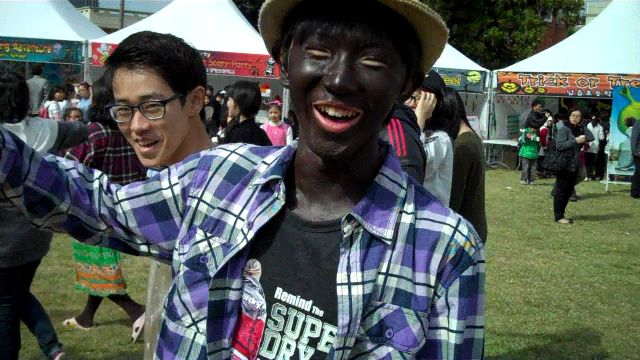
[caption id="attachment_2232" align="aligncenter" width="412"]Blackface is still common in Korea. Mainstream medias still portray blackface for entertainment. Blackface is still common in Korea. Mainstream medias still portray blackface for entertainment.[/caption]

PDA (Public Display of Affection) – How does it differ in Korea and America?

Jaye: "Korean couples are very lovey-dovey and personal. Also, they can be annoying on public transportations like the subway. I was trying to get through the door, but they were blocking the door and I just have to push through them. Sometimes on the street, they’re holding hands and just kind of creating traffic for the other pedestrians.
American couples are more carefree and they’re very playful. They’ll just flirt a lot."

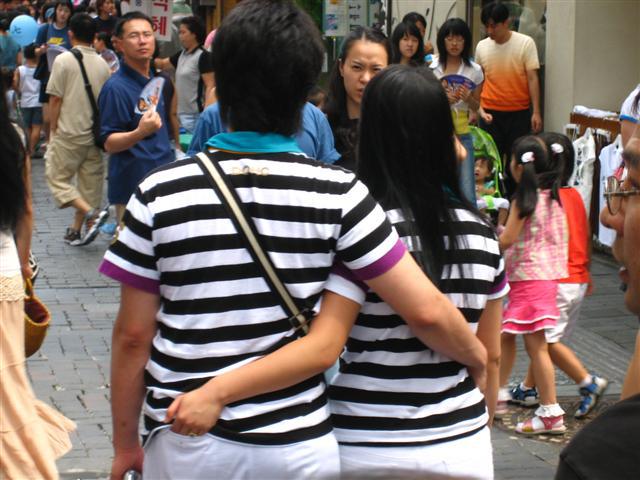
[caption id="attachment_2235" align="aligncenter" width="409"]Korean couples often wear matching shirts or sometimes entire outfits to show their affection to the entire world. Korean couples often wear matching shirts or sometimes entire outfits to show their affection to the entire world.[/caption]

What would you expect from dating a Korean guy compared to an American guy?

Jaye: "I have no expectations of dating a Korean guy. They won’t want to date a black female because of disapproval from parents and the norms in Korean society. But if they were to approach me, I expect he will try to be assertive and play out an image of being hip hop.
For American guys I would expect they would automatically expect me to accept their proposal because there are so few black people in Korea."

[caption id="attachment_2234" align="aligncenter" width="241"]G-Dragon is one of the most popular Korean male figures. G-Dragon is one of the most popular Korean male figures.[/caption]

How open would your family be to interracial marriage?

Jaye: "They would be very open to it. They are totally cool with that. They already knew that I was an open-minded person so they would really expect it. They wouldn't mind at all. Race doesn't matter at all. Even in America I would date men other than my ethnicity, and they've grown accustomed to my dating preferences."
black-woman-asian-guy

How well do you think other black Americans would adjust to life in Korea?

Jaye: "They would adjust very well. The cultures may be a little different, but black people, like Koreans, are raised to respect their elders. However, don’t expect Koreans to jump into a relationship with you. It’s easier for black males to pick up Korean women, but it’s not as easy for the black females to date a Korean guy."


[caption id="attachment_2233" align="aligncenter" width="449"]Night life in Gangnam Night life in Gangnam[/caption]


Being a foreigner in a different country can be difficult, especially if the people of that country have little knowledge of the foreigner’s cultural background.
It’s important to know the culture of the nation you’re visiting, but it’s also important for that country to be accommodating of your culture as well. Learning culture is neither unilateral nor bilateral. It is multilateral, and the more you learn, the wider your perceptions of life.
The next time you see someone foreign to your country; don’t simply rely on the rumors of others. Instead, open a line of communication and maybe you’ll learn a thing or two about a culture you have never had the chance of knowing before.

Jaye Wyn is an English teacher who has lived in Korea for four years. She enjoys not only hip hop but also Korean music. She also enjoys traveling throughout Korea in her free time.