Showing posts with label japan. Show all posts

Sunday, November 30, 2014

Animecon Japan 2014: A Canadian Perspective

anime1 anime2 anime3 anime4 anime5 anime6 anime7Ok, so I’m at an anime convention. I’ve been to these before, with varying results. Only this time, it’s in Japan (birthplace of anime), and at the mother of Japanese anime conventions - Animecon!
The first thing I notice is wall-to-wall people dressed up as anime characters. Colors, wigs, homemade foam-rubber weapons and latex body paint jump out at me in triumphant neon splendor. As I enter the showroom, booths upon booths of Japanese pop culture showcase their wares. There is just so much cool shit to look at! My brain goes into overload. I start foaming at the mouth. Cute Asian girls dressed in revealing anime cosplay surround me. I start hyperventilating and break out into convulsions on the floor. Well, no, not really. But everything except that last sentence is true blue. I’m in nerd heaven, in which I feel like a king.
I go outside to watch the cosplay competition, where costumed anime fans strike poses for triggerhappy blogging photographers…like me! I meet a few interesting people, including Waldo (finally found him!), Deadpool, and Mega Man! Afterwards, I check out the indoor stage where everyday anime fanboys (strangely, an absence of girls at this attraction) sing their hearts out to their favorite anime inspired tunes – Anime Karaoke, if you will. And, unlike karaoke in the west- which usually happens in late night pubs where would-be singers feel the need to drink down some “social lubrication” before getting up for a song…everyone in this convention crowd is hardcore into the material, going for gold on stage while the crowd engages in a collective orgasm of anime awesomeness. The crowd participation is amazing; synchronized fist-pumping to the music fills the airspace around the stage. It feels more like a heavy metal concert while sounding like an Astro-boy episode. Its pretty epic. I find myself just open-mouth gaping at the sight. Then there’s the two huge showrooms full of convention booths for cool anime art, comics, cartoons, music, mouse pads, iphone accessories, gimmicks and do-dads, pretty much any kind of pop culture application you can think of, they have it here sporting a Pac-man head or something. And then comes the highlight for me: the meet & greets! I suddenly find myself shaking hands with Ultraman himself, and touching his gun. (No, really! Dammit, you know what I mean. Pervert!)
Now, imagine this glorious scenario repeating over three days with thousands of Asian youths who never seem to tire. This is Animecon Japan. Pure Epic Awesomeness. Next year I’m bringing a Gundam suit.


Saturday, September 20, 2014

The Mean Things We Say about People from Other Countries

[caption id="attachment_2306" align="aligncenter" width="960"]Original image courtesy of FreeDigitalPhotos.net. Why can't we all just get along?[/caption]

As a foreigner to Chinese, Korean, and Japanese friends, I seem to incite conversations on international topics more often than would seem the norm in strictly native circles. And, perhaps as some perverse gesture of solidarity with the Westerner in the room, these conversations quite often turn into xenophobic venting sessions directed at East Asian neighbors. The catharses usually begin as polite self-deprecating observations on one’s own society and then morph, with varying degrees of speed and completion depending on the drinks being served that night, into stronger and more earnest insults to the reputations of nearby countries.

What strikes me most about the content of such conversations is not just that the participants have generally realized that I lived for almost three years in China and developed several friendships along the way, have a Korean boyfriend and a close relationship with his family, and have made a few Japanese friends in both Chinese and Korean language classes and am thus very likely judging their xenophobia with some critical scrutiny, but that the comments, whether they be made by Chinese people about Koreans, Japanese people about Chinese, Korean people about Japanese, or any permutation thereof, are all pretty much the same.

[caption id="attachment_2312" align="alignright" width="300"]Regardless of whether we're red, green, blue, or purple, we might just tend to insult our neighbors in similar ways. Regardless of whether we're red, green, blue, or purple, we might just tend to insult our neighbors in similar ways.[/caption]

A few close Chinese friends in Beijing once told me over lamb kebabs and beer that they considered Koreans “很吵,没有礼貌,不太聪明 (loud, rude, and unintelligent).” A few months later, I had a similarly sized group of Korean friends confiding to me over banchan and fish that Chinese tourists struck them as “시끄럽고 예의 없어 (loud and rude).”

Similarly, a Chinese friend complained to me several times that I should watch myself around Koreans, who are cold-hearted business-minded folks who will befriend you for personal gain and, once you cease to be of use to them, “只把你扔掉了 (just toss you away).” Perhaps, though, I shouldn’t heed that advice, as, according to a Korean acquaintance, Chinese people are “물질만능주의자 (exclusively materialistic).”

The hate doesn’t stop at bashing each other’s aptitudes and principles. A close Korean friend once told me that she thought that compared with Chinese and Japanese, 우리 나라 여자들은 가장 예뻐 (our country’s girls are the prettiest).” This  declaration ironically called to mind an offhand comment once made by a female Chinese friend that Chinese girls had bigger eyes and were naturally prettier than Korean and Japanese individuals.

Multiple Chinese and Korean people have also complained to me that people from the other country "always" try to seize everything important in East Asian history as their own invention. The Chinese end of this argument is humorously depicted in one of my favorite Youku videos, which alleges that a Korean professor claimed that Sun Yat-sen and Yao Ming had Korean ancestry and that Korean academics have before concluded that Confucius, Xi Shi (legendary beauty said to have lived in the 春秋 period), and Li Shizhen (Ming Dynasty doctor and polymath) had Korean blood and will soon declare that the universe itself was created by Korea.

Such xenophobic sentiments have not been limited to close friends in intimate quarters. The head of my office in Beijing once told me after some slight inebriation at a company banquet that he considered the smartest and most accomplished people in the history of the world to be Chinese, German, English, and Japanese, but “对不起,不是韩国人 (sorry, not Koreans).”

This comment was countered and perhaps topped by the Yonsei KLI Korean teacher (and my absolute favorite teacher at the program, so I take her comments in a benign context) who asked our class if we didn’t think that Korean students were “다른 나라 학생보다 더 똑똑하지않아 (just smarter than students from other countries)?”

It might be easy to think so when surrounded by fellow Koreans, but I have a feeling that some people from the other 195-odd countries around the tip of this tiny peninsula might disagree.


This post is adapted from an article originally appearing in Strolling Toward a Mountain of Tigers, the author's personal blog on life, science, and how those two words together are redundant.

Tuesday, April 15, 2014

Drink up! (The drinking culture in Asia)

Beer, vodka, soju, sake, whiskey. Whichever your preference, alcohol is a great way to unite people. Drinking has become so widespread that there are customs and cultures based on it.

Drinking cultures vary in each country. If you’re planning to drink in Korea, China, or Japan, here are some tips to get you started on your inebriation.


China


The preferred choice of alcohol there is baijiu. Baijiu is high proof, and because drinking in China has been categorized as masculine, most men tend to drink it. Though there are times when they tend to drink beer or wine, nothing shows your masculinity like baijiu. However, it’s not always about finishing your shot of baijiu before anyone else. There’s an etiquette to drinking when you find yourself sharing drinks with business associates, be mindful of how you behave.

chinese

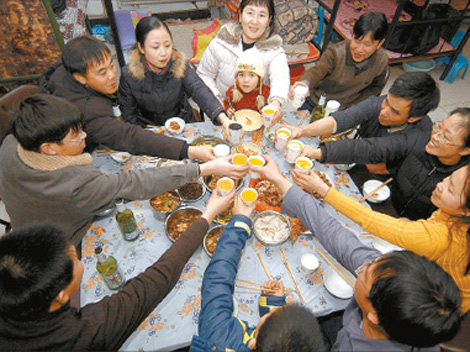
When someone toasts, it is expected of you to finish your cup, or ganbei. When people do toast, be sure to clink your glass against everyone’s. If the person you’re toasting against is your superior, be sure to bring your glass lower than theirs when you clink glasses. But beware, if you clink glasses, it means you want to go bottoms up! If you’re not sure how to work yourself into the Chinese drinking culture, just be sure to use both hands when offering, receiving, or drinking your beverage.

Japan


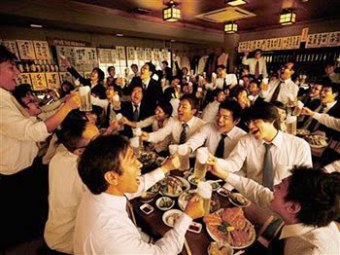
As most people may have heard, sake is popular in Japan. However, the most popular drink is actually beer. With breweries like Asahi, Kirin, and Sapporo, you’ll see restaurants, bars, and izakayas (Japanese pub) stocked and ready to serve you beer. But if you’re looking for something more traditional, most izakayas are ready to present you with sake, which can be drunk either cold or hot. It may not sound appealing, but certain sakes taste much better when served hot.

japanese-drink

If you find yourself sharing drinks with Japanese businessmen, make sure you NEVER pour your own glass. Something to keep in mind is you should always wait for other people to offer you a fill. It is custom in Japan to never leave a glass or cup empty, so if you happen to see someone in need of a refill, offer to pour. Some may refuse to show modesty, but if pressure is applied, most will accept your offer. In turn, they will insist on refilling your glass as well, so be sure to leave your glass full if you don’t plan to drink anymore.

Korea


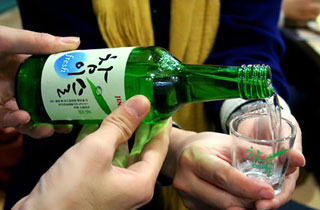
The most sought out alcoholic beverage in Korea is soju. This traditional Korean drink has sold twice more than any other spirit or liquor worldwide. In Korea, the drink is found almost anywhere – from your local convenience stores to top-notch Korean restaurants. One of the best things about soju is that it’s relatively cheap and it’ll get you buzzed (or heavily intoxicated, depending on your consumption). What’s even more popular than soju is somaek (소맥; soju mixed with beer). The golden ratio (황금 비율) of soju to beer is 3:7. Some will choose to add more or less soju, but you can’t go wrong with 3:7.

soju

Wherever you go to drink, be sure to always toast the first glass or shot and finish it, too. Depending on whom you’re dinking with, you may have to finish your glass every time your counterpart does. In corporate Korea, your superiors will want to keep pouring you drinks and it is considered disrespectful if you don’t empty your glass. Also, be sure to use both hands when either pouring or receiving drinks (especially if the counterpart is your superior).

Despite where you are, if you're out drinking, always be sure to keep the customs of the host country. Being able to blend in with that country's drinking culture will prove more fun and interactive. Just be sure to drink responsibly. Now, drink up!