Showing posts with label Spirituality. Show all posts

Sunday, December 14, 2014

French Historical Conversations: Pope Edition

Sometimes people believe that walking under a ladder is bad luck. Sometimes people think that swallowing a watermelon seed means that a watermelon will grow inside their bodies, eventually killing them. This is silly. You know what else is silly? The notion that nothing of intellectual value was occurring between the fall of the Roman Empire and the Renaissance.

While it may be true that advances in science were lacking at this time in comparison to the Renaissance, it doesn't mean that people were less creative or less intelligent than just a couple of hundreds of years prior. The Renaissance was born out of an acceptance of the self as a powerful being, capable of accomplishing large tasks. It has been said (by my tour guide in Florence) that before the Renaissance, instead of making great things happen, people simply prayed and hoped that God would make great things happen. It would be much easier that way, wouldn't it?

With this in mind, we understand that the people of the Medieval Period were somewhat more hesitant to undertake grand construction projects and were very dependent on God. Much of Europe in the 11th century, through which we will take an historic adventure today (aren't you lucky!), considered itself one great land area under the name of Christendom. In Christendom, spiritual needs were addressed by one branch of power, called the sacerdotium. Secular needs were addressed by a different branch of power, called the imperium. It was very important for the imperium's actions to be supported and recognized by the sacerdotium, given the importance of God in the medieval conscience. This division of power and responsibility was intended to meet all of the needs of the people. Therefore, it also meant that clashes between the two branches were about as pleasant as walking in on your parents giving each other a sponge bath. 

Now that I have provided you with this enlightening information about medieval society, you are prepared to enter proudly into the life of one of the most interesting characters in human history: William the Conqueror.

In 1066, William, the Duke of Normandy, waltzed himself across the English Channel and claimed the throne of England. He was a bit like the honey badger; he saw what he wanted and he took it. Way before William became William the Conqueror, however, he was known as William the Bastard. 

This can be a difficult title to carry around when one intends to rule a large territory. Just imagine poor William attempting to go about his business in any normal fashion:

"You there! Hello, I'd like for you to make a longsword with a snake on the pommel, please."

"Yes sir, Mister Bastard, sir!"

How embarrassing! 

Poor William was saddled with this unfortunate title because he had been born to a powerful father and his mistress, who was not an important character in Norman society. We know so little about her that historians continue to argue about the simplest details concerning her. Historians are very good at arguing with each other. This is why I recommend never inviting more than one historian to a party.

[caption id="attachment_3368" align="aligncenter" width="598"]brother-yelling-at-sister Historians.[/caption]


Anyway, William's mommy and daddy were not married; this meant that William was illegitimate. Despite this, he was given power over the lands his father held, but not without a great deal of anarchy that he was forced to work diligently to contain. Being illegitimate at this time was probably one of the worst things a person could be; William's very existence was like a slap in the face of God. People who had been loyal to his father were loathe to grant fealty to someone like William. It was worse than cooties.

William was greatly concerned with retaining power over his lands, but he also wanted to bag a sweet chick. It was because of this that he became absolutely enamored with a sweet mademoiselle who was called Mathilda. Mathilda was remarkable for a number of reasons, one of these being that she came from the territory of Flanders.

[caption id="attachment_3332" align="alignnone" width="1322"]Matilda_of_Flanders I wonder if he called her "cupcake."[/caption]

At a time when William was working fastidiously against efforts to usurp him, he decided to marry the aforementioned cutie pie. This posed a problem because William's contenders feared that they would be unable to remove him from power if he was also given control of Flanders. So, they concentrated their efforts against him. It was also problematic because William and Mathilda were cousins.

Understandably, opponents of William seized upon this unfortunate fact in a manner akin to an untrained mongrel devouring an unattended cut of beef. William's intention to marry darling Mathilda was so unnerving that even some of his supporters threw their hands up in the air and declared, " No way, dude!" (Probably).

According to the social norms of the time, cousin-marrying was pretty bad. It was an affront to God Himself.

William really, really like-liked Mathilda, though. So, he asked the pope to sanction their marriage.

If the sacerdotium was cool with it, the people of the court should be cool with it, too

Their conversation probably went like this:

"Oh, hey Pope! What's up, dude?"
"Oh, you know,  just chillin' and kickin' it in the Vatican. It's hot as hell, though. Heh heh. Get it?"
"Ah, yeah. That sucks, dude. Listen, Pope- have you heard about my new girlfri-"
"Yeah, dude. WTF. You gotta stop that, man. It's like, gross."
"Aw, but Pope! She's so so cute!"


[caption id="attachment_3333" align="alignnone" width="1109"]Charlemagne and the Pope This is Charlemagne and Pope Adrian I, but we can imagine it all went down like this.[/caption]

And then, William went ahead and married her anyway- even though the pope said it wasn't cool. We know from historical evidence that William later asked the pope to make a declaration that his marriage wasn't an absolute travesty and a sin breaking the laws of nature. The conversation probably went like this:

"WTH, man?! WTF. I told you that was super icky. I don't even wanna be your friend anymore."
"But, Popey! I couldn't help myself!"
"Sick, dude."
"Listen, what can I do to make you let this go?"
"...um..."
"Please, Pope!"


"Alright, I want you to build me some abbeys. I want one for men, and one for women, and hopefully their work with each gender will prevent this kind of atrocity from recurring."
"Okay, you got it!"
"But wait! I want them to be, like, super awesome. I'm not kidding around, dude. I want towers and spires, and stonework, expertly carved."


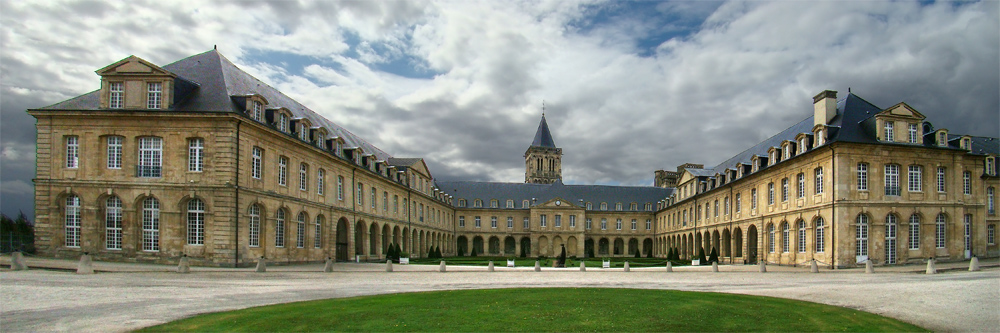
So, William commissioned the construction of two individual, distinct structures which were aesthetically pleasing and innovative. 

[caption id="attachment_3334" align="alignnone" width="1204"]Normandie_Calvados_Caen1_tango7174 Women's Abbey[/caption]

[caption id="attachment_3335" align="alignnone" width="1200"]Caen,_Abbaye_aux_Hommes_02 Men's Abbey[/caption]

If you'd like to visit these enduring tributes to forbidden love and papal indulgence, you can find information about visiting hours here. 

Saturday, December 6, 2014

Does Religion Equal Spirituality?

[caption id="" align="aligncenter" width="633"] Can we find a sense of spirituality from our own experiences or do we need to rely on the words of others?[/caption]


Does Religion Equal Spirituality?

I want to ask what it means to be spiritual in today's world. Are being religious and being spiritual the same thing? Is spirituality something that can only be found and practiced within man-made walls? If it is, then what is there for those who don’t tend to follow these traditional routes to spirituality? Religions like Christianity and Islam have been around for thousands of years. They have influenced the world and their followers greatly. However, is there only a choice between finding spirituality in religion and having none at all?

I, for one, don’t think that the choice is necessarily this black and white. It shouldn't be. I believe that it is indeed possible to feel a sense of spirituality without being part of a formal institution. As someone who participated in one of these establishments every week for nearly 20 years, I can say that I never felt close to feeling spiritual when sat between those walls. Perhaps I just need to explore another religion as is becoming the trend nowadays.

According to a survey conducted by Pew Research in 2007, "More than one-quarter of American adults (28%) have left the faith in which they were raised in favor of another religion - or no religion at all." What motivations are standing behind such a statistic? Of course those major organizations can give wonderful guidelines for communities to live by, but they also provide numerous rules to abide by. These rules often restrict the soul, not set it free.


Spirituality in the Twenty-First Century

Shakespeare's Hamlet has been famously credited for coining the phrase “nothing is neither good nor bad, but thinking makes it so.” For a lot of people, being part of a structured, organized religion is the key to spirituality. However, look at the world and how much it has changed – the way we eat, drink, learn, play, party, travel, and communicate – the list is endless of what has been altered over time. So why do we continue to follow methods that were created so long ago? Young people nowadays are leaving traditional religions and are searching for new means to develop their inner selves. Besides, there is no clear definition of spirituality. No one can say one way is either correct or incorrect. For some it may sound oxymoronic to say ‘Yeah, I'm spiritual, but I'm not religious.” People should be entitled to feel how they want, and I’d even encourage people to find some sense of spirituality within themselves, no matter how small it may seem to be. Too many people these days are trapped behind desks, phone screens and computers and need to get out and experience the world to find that unique sense of being.


[caption id="" align="aligncenter" width="329"] Do we need to pray to unearthly gods or do 'the answers' lie elsewhere?[/caption]

What Is Being Spiritual?

Why do we even need spirituality? Is the world just blood, bone, rock, plant and physical matter? No one can say for sure, not yet anyway. Nobody probably ever will. I’d like to think that there is something else, something mystical, incorporeal on our universe. It is that ‘x-factor’ that makes our lives more enjoyable and worthwhile. It can’t be just about money and material goods, can it? This is where the word ‘spirit’ comes to mind. It is where we learn if there is a deeper meaning to life. Everyone has a spirit. Perhaps they don’t call it a spirit, but rather ‘soul’ or ‘energy’ or ‘character.’

Since arriving in Korea, I was initially surprised to learn how Christian the society here is, especially as I don't tend to associate Asia with Christianity. I've worked closely with many clever and kind people who get up every day to attend early services and spend their weekends dedicating all their free time to cooking, cleaning and decorating churches. Perhaps these people are in touch with their spirits but on the face of things, they were also constantly exhausted and often fell ill due to a lack of a healthy diet (fasting) and  a lack of sleep. Surely a healthy body is part of having a healthy mind and maybe even a healthy soul.


Where Can We Find Spirituality?

If spirituality isn’t relegated to churches, temples and mosques, then where is it hiding? Of course, for some, it remains in these places. But a concrete answer to spirituality will never really be found: One man's trash is another man's treasure.

For me, our spirit is harnessed through our experiences – the places we go, the people we meet, the cultures we encounter, our interaction with nature, even the books and music we consume can shape our personalities, our way of thinking and ultimately, our souls. This variety of factors opens our senses, broadens our thinking and can make us better people, if we are willing to learn from them. On a personal note, though it may sound ‘hippyish’, I think I have gained an immeasurable amount from travelling. Of course, travelling is not a religion, but its impact on an individual cannot be underestimated. I don’t envy those who have travelled so much more than me but instead wish to follow their lead. There is so much to be learned from meeting others and seeing what makes them tick in life.

I’d like to encourage those who lack a sense of spirit to get out and search for it. Though I can’t say what it looks like or where it will be, the truth is out there.

(Featured image credits.)

Friday, December 5, 2014

Awaken Your Spirituality

What does spirituality look like?

Happy

Calm

Peaceful

Strength

Courage


Soulful

Confident

Clean Slate

Prayer

Gentle


Quiet

Relaxed

Bliss

Serenity

Therapeutic


Meditative

Religion

Pure

Nirvana

Light


What is its purpose?

There are many differing views on what spirituality is, what it means, and what it can do. A simple and hopefully universal way to put it: Spirituality is the development of personal growth and transformation through various processes. Including but are not limited to meditation, prayer, sorcery and witchcraft, the use of hallucinogenic drugs, and even depression and moments of crisis.  I have found that whenever things don’t feel right or seem cloudy, I can sit down and use some of these processes as a way to reflect and then attract good feelings and things into my life. This article will explore a few processes that may aid an individual or group to become more spiritual.

How does one explore their spirit?

Meditate - Clear your mind, breathe, dust off your white slate, and find your higher self.

People tend to practice the art of meditation to calm and lighten their spirits. Meditation will relax you, keep you healthy, and bring you the things you want into fruition. There are so many different variations of meditation; you just have to try them all. Here are a select few:

                                Gong Meditation: What at first seemed strange turned into a beautiful and relaxing state of bliss. As the yoga-therapist rang different sounds of an actual gong, I experienced complete serenity and forgiveness just by listening and lying on my right side in a dark room.

Hypnosis: For a free trial with a licensed and well-trained hypnotist, I experienced the immense and powerful joy of walking down imaginary steps and onto a beach. The sensation was so powerful that I cried enough to soak my t-shirt. It felt like lucid dreaming; it felt real.

Tandem Reiki: Tandem Reiki is another form of Traditional Reiki where instead, two practitioners are playing with your chakras, at either end of your body. After exploring both traditional and tandem Reiki, I was able to reflect on my Experiences. I felt I had been up in the clouds of my mind and could barely come down, even when I opened my eyes. I felt pulses in parts of my body, and was told one of my chakras needed healing. I experienced visions of horizons and stars. The pleasure of being quiet and still while acquiring new awareness is inexplicable. I highly recommend t this to anyone.


Pray – Live a life of gratitude and better your attitude.

Individuals all around the world use prayer and the act of giving thanks to feel more spiritually connected in life. Prayer can change everything, as it’s a lot like the Law of Attraction. In the film, ‘The Secret’, a story is told about Gratitude Rocks. A man came across some small rocks and put one in his pocket. He decided that every time he took the rock out of his pocket or put it away, he would say ten things that he was grateful for. He showed the gratitude rock to a friend living in South Africa. A few months later, the man got an email from his friend in South Africa with a request for gratitude rocks to be sent. The South African man’s son was dying from an unknown disease and the family needed all the prayers they could get. The man was thinking to himself, “These are just any old rocks”. But he went down to the lake and picked a couple of really nice rocks. He sent prayers along with the rocks. Three months later, the South African man called his friend and said, “Thank you for sending the Gratitude Rocks. My son is healthy today. Now my family and I sell Gratitude Rocks of our own and use the money for our charity”.

Prayer brings many miracles, and it also makes you feel good. Just sending a prayer in the morning, afternoon, or night can make you feel good, even safe. You are essentially connecting with someone on a mental and spiritual level. Our thoughts and our neighbor’s thoughts can change anyone’s lives. It’s pretty awesome to experience prayer; by yourself or with a group. It can be for an individual, a group, a country; for water, resources, shelter, warmth; for serenity, peace, balance, more faith. Prayer and our thoughts can change everything!

An unexpected example: This Thanksgiving, my Dad was voted to say prayer in front of all of our family. My Dad is usually a quiet and reserved man; he’d rather hear the prayer. But because of his recent scare in a near death experience, we all wanted to hear from him. As we all held hands and listened to my father speak of how grateful he was to be alive and with the family, tears started to form across the room. There was a bright beam of imaginary light that streamed through our hands and into our bodies. Each one of us felt a part of the same spirit. We all felt thankful. We all felt God.


Try Yoga – The wonders of bending your knees enough so that you may turn into a tree.

Yoga has been around for thousands and thousands of years. Its original purpose was to transform your life, your mind, your body, and your spirit while also aiding in your physical health. In the recent decades, yoga has become very popular in the Western world. In fact, yoga practice has become so popular in the United States that it is now a “6.9 billion industry”. It has become somewhat of a workout craze… But, remember. The original practice and purpose of yoga is to transform more than just muscles and your physical health! So, instead of heading to the gymnasium-like-yoga studio, try practicing yoga alone in your room for once; become one with your spirit. If you lend your respects to Hindi history and beliefs, other spiritual transformations can take place.

So, you’re tired of doing yoga alone in your room and you want to try something new, but can’t make it to India? Try Hot Yoga. The current city I reside in is home to over 10 different yoga studios; each studio practices various yoga techniques. Because I enjoy yoga and love saunas, I started taking Hot Yoga classes. On average, these classrooms are set to 104 degrees. The heat promotes good blood circulation and helps your body to detox. The classes were always challenging and unique. One time while attending a Hot Yoga class, I experienced what could perhaps best be described as a spiritual orgasm. Seriously, though. As my head and shoulders went backward far enough to almost touch my yoga mat, I felt this extraordinary ray of sunshine jolt through my throat and sternum and out through my back. I had swallowed and ingested spiritual light! I was shocked, relaxed, could barely get enough air.  I felt as though I was being reborn, I felt as though I was finally alive… So, Hot Yoga. Try it out.


Study Sorcery and Witchcraft – Is it all really black magic?

What does spirituality look like to a sorcerer? He or she might attempt to communicate with the dead from time to time, or perhaps wish a plague against some enemies.

Papua New Guinea undergoes countless moments of violence and murders all because of the strong beliefs and paranoia revolving around sorcery and witchcraft. Many single mothers are made victims of attacks that form from anger and suspicion. If a flood or natural disaster occurs, people start pointing fingers to so-called sorcerers.

Despite these social stigmas, the danger and magic of spiritual witchcraft and sorcery is exciting. It has been prevalent in countries all over the globe. If you’re looking to tap into some spirituality, I highly suggest watching a video or two on sorcery and witchcraft, things happen, if only in your own mind.


Dream up Hallucinogenic Drugs – You don’t have to be an Amazonian Shaman to tap into the spiritual world.

Many religions have explored the consumption of various intoxicants such as hallucinogenic and psychedelic drugs, plants, and alcohol.

Even your everyday weed has some serious historical and religious uses; For example, “some historians and etymologists have claimed that cannabis was used as a religious sacrament by ancient Jews, early Christians, and Muslims of the Sufi order.”  Like we didn’t know that.

A question lingers in my head: Is it better to attend a spiritual journey with or without drugs? Drugs can, believe it or not, really mess you up. Have you ever watched ‘Intervention’? Currently, a new craze for Amazonian hallucinogenic drug DMT is killing individuals, mainly teenage males. Is it worth it? “Hmm, let me figure out my life and become one with spirit, and then… wait, I’m dying”. Was it all worth it? Will we never know from that individual how awesome his or her spiritual journey went? What about long term mental or physical effects? Spiritual effects? Can’t I reach a state of nirvana and become psychic without using drugs?

One argument suggests that in “the belief system of your mind the drug becomes the power necessary to open the door of consciousness. This perspective indirectly creates the belief that you are less powerful. The paradigm results in disempowering your self”. Despite some paranoia, I had to see the good in both spiritual transformations. I chose to listen to some pretty crazy and awesome stories from friends and acquaintances that have tried mind-altering drugs and have become one with their own or another spirit.  Friends had felt united, awakened, happy, and in tune. Still, most of the friends that I have who enjoyed drugs are still doing them to achieve higher awareness. Perhaps leaving it all to one person, particularly a Shaman, seems more ideal.

In no way am I promoting the use of drugs, but I would like to say that there is no right or wrong way to achieve spiritual bliss. As long as you are hoping to tap into a happier and more aware life, whatever way you choose, your spiritual path is your personal journey. You just have to find what works for you.


Gain a New Approach – Get lost in the woods.

Can’t seem to find truth in your current religion or anyone else’s for that matter? Then get outside and idealize what you think is truly right. Find what is right for your own spirit. A perfect and personal favorite example: Ralph Waldo Emerson and the Transcendentalists. Emerson and his friends went against what the church told them and used their soul intuition and nature to shed light on spirituality and many of his writings and beliefs are still followed today.

In fact, people all over the world are finding ways to discuss spirituality over or with religion. Sometimes spirituality and religion go hand in hand, and sometimes not in the least. Pope Francis, the new Pope of Rome, is even changing things up in Italy. His beliefs are more intuitive than material based. Originally from Argentina, Pope Francis has literally thrown out the holy chair, refused to dress like past priests,and prefers wearing silver over gold. Not every Catholic is happy about the radical changes as some believe this new pope is ruining rituals and traditions. There are atheists and people from other religious backgrounds who find this argument almost humorous. But, isn’t this all for a more spiritual awakening among people and the church? Right in the media for everyone to see and comment on, how can the new Pope handle all of this pressure? I believe his doings are awakening our spiritual beliefs and ideas. Either way, finding a new approach is never a bad idea.


Practice the Law of Attraction – not just mental pictures.

We have all of these different processes to explore and may even be struck by spontaneous enlightenment from time to time, but what do all of these spiritual endeavors have in common? I vote for the use of the Law of Attraction. I cannot help but to be completely fascinated with this study as of late. If I want to attract a good meditation into my life, if I want peace, if I want to become more spiritual, then I think about it. I meditate about it, I pray about it, I talk about it, and I practice it.


Communities and tribes from all over the world practice diverse spiritualistic and ritualistic beliefs and traditions, but they all have something in common:  the desire to transform one’s soul, reach a higher plane, and connect with all living and even non-living things.  Essentially, a spiritual person is someone who lives to grow in the light, and also share the light. Perhaps the most beautiful thing about spirituality is that it grows from within an individual; it is what they find, believe, and choose.
In the end, your spirituality is what you make it. Awaken your soul.

SMALL-nature_winter_sunrise_wallpaper-

Why Atheists celebrate Christmas

Christmas decoration

I must have been 5 or 6 years old when my best friend told me during gym class that Sinterklaas (the Dutch version of Santa Claus) didn’t exist. I didn’t want to believe it, but he kept insisting. “It’s your parents who are giving you those gifts,” he said. I kept being in denial until I got home and asked my parents about it. When they confirmed, I lost my faith in Sinterklaas. It was then and there that I stopped believing in claims of a higher power if not proven by science. In other words: I’m an atheist.

It’s difficult to know that you are the only one you can fall back on, that you’re alone in this world, without some higher power looking over your shoulder. No guardian angel, no deity, no force that’s with me; I have to do everything myself. My father knows both sides of the story: as a devoted muslim he felt comfortable that God was always watching over him, but when he abandoned his faith, so did His watchful eye. He tells me life was easier as a Muslim, because his faith in God would always help him when he would face difficulties. Now, he has to face them all by himself. My father still goes to a mosque sometimes to feel the spirituality of the place, whereas I go for the magnificent architecture, which I like to photograph. Spirituality is meaningless to me; it’s like telling myself Sinterklaas still exists when I know he does not. I have no use for it in my life.

Now that I am living in Korea, I sometimes feel out of place when spirituality is involved. However modern it may look on the outside, Korean society still has a big place for spirituality. Soothsayers and palm readers play a big role in many people’s choices in life, Buddhist temples and churches are still frequented for guidance and prayer, and multiple times a year rituals are performed to honor deceased ancestors. All this spirituality means nothing to me. I think that the soothsayers and palm readers are a bunch of frauds that make a good living off the uncertainty of people, I frequent Buddhist temples and churches only for the amazing architecture and scenery I love to photograph, and I have no need for honoring my dead ancestors because they are dead and can’t hear me anymore.

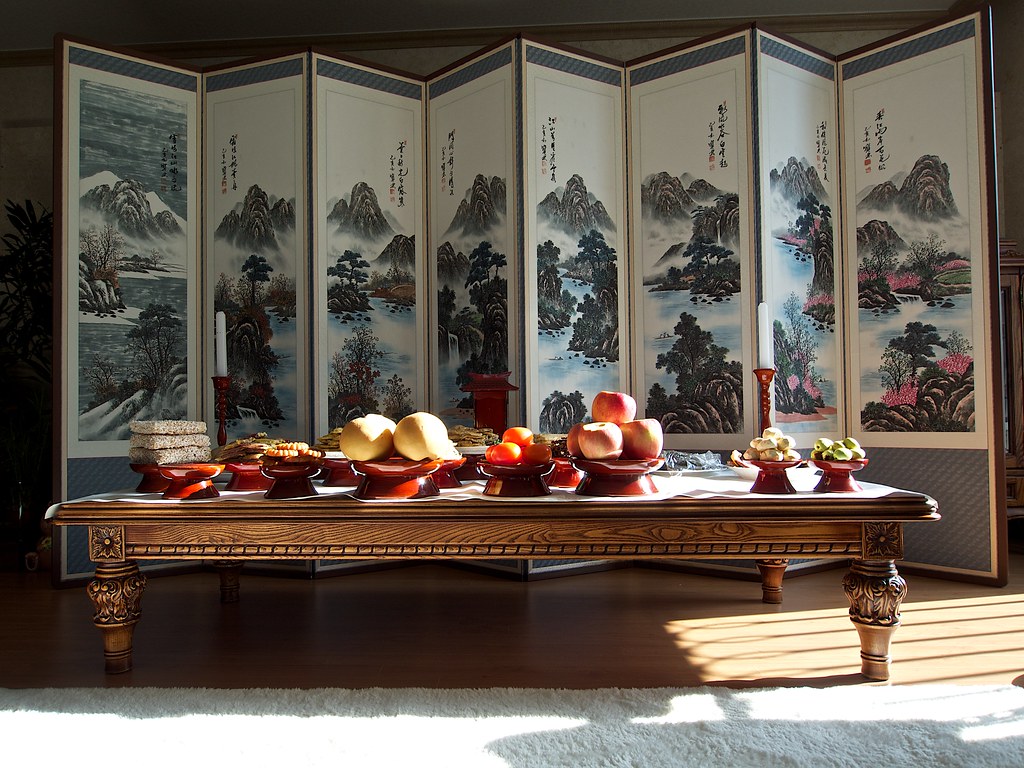
Although spirituality hasn’t any meaning to me, I can’t escape it due to my Korean wife’s family. My wife used to go to a palm reader in the early stages of our relationship. She was shocked to hear the palm reader say that we would break up a few years later, at which I got angry and told her she shouldn’t see those people anymore. The problem resolved itself. When the deadline of the prophecy passed, our relationship was stronger than ever. She hasn’t gone to one of them since. I don’t have any problems with my mother-in-law going to a Buddhist temple every week. Being an atheist doesn’t necessarily mean that you think other people should be atheists as well. Religion and spirituality is something personal that everybody should figure out for themselves. No, the most frequent exposure to spirituality is the ritual to honor the dead that I have to go through multiple times a year. There is charye (차례) on New Year’s Day and Chuseok (추석) in the Fall, and because my wife’s grandmother died a couple of weeks after Chuseok, we need to repeat the whole ceremony again on the day she died (which is called Jesa or 제사). My wife’s grandfather died on another day still so there’s another day for that too.

[caption id="" align="aligncenter" width="1024"]Chuseok Table Table set for Chuseok (photo by Emre Kanik)[/caption]

The ceremonies are almost identical (I haven’t found a difference yet, but then again, I could be wrong): It starts with preparing a lot of food and putting it on a table in a predetermined way, organized by color and/or type of food. Nobody seems to know because every time we are arguing what goes where and shifting around the food. Several times we need to refer to a printed piece of paper with the set up on it to get it right. Then my father-in-law and his brother change into their nicest suit and the ceremony begins. Well, not immediately because my father in law, who needs to lead the ceremony, always forgets what must be done. He’s studying a book with instructions and pictures intensively before we start. During the ceremony he constantly reaches for it too, because he’s not sure about the next step. While not having the need for any spirituality, I still participate in all the bowing and circling a cup of rice wine (Jeong Jong, 정종) around incense three times. There is also a period just before the final bow when we shouldn’t look at the table so the spirits of our ancestors wouldn’t be disturbed while eating the food from the table. Though I think the reason you shouldn’t look is that you won’t see that there’s actually nothing going on at all. We awkwardly wander around in the living room until my father in law says it is time to continue the ceremony.

So why participate in all this if I’m so skeptical, you might ask. The answer is the same as when we celebrated Sinterklaas during my childhood. After I stopped believing in Sinterklaas we didn’t stop celebrating it. Partly it was because of my little sister, who still very much believed, but also when she stopped believing we continued celebrating. Although it shifted to celebrating Christmas, which is even weirder to celebrate as an atheist when you think about it. I remember we would really look forward to the gifts we would receive and preferably open all at once. Now that I’m an adult and living in Korea I’m in a whole different situation. I don’t celebrate Sinterklaas nor Christmas anymore and I don’t need all the rituals and spirituality. However, when people express their gratitude when I know the proper way to bow in a funeral, or help my in-laws setting up the table and participating in the ceremony, I know I still do it for the same reason as celebrating Sinterklaas when I was just a kid. I’m still doing it for the gifts, but I’m not on the receiving end anymore and that makes it even more rewarding.

Don't get me wrong, if you believe in a god I still think you're wrong, but it's just not worth it disrupting Christmas for. Like I found my way to deal with spirituality you have found yours. People throughout history have been wrong or right on numerous issues and have solved them in any number ways, including the really ugly ones like suppression and violence, and good ones like dialogue and arguing. I like to choose for the latter rather than the former, so unless you are one of those people who advocate the former, I think we're going to do just fine.

Friday, September 12, 2014

A Little off the Top: A Brief History of Circumcision

I apologize for this in advance. I have fallen behind in my duties as an IDC writer, and I decided to let the Chief choose an article topic for me this week. He hit me with circumcision. And then he said, “Well, that was fun! Why don’t you write an article about it?”

Where God Went Wrong

In all seriousness, circumcision is a serious issue. Even today the debate rages as to its health benefits versus its hindrances. Is it better to be cut, or is it better to be the way God made you and not the way some claim God would have made you if he had paid closer attention to the blueprints? From a religious standpoint, circumcision makes no sense as it implies God made a mistake in the design. Same thing goes for holy water. What, exactly, is the priest adding to water that God forgot to include in the recipe? “Whatcha got there, God? A little water? Just hydrogen and oxygen? Nice try. How about this – Dominus Ominous! Kazam! Now THAT you can kill some vampires with!” Why do so many religions claim that God is infallible and then go ahead and correct God’s obvious oversights?

[caption id="attachment_2290" align="alignnone" width="300"]Well, hey there, little fella! Hmm... something's missing... or should be... "Well, hey there, little fella! Hmm... something's missing... or should be..."[/caption]

A Classic Whodunnit?

I am not going to get into a religious debate with you. That’s not why I am writing this. I am writing this because someone, somewhere, wants to know why that happened to his foreskin. You want to know why? We don’t really know, to be honest. Who had the idea originally? The Jews, right? See, there you go again, blaming the Jews for something they didn’t even start. No, in fact, circumcision goes back long before the Bible, back into the prehistory of human civilization. Whose brilliant idea was it to cut off a little piece of your thingy? We don’t know. All we can surmise is that the practice of circumcision started long, long ago, in East Africa, when someone decided that touching the little fella felt too good and could lead one into temptation. How would civilization ever develop if everyone sat at home touching themselves like we do today, what with the internet and all? That does explain a lot about our current situation… but back then, we had our whole lives ahead of us! Developing the wheel, and then building roads to roll it on. Stonehenge, Easter Island, the Great Pyramid of Khufu or Cheops or whoever the hell that guy was, all of it eventually unfolding into our bright modern age of airplanes and standing in security checkpoints to get on one of those airplanes. None of this could have happened without circumcision. If some random guy way back when in East Africa had not taken a sharpened stone and sliced off the feel-good skin on his wedding tackle, would we have made it this far? Or would we have all just masturbated our civilization into an early grave, scores of unsung would-be inventors dying of some rampant outbreak caused by untreated chaffing? Would we have vanished as an unsung species of blind, hairy-palmed do-nothings? One can only theorize. So let’s do that.

[caption id="attachment_2291" align="alignnone" width="300"]The usual suspects The usual suspects[/caption]

We have Opportunity, but what of Motive?

The most prominent theory is that male genital mutilation (because that is indeed what it is) began as a method of “purifying” the individual – removing the most sensitive part of the penis in order to reduce sexual pleasure. It just felt too damn good, apparently, and we were afraid that we simply lacked the self-control to be a productive civilization rather than a herd of horny hand-monkeys. The male prepuce (foreskin) is said to be the main region of erogenous sensation – the male G-spot, as it were, before we nipped it in the bud – and therefore, we could not be trusted with it.  Pleasure, we apparently decided, had no place in this world, only in the afterlife, when we had earned it by being total douchebags here on this corporeal plane.

[caption id="attachment_2261" align="alignnone" width="300"]Visual distraction: Look, puppies! Visual distraction: Look, puppies![/caption]

Circumcision, therefore, became entwined in religious ritual, a way of getting us incarnate humans to reject the pleasures of the flesh and to seek a higher spiritual calling. Look at all the great religious leaders throughout history – surely they could not have enlightened us all had they all been diddling their doodles in the bushes rather than preaching from the pulpit about why such diddling is a sin. Who was the first big leader in the Bible? Moses. Let’s look at him… I mean, really look at him. Let’s peek under that tunic and… wh – what’s this? Moses was never circumcised! And neither were his sons! (Exodus 4:25) What gives? God was even going to kill Moses for not doing the deed to bleed… that is, until Zipporah took the initiative and circumcised her son in Moses’s stead, going against her own beliefs (she found circumcision

[caption id="attachment_2292" align="alignnone" width="300"]Son, gonna need you to take one for the team here... "Son, gonna need you to take one for the team here..."[/caption]

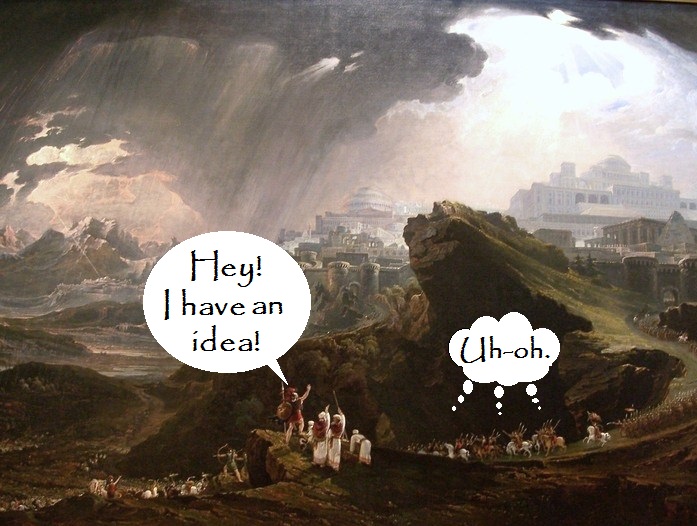
to be repulsive) and sparing Moses so that he could lead his people out of Egypt… and into the desert for 40 freakin’ years. They wandered, they got water from rocks, they ate manna, and they received the Ten Commandments. Do you know what Moses didn't do during those 40 years? Institute circumcision as a common practice for the Jews. It wasn't brought back into practice among the Chosen People until Joshua popped up as the new leader and said, “Hey, guys, I have a great idea…” (Joshua 5:2-10) As soon as all the men had sliced up their goodies, they joined Joshua’s army to invade Palestine, because as you can imagine, they were probably pretty pissed and looking to kick someone’s ass.

Who Else Wants One?

The Greeks and the Romans, however, never went in for such silliness. They abhorred circumcision as the plight of the Jews. It was a Jewish issue and of no concern to the likes of Caesar or Constantine or Socrates or Plato. Many of the Jews saw the frivolity of their self-mutilation and tried to pass themselves off as uncircumcised Greeks, until around 140 C.E. when a new procedure called peri’ah was introduced. This made circumcision even worse – it was more painful as it stripped away all of the foreskin, right down to the glands, and it was impossible to conceal. Today, in medical terms, this procedure is called a synechotomy, and brother, you do not want to be on the receiving end of this treatment. Before this, early circumcision as it was done by Abraham and his ilk only cut the very tip of the foreskin that overshot the end of the penis proper. Now they were shaving it down to the shaft, and I am sure I do not have to remind you how many super-sensitive nerve endings there are down there. They are called the Meissner corpuscles, and they do not like to be cut, scratched, or caught in your zipper, and they don’t grow back if you are circumcised. On the negative side, they take away from some of the sensations of sex. On the positive side, you don’t have to think as hard about baseball to buy yourself a few more seconds. Anyway, a synechotomy is the type of circumcision you get as the medical norm today. Just for the record, I will share more information than you would care to know: I, myself, am circumcised. I’m not Jewish (at least, I don’t think I am, and that seems like the kind of thing I would know), I guess my parents just thought it was a good idea. The trauma of just being born not being satisfactory, they figured a little slice off my new naughty bits would keep me clean and teach me an early lesson: Life hurts sometimes. Obviously, I have no memory of the procedure itself, but there it is. Look! A kitty getting tickled!

http://www.youtube.com/watch?v=urturSNMgd0

Passing as a Regular, Unclean Guy

Moving on… not all men liked the look of being circumcised, largely due to the stigma that often accompanied it, particularly for the Jewish men. Many circumcised men would go to great lengths to restore their foreskin to improve their social standing or to avoid persecution. During World War II, some circumcised men underwent surgery to restore the foreskin – even those that were not Jewish – simply to avoid trouble from a certain goose-stepping group of idiots. In ancient Rome, men would try to restore the foreskin so that they could participate in athletic events or patronize the local bath houses – both of which required them to be fully nude. To achieve this, they sometimes wore a copper weight, called a juedum pondum, which was hung from the remains of the foreskin to stretch it out again. Similar weights, such as the Foreballs, are still in use today by circumcised men who wish to restore the uncut look. So there’s that image.

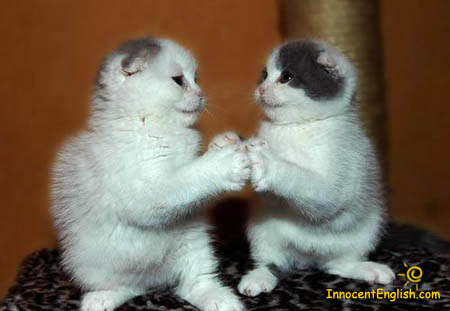
[caption id="attachment_2259" align="alignnone" width="300"]Out of consideration for our readers, the image “Stretching the Foreskin” has been replaced with this picture of kitties playing patty-cake. You’re welcome. Out of consideration for our readers, the image “Stretching the Foreskin” has been replaced with this picture of kitties playing patty-cake. You’re welcome.[/caption]

Getting back to history...

Jericho: A Cut above the Rest

Are you still reading this? Fine. So if Moses did not practice circumcision, why is it still practiced today? Let me tell you about the mass circumcision at Jericho. After wandering in the desert, where many of the fighting Jewish men had died, Joshua, the new leader, felt he needed to reinstate the covenant with God to ensure his people’s victory over the Canaanites. As noted earlier, there was no circumcision during the forty years in the wilderness. Now, at Jericho, Joshua decided it was time to set things right. He proceeded to circumcise anywhere between 300,000 and a million men, depending on whom you ask. These men were then laid up for three days to recover, the third day of recovery said to be the most miserable. The spot where this happened is known as the “Hill of Foreskins” because that’s where all of those little bits of flesh were buried. Then, after Passover and a weird little trick involving ram’s horns, they swept down on Jericho and “destroyed with the sword every living thing in it—men and women, young and old, cattle, sheep and donkeys” (Joshua 6:21). Because they were understandably very pissed off, and misguided rage can be therapeutic.

JoshuaSun_Martin

Then came the Talmudic period (500 – 625 C.E.) and the introduction of the Metzitza, the third stage of circumcision. This is the famed version of circumcision in which the mohel, or circumcision specialist, sucks the blood from the wounded baby peepee. Gross, right? Yes, it was…because it did transmit diseases to many a sliced infant, and it caused many deaths. Today, if this traditional method is followed, the mohel performs a metzitza b’peh, a practice that uses a glass tube to suck the blood, bypassing any viral transmission. This practice has, of course, come under some scrutiny. And, finally, the Reform Movement of 1843 decreed that circumcision was cruel and unnecessary. Theodor Hertzl, the founder of Zionism, refused to have his son circumcised. Good on ol’ Hertzl for breaking with tradition.

Those Christian Cut-Ups

Christians, on the other hand, were never very big on circumcision. St. Paul the Apostle even warned parents against circumcising their children, and was even quoted as advising at least one person to beware of the “circumcision group” (Titus 1:10-16). The modern practice of using Hebrew circumcision style dates to the late 19th century in both England and the U.S. South Korea adopted circumcision after WWII, during the American Trusteeship and it was common place after the Korean War. Consider that the next time you hear a conspiracy theorist saying that circumcision is proof that the U.S. is under Israeli control… even though circumcision has not caught on in other parts of the world. Most people from these circumcised cultures still claim it is done for sanitary reasons, but this is not really true. A little soap and water can cleanse a foreskin just as well as it does anything else down there. The real reason behind circumcision is still to prevent masturbation (and take it from me, one of the circumcised – it didn't work).

[caption id="attachment_2260" align="alignnone" width="300"]A squirrel drinking an itty-bitty beer! He can't do that! A squirrel drinking an itty-bitty beer! He can't do that![/caption]

I am not saying I am against circumcision. I actually am happy my parents made that odd decision and had me sliced up. It is just more aesthetically pleasing to me, mainly because of the culture I come from, I guess. That’s just me. Still, many adult men decide to have circumcisions performed simply because they do not like the reaction they get from some people when they whip out that extra bit of flesh at the bus station. They also feel it may be better to be circumcised, if only for aesthetic reasons. Most doctors advise against this, however, as it is painful and can carry such negative side-effects as psychological impacts, emotional difficulties, and – in rare cases – physical problems. Some still feel that circumcision protects against such ailments as penile cancer and STDs, but studies into these claims have been inconclusive. Conversely, some men go to great lengths to reverse the effects of a circumcision in order to restore some of the lost sexual sensation, even though this is impossible as the nerve endings can never be repaired.

It’s Almost Over!

On a final sickening note, the practice of female circumcision also exists, and it is horrible, brutal, cruel – just barbaric. And remarkably, rather than being wiped out by now, this practice is actually growing in popularity. Meanwhile, as our world culture becomes more and more homogenous, the practice of male circumcision seems to be falling out of favor. Fewer and fewer parents are choosing circumcision for their offspring in the U.S. Both the American Association of Pediatrics and the Canadian Pediatric Society have taken the position that circumcision is medically unnecessary. Since 1971, male circumcision has been on a steady decline in North America. As far as the rest of the world is concerned, the majority fashion choice is sporting the ol’ flesh turtleneck. We still need to put an end to female genital mutilation the world over. That horror must be stopped. As a male, I can say I am OK with the cut of my jib. I have yet to hear of any female who has spoken up in favor of her procedure.

If you take anything away from this troubling article and its disturbing imagery, let it be this: Girls should never have to be circumcised. Anywhere. Ever. Even boys don’t really need it. The enjoyment of sex is nothing to be met with shame or punishment. Still, we do need to reduce our numbers – that is painfully obvious. Use protection, be responsible, and have fun. The earth can provide for us all – if we can stop the corporations from hogging all the resources and making the rest of us pay for them.

Screw the corporations. Let’s circumcise them.

[caption id="attachment_2294" align="alignnone" width="204"]"Just you try it, m***erf***er!" "Just you try it, m***erf***er!"[/caption]


Wednesday, July 23, 2014

The Amber Road

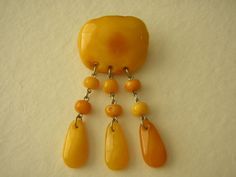
AmberMy family comes from Latvia, a beautiful Baltic country made up of various trees, rivers and lakes, and a very wide range of biodiversity. While Latvia is well known for its amazing architecture and extensive liquor making, Latvia is also often sought after its beautiful and very resourceful Amber coast.

Since I was a child, special beads, bracelets, necklaces, and other ornaments made of Amber have been passed around in and outside of the family. My elders and even young cousins still tend to ooh-and-ah over all of the various colors, shapes, sizes, textures, and even insect surprises they find in their amber pieces. Needless to say, it has always been an honor in our small Latvian-American culture to receive a new piece of Amber.

Amber essentially is translucent, fossilized tree resin which varies in color from orange, yellow, cherry, green, and in rare cases, blue. Although over 90% of amber is found in north-eastern Europe on the Baltic Coast, there is a surprising amount found in the Caribbean and Dominican Republic. In the Dominican Republic, blue and florescent amber is dwelled out from big tunnels and shipped around the world for profit. Amber can be sold in its rawest, most natural form, or it can be modified, reconstructed, and even bonded.

What makes Amber so special? Perhaps it is the way it is made. Perhaps it is the prehistoric and legendary history. For my family, it has always been the heart-warming feeling when holding onto something from ‘home’. For Latvians, Amber generates a lot of trade and tourism for the country. For others, the amber may be considered special because of its natural beauty as it is often used as jewelry, in glass blown smoking pipes, as folk medicine, and even in perfumes.

Amber is often referred to as “The Gold of the North”, as it has been used as a trading resource since before the Stone Age. Even more interesting, there are pieces of amber which contain flies and mosquitoes which date back 40-60 million years ago.  Amber has also  been found in the ancient tombs and temples of popular ancient rulers throughout Egypt, Syria, and surrounding the North Sea. This is includes ancient Egyptian Pharaoh Tutankhamen and even Apollo of Delphi. The best way to trade and ship amber in the past and today was by use of the Amber Road. The Amber Road makes up multiple routes throughout the Baltic States, the Netherlands, Switzerland, Belgium, Germany, France, and other parts of Central Europe. The Amber Road continues to bring trade and tourism to the continent, especially in the Baltic States.

Culturally, amber is the result from an Amber Palace bursting at sea in The Legend of the Sea Queen, as told by many Lithuanians. In the Baltic legend, Queen of the Sea, Jurate, lives in an Amber Palace. When her father finds that she in love with a fellow named Kastytis, he jealously destroys her palace leaving the sea and shore with pieces of her beautiful-resin made estate.

The real Amber Palace perhaps is the Palanga Amber Museum found in Lithuiana. This beautiful museum houses all forms and sorts of amber from all over the world. My family and I cannot wait to go and visit.

Tuesday, July 1, 2014

7 Things to do in Nepal when You're Dead

Flying into Kathmandu from Oman is an easy four-hour flight, so last February I picked up a bottle of Bombay Sapphire at the Muscat duty-free shop and boarded a plane. By sun-down I was in Kathmandu, and the first things that struck me were the friendliness of the people, and the absolute chaos of the traffic. While I waited for my friend to meet me, I struck up a conversation with some cab drivers, explaining that I had come to Kathmandu from Oman with hopes of enjoying a cooler climate and, since it was technically the middle of winter, maybe even seeing a little bit of snow. The cabbies informed me that it had not snowed in Kathmandu in nine years. Since my hopes of frolicking in fresh snow were dashed, I had to find other ways to occupy myself in the City of Temples. Below is a list of must-dos when visiting Kathmandu.

1. Enjoy the Night Life

One of my new cabbie friends drove us to the location of the cheap little hotel I had booked in Thamel, a part of the city known for its touristy vibe. The smaller hotels in Kathmandu are very cheap, and you can usually get a room for around $24 USD a night. As we drove through the crazy rush of oncoming headlights and the beeping horns of cars and motorbikes, I noticed that a lot of the streets were dark. I saw a lot of vendors along the side of the roads, with portable little shops set up on the backs of motorbikes, illuminated with candles. This is due to the fact that Kathmandu has daily black-outs for half of the day to conserve energy. This can be a hazard because the streets of Kathmandu are not very well maintained. There were lights at the hotels, powered by generators, and each hotel room has at least one generator-powered light, but the TV is not hooked up to a generator. Not a problem, however. After all, who comes to Kathmandu to watch TV? We made a few drinks with the Bombay Sapphire and some tonic water delivered to the room by the hotel staff, and set out to see some night life.

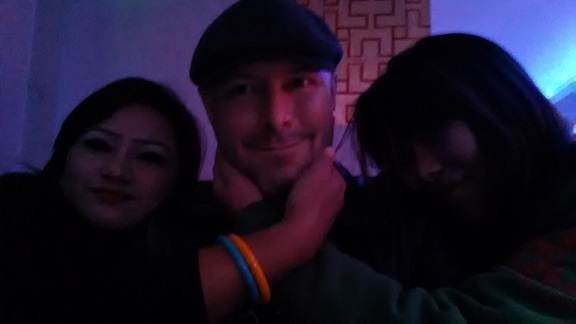
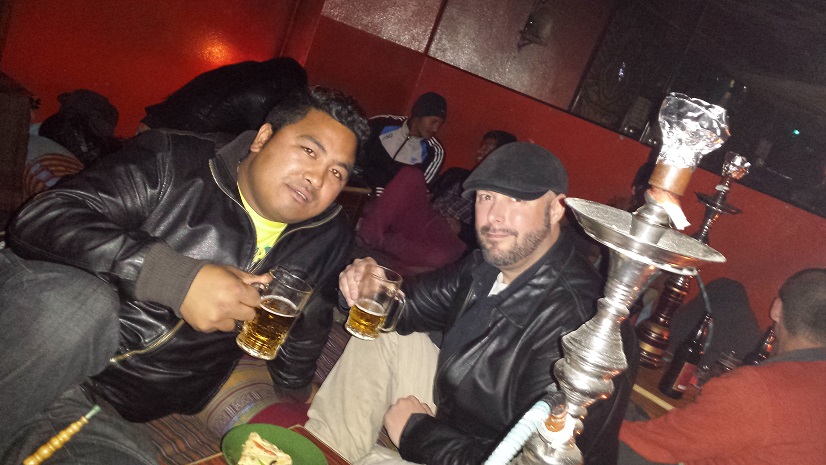
After dropping our room keys at the front desk (a good idea when travelling in unfamiliar regions with the intention of imbibing), we wandered down to some shady streets where we were beckoned into several lively-looking bars and clubs. We chose one for its colorful lights display, and were soon seated inside. Once our hosts learned that the girl I was with was neither my wife nor my girlfriend, they weren’t shy about introducing some of the local ladies to our table. We drank, took pictures, and smoked a lot of shisha before venturing out to visit a few other places. We went to a few pubs, including the Kathmandu Irish Pub. The place was dead, but we had a few drinks with the owner and his friend, and they gave us free reign over the music selections. After several tunes from The Pogues and some requested Billy Joel from our host, we decided it might be fun to see some live music. Oman has no live music scene due to a strange law that says three or more musicians cannot be onstage together at the same time because, you know, music leads to dancing and dancing leads to sex and sex leads to Hell.

[caption id="attachment_2040" align="alignnone" width="300"]Hell, I tells ya Hell, I tells ya[/caption]

Outside the Irish Bar, we walked down the confusing, winding, and dark streets as shady people shuffled by and muttered offerings of hash, weed, even mushrooms. It reminded me of the guys in the parking lots of Grateful Dead concerts who would walk quickly through the crowd muttering, “Buds! Doses!” to the Deadheads, trying to make a sale. We walked down the street until we heard live music coming from a place called Pub H20. We went in to discover a very talented little band playing in a very tiny little bar. The place was crowded with friendly expats, so we stayed to listen to a few familiar songs, then headed out to a bar that became a favorite: The Buddha Bar. This is a shisha bar hidden down a little side street with a very cool, hippy-like vibe inside. You sit at low tables on thick floor cushions and smoke shisha while the staff bring you drinks. The music was good and we got to meet a lot of the local Nepalese night owls, so I really enjoyed it. I even bought one of the Buddha Bar T-shirts.

buddhabar

Over the course of our visit, we made several friends. I have met a lot of friendly people in my travels, but none as sociable as the Nepalese. During my 12 days in Nepal, I made three new Facebook friends and still get WhatsApp messages and phone calls from two others.

2. Shopping

The next day, we headed out to do a little shopping. Nothing, not even the random offers of drugs, reminded me more of a Dead Show than the many, many shops along the maze of streets around Kathmandu. As a Deadhead, or a fan of the band The Grateful Dead, the city reminded me of one big Dead show that never stopped. Even after the band had picked up and moved on, the hippies had set up shops where their tents and VW buses had been. Hence, the reference to “Dead” in the title of this article. The parking lot had become a winding, confusing network of streets, and these streets were maintained about as well as a Deadhead might maintain them. Most places are smooth and dusty, while others are littered with rubble and loose cobblestones. You may even encounter one or two big, deep, open holes along the roadside, dug for some reason and yet not filled in, and not marked with any kind of reflective tape or warning sign, so watch out. Keep one eye on the road in front of you as the other eye soaks in the colorful shops.

shop1

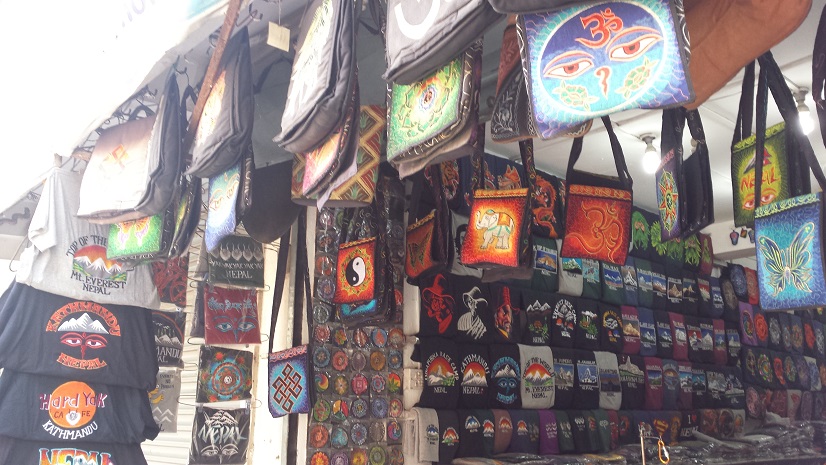
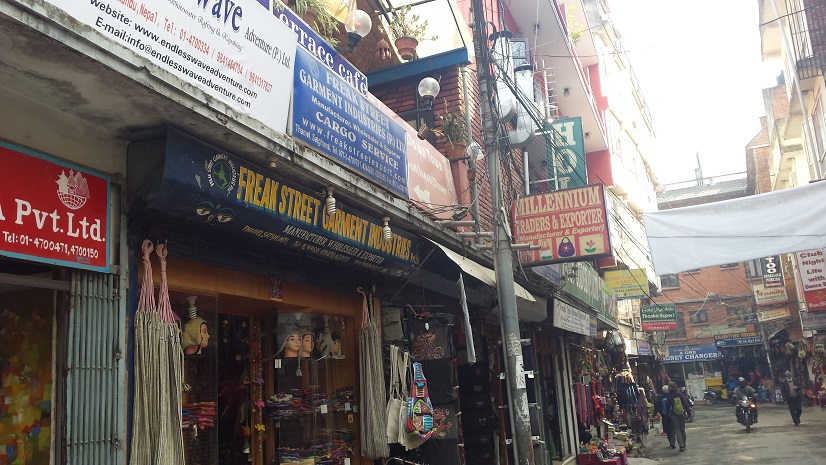
And the shops are colorful. The shops of Kathmandu are very similar to what Deadheads called “Shakedown Street” which is the vending area of the parking lot scene of a Grateful Dead concert, named for the album and song of the same name. You will see a plethora of colorful tie-dyed clothing, woven items of multicolored yarn, and a wide assortment of colorful jewelry, pipes, and posters that the hippies sold to finance their long, strange trip. In Kathmandu, Shakedown Street is known as Freak Street, and there you will see a lot of similar items, often made from hemp or yak hair, as well as tie-dyed T-shirts, colorful handbags and hats, bracelets and necklaces, hacky-sacks, and the occasional pipe or bong of colorful blown glass.

freakstreet

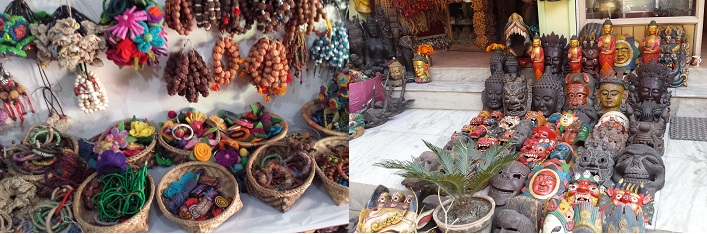
There are, of course, lots of cultural Nepalese and Tibetan items varying in price from hundreds of dollars to a few rupee. Popular gift items include singing bowls, used in Buddhist monasteries for meditation and ritual purposes (you can get the smooth machine-made ones or the traditional hand-made, and they all sound very relaxing when rung). You can also get some very beautiful and elaborate Mandalas, hand-painted by monks and students at the local monasteries. There are lots of tea shops where you can buy traditional Nepalese teas grown in the mountains of Nepal. You will also see a wide selection of statues, knickknacks, and funky power-animal hats made, again, from yak hair. You’d think it would be very itchy, but it’s really just very warm.

shops2

It is easy to get lost wandering around the streets exploring, but just when you think you can’t find your way back to your hotel, there you are. It reminded me a bit of my first Dead show when we couldn’t find our way back to a friend’s van after the concert. Positive energy… and this city is full of it, in the strangest of places if you look at it right. If you do get lost, there is no shortage of rickshaw drivers who will take you exactly where you need to go for a very small fee.

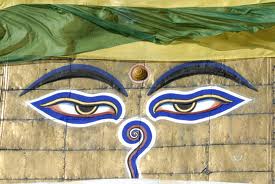
[caption id="attachment_2036" align="alignnone" width="275"]Buddha Eyes are a very common sight in Nepal. They are on everything from temples to T-shirts. Deadheads might call them 'Eyes of the World' Buddha Eyes are a very common sight in Nepal. They are on everything from temples to T-shirts. Deadheads might call them 'Eyes of the World'[/caption]


3. Safari!

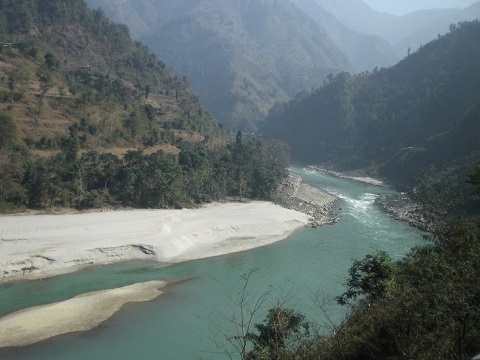
After finding gifts for my niece and nephew back in the U.S., I bid farewell to my friend and hopped a bus down to Chitwan, a little province about five hours south of Kathmandu. The bus ride offers some tremendous views as you bounce along the mountain roads along the blue Trishuli River, which provides some fantastic white-water rafting. It is very naturalistic, and it is not uncommon to see young women bathing in the many little waterfalls along the way. Again, it reminded me of the hippie version of a Utopian lifestyle.

river

After a few stops, I arrived at my destination. The driver from the Sauraha Resort picked me up at the bus stop and drove me to what would be my home for the next three days. The owner was very nice, if a little surprised that I had come on my own. He sat down with me while I had my complimentary lunch and went over my itinerary for the weekend. First, a quick tour of the wildlife reserve’s museum, then sitting on the shore of the river in deck chairs with other travelers to drink beer and watch the sun set over the park. The next day would include a river tour in a canoe, then a walking safari through the jungle to spy on whatever animals may be around. Then a trip to the elephant breeding grounds before returning to the resort for a late dinner. My final day would consist of an elephant safari (riding elephants!) before I was taken to the bus for the return journey back to Kathmandu.

The museum had photos, footprints, and skulls of some of the local fauna: Elephants, buffalo, rhinoceroses, crocodiles, tigers, and assorted birds. Poaching is very much a problem here, so there are armed guards posted around the park as well. I stood by on the paths in the woods outside as some of the tamed elephants came lumbering past. They really are beautiful animals, and the expressions on their faces tell you exactly how they are feeling at any given moment. Mostly, they are bored, it seemed, but once in a while one of them would think of something amusing and a smile would break out on her huge face. Even their eyes smiled in those moments, but those moments were rare from what I could see.

elephant1

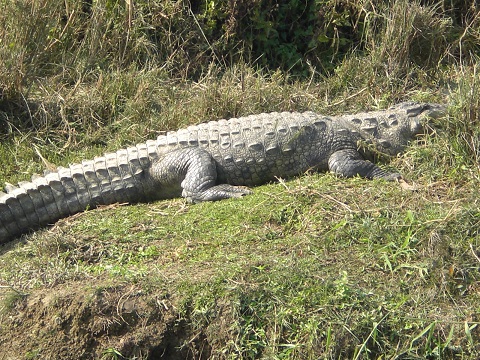
The next day, I went with a guide to the river and we plopped ourselves into a long, narrow, leaky wooden canoe. The oarsman shoved us away from the shore with a long pole, and we began our lazy cruise down the river. It was so peaceful and quiet. At one point, I draped my arm over the side and let my hand drag along in the cool water. My guide quickly suggested that this may not be a good idea, and later I saw why: Huge crocodiles. We saw several of them that day, but the first one was a really big sucker, lazily sunning himself on the banks of the river. I asked my guide what kind of crocodile it was, and I must have misheard him because it sounded like he said “Mass-murder crocodile.” I apologized for not understanding his accent, and asked him to repeat it. Again what I heard sounded like “Mass-murder crocodile” which did little to ease my nerves as the oarsman moved us closer and closer to the big, scaly beast. That croc would have no trouble at all in toppling our little canoe and dragging us all down for a death-roll. But the big fella didn’t even move his tail. My guide explained that the croc had just eaten, and would have no interest in returning to the waters for a while.

croc

We continued drifting down the river, and saw all sorts of birds and buffalo, and women on rocks at the shoreline washing clothing in the waters as children played nearby. Everything here seemed to be included in the great balance of nature, and it was all beautiful. After about two hours, the oarsman pulled up to a path that headed off across the reserve. My guide and I got out, thanked the oarsmen, and watched as the canoe drifted away. Then we walked up into the grasses of what looked a lot like how I imagine the Serengeti would look. My guide politely asked if he could excuse himself as he was feeling his own call of nature. A minute later he was back, and excitedly telling me to follow him.

“What is it?” I asked. “Rhino!” he replied.

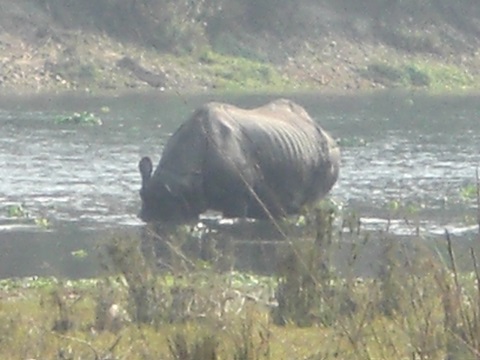
Soon we were off and running across the water’s edge, down to some lowlands at a fork in the river. I realized how out of shape I have become as my chest was pounding in less than a minute and I was breathing so hard I was sure I would scare the rhino away. Looking back, I realize how silly that is: Scare a rhino away? Luckily, we did not have far to go, and soon we were slowing down and I could see the large prehistoric-looking creature wading through the waters, eating some plants from the river bottom.

rhino

My guide kept a low profile, so I followed suit. We crept a little closer. The rhino was a good distance away in the water, but my guide informed me that they could go from 0 to 60 very quickly. Fortunately, their eyesight is very poor, but their hearing is very good. We crept around quietly in the grass as I took pictures. This sort of an excursion deserves a much better camera than the little pocket camera I had. My guide offered me his binoculars to get a closer look. It was much more impressive than the colorful birds we had peeped at before. At this point, I felt very satisfied in my one-man safari: I had seen crocodiles and birds, and now a rhino, one of the great endangered species of our planet.

Once back on higher ground, my guide spotted something in the dirt: A big paw print. “Tiger!” he said, circling the print with his walking stick. This was so other safari guides would see it and be alert for the presence of the big cat. Sadly, that was as close as I got to an actual tiger on that trip. Perhaps that is a good thing. We walked past some cameras hidden in the brush that had been placed there to help count the tiger population. They took our picture as we walked by.

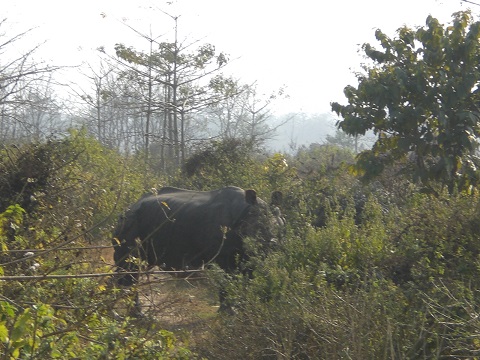
The best part of this safari came a little farther down the path, when off to our right we heard bushes rustling, heavy breathing, and vegetation being munched. A big, gray mass moved slowly behind the brush about fifteen yards away – another rhino! My guide waved to me to follow him, very quietly. I figured he knew what he was doing, and I really wanted to see a rhino up-close, so onward we crept. We moved very slowly, and whenever a twig snapped or a branch rustled, we’d stop and listen. Sometimes, the rhino would stop her munching and listen, too. This made me nervous as I remembered what my guide had said about their hearing. At one point the munching stopped and the rhino lifted its huge head, its horn jutting above the grasses it was dining on. My guide turned to me and asked very, very quietly: “Can you climb a tree?” My heart stopped and my eyes went wide. Just the look on my face must have been answer enough, because then he said “Hide!” I crept as quickly and quietly as I could behind a nearby bush. My guide found one of his own and none too soon, as the big horned behemoth casually trudged between us onto the path we had just been walking on. It paused, and looked around. I was very quietly raising my camera to snap a very quiet picture. How could I not? But my guide saw what I was doing and reached out for my camera. I gave it to him, thinking he was going to put it in his pocket where I couldn’t use it to get us both gored to death. Instead, he took it and began creeping up behind the rhino! He got a good shot of it, and then we ducked behind the grasses. At this point, we had traded places with the rhino. It continued across the path and disappeared into the brush on the other side. We quickly and quietly continued on our way in the other direction.

rhino2

The rest of the safari consisted of some crazy tree-killing vine (seriously, the thing creeps up the tree and takes two years to strangle it. I could imagine the tree screaming as trees do, creeping the hell out of the other trees), some amazingly blue birds, a wren, some more elephants, and another crocodile. The rhino had been the crowning jewel. We left the jungles a couple of hours later and headed for the elephant breeding grounds.

4. Gawk at Elephants (but maybe don’t ride them)

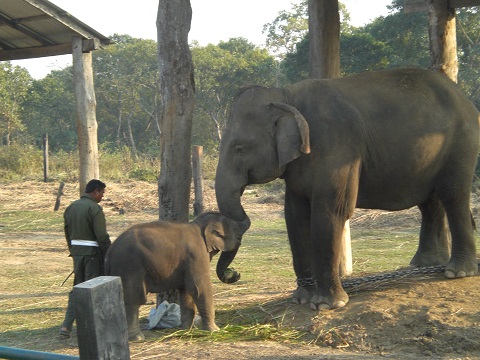
The elephant breeding grounds, I am sad to say, are little more than an elephant brothel where the women are forced to work. Domesticated female elephants are chained up under high wooden roofs with some hay to munch on as they await the midnight marauding of the wild males that live in the park. Tourists don’t get to see any actual mating as it all takes place at night. Now, I agree that the world needs more elephants, but is this method ethical? Do the females get any say in who they mate with, being all chained up out there? At least they get the company of their children, as several of the mommy elephants were accompanied by cute little baby elephants… but then again, is this something that children should have to see? Their own mothers? And what mothers! These poor animals are pregnant for nearly two years before the baby is born! Can you imagine that? At least it is two years of not being chained up in an elephant whorehouse. While they are gestating, the big girls get to relax in the open fields and forests of the breeding sanctuary, no doubt in the company of any children they already have.

babyphant

The next day I awoke before dawn to go out with my guide and ride one of these big, lovable, intelligent beasts. The morning was cold and very foggy, which played hell later on with the cold I was developing. One of the hazards of international travel: Every new climate brings a slew of new bugs and viruses into your system. I rode out on the back of my guide’s motorbike to the elephant ride launching area. There, you climb atop wooden scaffolds and wait for the driver to park his elephant under your feet. Then you just step over onto the big bastard and slip into the crated frame strapped to its back. Three other people climb in with you, one person to a corner to maintain balance. Once we were all situated, the driver nudged the elephant and we were off into the morning mist. First we waddled down a huge, muddy embankment into the river, crossing over to the other side where the good jungle was. It’s a good thing they balance those crates with a person in each corner, because on more than one occasion I felt certain we were going over the side.

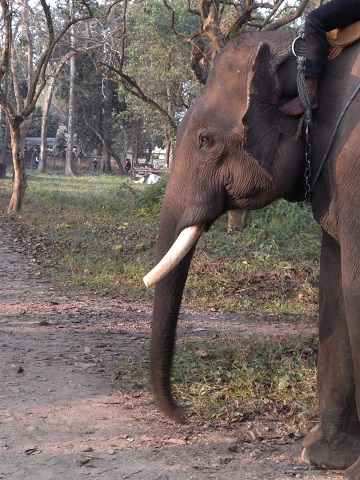
The ride through the early morning was a delight, and I got to see a few more animals that I had missed the day before: Deer, peacocks, wild boar, and an ornery chicken. Still, I must say that I felt bad for partaking in what I now realize is animal slavery. The elephants did not seem happy. The drivers would coax the elephants to move by driving their big toes into a little spot at the back of the elephant’s ears that looked like it had been jabbed to the point of being very tender. If that didn’t motivate the elephant, a stick was administered to the top of the elephant’s head. Not a big stick, thank God, and not a hard hit, either… more just a firm tap. But still… I was happy to see our elephant mount a bit of a protest at one point. The big girl just stopped by a tree to reach up with her trunk and pull off some particularly tasty-looking branches. She stood there, enjoying her breakfast, apparently impervious to our driver’s toe-jabs and stick-taps. He whistled, he barked, he jabbed some more, but she remained where she was. Finally, she swung the uneaten portion of the branch over her head and hit our driver right on the ol’ coconut. Good for her, I thought. The driver didn’t seem to mind. I guess that happens a lot.

[caption id="attachment_2024" align="alignnone" width="225"]Toe-jabs keep the pachyderms moving Toe-jabs keep the pachyderms moving[/caption]

Later that day, I said good-bye to my gracious host, the manager of the resort and his family. I left my guide a hefty tip and gave some decorative Omani weaves to the manager’s two young daughters. As we drove away, I saw the two little 3- and 4-year-olds tying them into each other’s hair. It’s always a good idea to bring little gifts when you travel for just those occasions. I took some more pictures of the mountains and river on the ride back – including one of a bus that had gone off the road and dropped a ways down the edge of a cliff some time ago. It does happen.

5. Get to Know some of the Locals

One of the best things you can do when you travel is to meet the locals. Spend time with them. In a country like Nepal, it is very easy to do, as the local population is very gregarious, and it is not uncommon to be invited into someone’s home to meet the family. Don’t be shy… do this. Not only does it show the people of the world that the people from your part of it are cool, but it will give you a very rewarding experience to remember fondly. Remember before when I said I found some gifts for my niece and nephew? I found them, but I had not yet bought them. I didn’t want to have extra stuff to carry when I traveled to Chitwan. Now, back in Kathmandu, I went to pick up the presents. The man who sold them to me was a very kind fellow who also owned a tea shop. We went to his tea shop, where he introduced me to his wife and daughter and made us some delicious milk tea. We chatted, comparing life experiences… he had worked in the fields and saved money all his life to move his family to Kathmandu and open some shops. He was living his dream, and he was a happy, friendly man for it.

Later, I ran into another fellow on the street who asked me where I was from. He offered to show me some of the temples around Kathmandu. His name was Prem, and I spent the day with him, getting some great pictures.

temple1

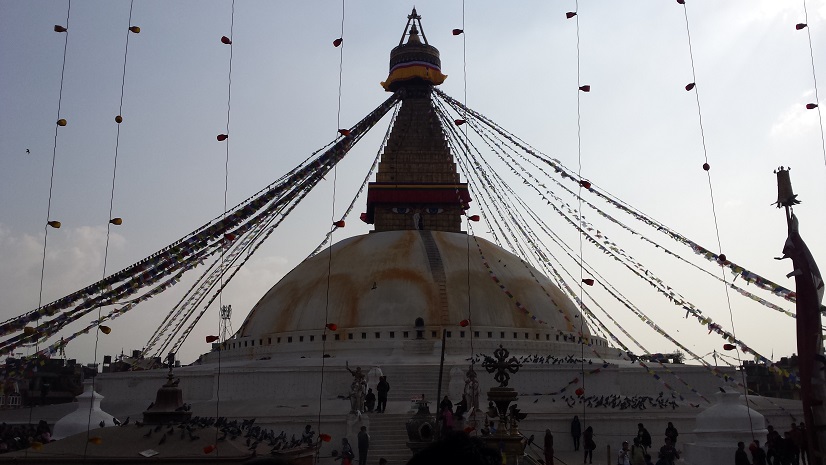
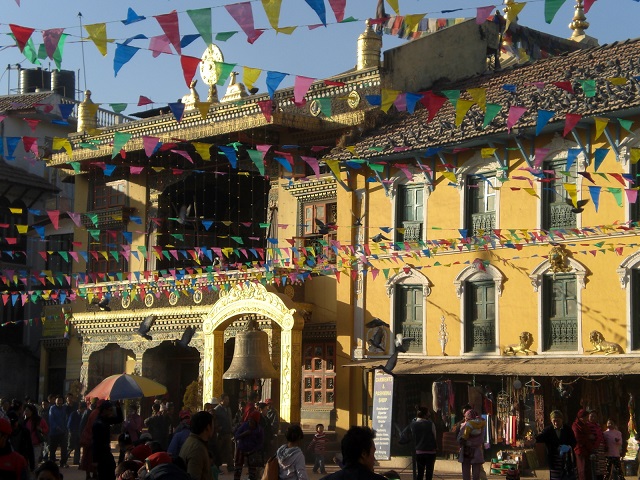
He showed me the proper way to pray at the entrances to the temples, and explained that it is proper to move clockwise around the inside of the temple. As in most Asian countries, it is also customary to remove your shoes before entering. He also told me the names of the various deities. He showed me how to apply the red paint to my forehead for the Third Eye. He even took me to Boudhanath, the famous Buddhist temple in Kathmandu where the Buddha’s bones are said to be interned. I asked him later if I could give him some money for his guide services. He refused it. He said his family lived near Boudhanath, and asked me if I would come visit his home. How could I not?

monks

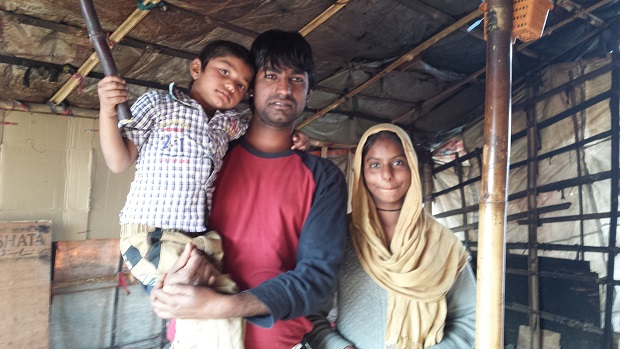
He led me across the busy street, behind the row of shops and down to a small, dingy collection of shanties and tarp-covered huts. We went into his one-roomed house that he had built himself. His wife and young daughter, he said, were away, visiting a sick father in another part of Nepal. He introduced me to his sister and young son, who chewed relentlessly on a stick of sugarcane. His sister made us tea while we chatted about his life and where I came from. Later, his brother joined us. I spent the afternoon with those people, and they never asked me for anything. They said they just wanted foreigners to see them, to know how many Nepalese lived. No one ever came to see this part of Nepal, but it was important that people should. I took pictures and they made more tea. The room was little more than two large wooden-plank beds covered with various blankets and stacks of boxes and containers around a central post and a small wood stove. So much poverty and squalor, and yet so much kindness… and just across the street from one of the most famous Buddhist Temples in the world.

fam

He and I still talk. He has my phone number here in Oman. This is why traveling is important.

6. Visit More of the Temples

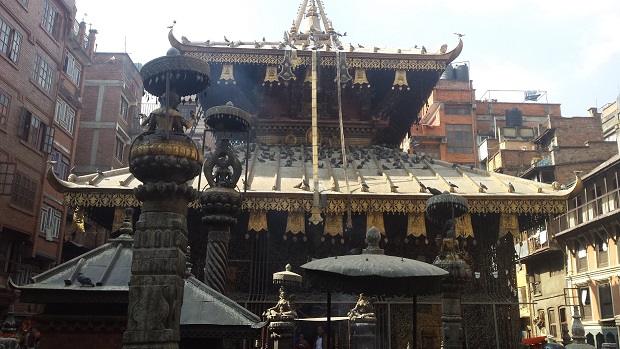
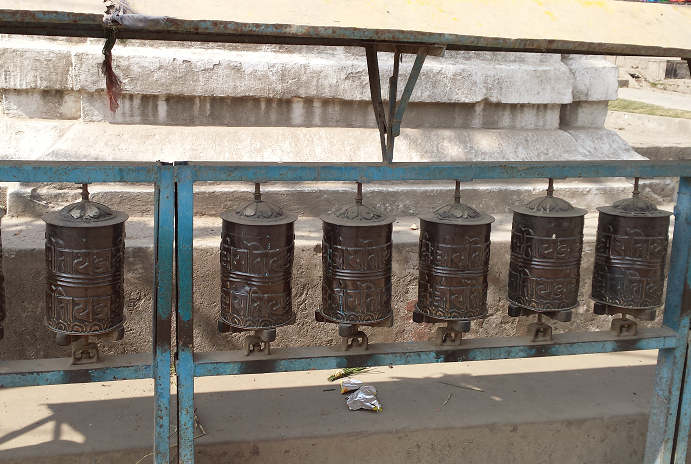
Aside from Boudhanath and the many smaller temples hidden throughout the city, there are other major temples that are worth a day to explore. One is Swayambhunath, or the Monkey Temple. It got this name because of all of the cats that run around the temple steps. Did I say cats? I meant monkeys, of course – monkeys everywhere! Before you enter the temple, there is a marking of the Buddha’s footprints by the entrance. It is considered good luck to touch these and then touch your forehead before entering. This temple, as most temples in Nepal, is decorated with spinning prayer wheels, some small and lined along the walls, others huge, and by themselves in little side-rooms to the temple. It is important that when you spin one of these cylinders, you spin it clockwise. If you spin one of the larger ones with its own room, walk around with it three times and pray.

[caption id="attachment_2033" align="alignnone" width="300"]Prayer wheels. Remember to spin them clockwise. Prayer wheels. Remember to spin them clockwise.[/caption]

The steps leading up to the temple are many, and it is an exhausting hike, lined with fortune tellers, artists, and craftspeople making all sorts of Buddhist-themed jewelry and other souvenirs for sale. Some of the salespeople on the stairs can be very pushy – pushier than most travelers would like. If you do not wish to buy, do not engage them in conversation. Keep your eyes down and keep moving up. A simple word of kindness here can get you a very annoying traveling companion. Even if you finally explain, “Look, I have no money! A monkey stole my wallet!” they won’t believe you and will keep following.

[caption id="attachment_2028" align="alignnone" width="300"]Boudhanath, where the Buddha's bones are said to be interred Boudhanath, where the Buddha's bones are said to be interred[/caption]

That’s no exaggeration about the monkeys, either. They are crafty little thieves. My friend had her juice box stolen from her when she sat down with one of the fortune tellers. The monkeys will swipe anything that is set down for a moment that looks colorful or tasty. Sure, they are cute, but they can be little jerks, so watch yourself and don’t make eye contact with them, either. No eye contact with monkeys or salespeople.

Do remember to be respectful, as always, as the Monkey Temple is the most sacred Buddhist pilgrimage site. For followers of Tibetan Buddhism, it is second only to Boudhanath. As with the temple at Boudhanath, it is proper to walk around these temple sites in a clockwise fashion, three times for the best results. There are a few rules of etiquette to remember when visiting any holy site, and even though Buddhists have a reputation for being very laid back, it is a good idea to familiarize yourself with them before visiting a temple.

[caption id="attachment_2029" align="alignnone" width="300"]Swayambhunath, or the Monkey Temple Swayambhunath, or the Monkey Temple[/caption]

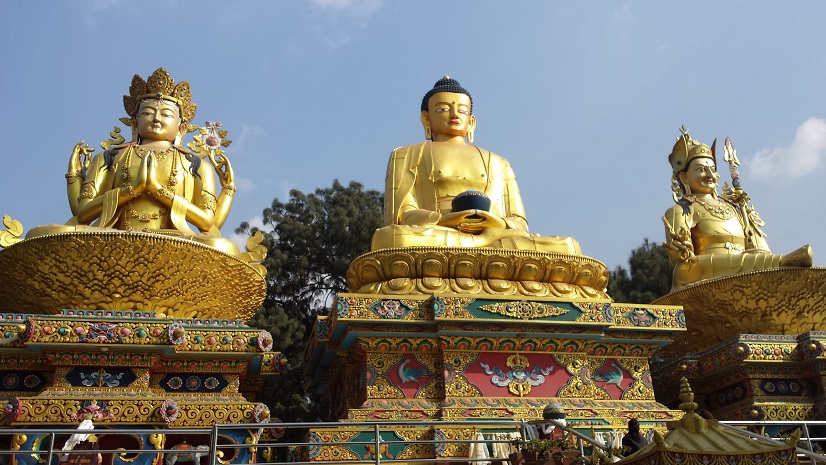
If you visit the Monkey Temple, it is a short trip to another picturesque site, Three Buddha Park, where you can see the statues of the Three Buddha of Swayambhu. The one in the center is the Amitaba Buddha, and the statue is the largest Buddha statue in Nepal, measuring in at 67 feet (20.4 meters). Each represents one of the dominant types of Buddhism: Theravada, Mahayana, and Vajrayana.

[caption id="attachment_2030" align="alignnone" width="300"]Three Buddhas of Swayambhu Three Buddhas of Swayambhu[/caption]

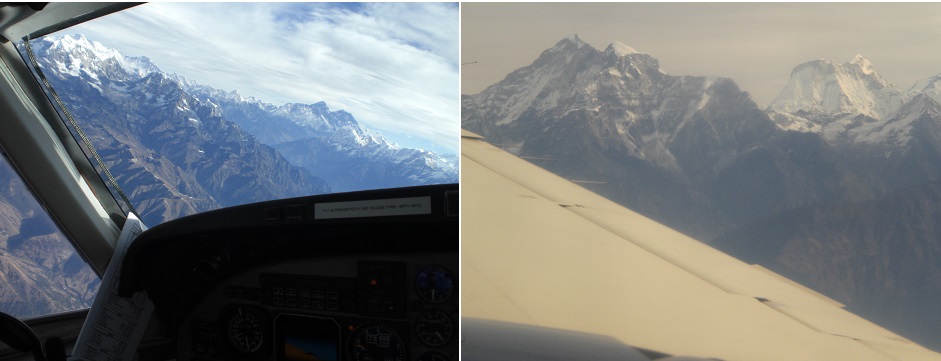
7. Get Drunk and Fly a Plane Around Everest

On my last night in Kathmandu, I went out with a friend I had made who worked at my hotel, a fellow named Shantos. He and his friends invited me to go drinking with them, and we soon ended up back at the Buddha Bar. We drank and smoked shisha. The shisha severely aggravated my sore throat from the cold I caught while riding elephants in the early-morning mist, so I started drinking ginger brandy. I mentioned that I was sorry that I did not get to see Everest. It is a long way from Kathmandu, really, and requires a grueling twelve-day trek to see it up-close. Shantos said they fly airplane tours to see Everest. He offered to book one for me through the hotel. The price is a little steep – around $150 USD, but I felt it was something I needed to do, so I readily accepted.

The next morning, I awoke blurry-headed and still drunk. The pounding in my head turned out to be Shantos pounding on my hotel room door as he tried to wake me up for my flight. I jumped out of bed (luckily I had slept in my clothes) threw on my shoes and jacket, and headed out. Before I knew it, my hangover and I were circling Mount Everest in a little prop plane. If you arrive drunk and sit in the wrong seat, they even let you fly the plane for a bit… Obviously, they were just having fun with me. Although I got to hold the controls for a few seconds, I could tell it was the co-pilot who was really handling the plane. Or perhaps I had replaced the co-pilot? I really have no idea how planes work. As we got closer to the mountains, I was relieved of my pretend pilot position. Still, I got some great picks through the cockpit window. When we landed, I even got a little certificate that says “I did not climb Mt. Everest, but I touched it with my heart.” I call it my “I pussed out and took a plane” certificate. Afterwards, I returned to the hotel for some rest. The next day, I did some last-minute shopping and then booked a cab to take me to the airport. I said goodbye to my new friends, and that was that.

[caption id="attachment_2031" align="alignnone" width="300"]See that square-shaped peak that looks like the top of a cowboy hat on the far right? That's Everest. See that square-shaped peak that looks like the top of a cowboy hat on the far right? That's Everest.[/caption]

Parting Shots

Nepal is not the cleanest tourist destination, but it really is fulfilling on a spiritual level. I would have liked to have been able to travel into Tibet while I was there, but it can be pricey and there is a long waiting period for the necessary VISAs and I didn’t have the time or the money. It was nice to see Everest, even from the air, but it would have been nicer to actually set foot on it… even walk up a few feet just so that I could say yes, technically, I had climbed Everest… not all the way to the top, of course. The trek to Everest is a popular thing for the more adventurous travelers with more time and money (and physical health) at their disposal, but for a guy like me… Hell, I was lucky I woke up in time to catch the flight. All in all, it is a very good experience. But do be careful… a report came out recently that Kathmandu, for all of its friendliness, leads the word in kidney theft. Yes, you read that right – those urban legends you have heard? It actually happens in Kathmandu… but usually not to tourists. It is more of a local problem. Just the same, don’t be stupid, no matter where you travel. Keep your wits about you and don’t wander off down any dark streets with any strangers for any shady kind of dealings. According to recent news reports, people begging for money for kidney operations is common in Kathmandu. I did not see anyone specifically begging for kidney money. I did see a few kids involved in a scam where they ask a tourist to buy them some milk in a grocery store for a sick sibling back home. Tourists just offer to give them money, but the kids refuse, and instead insist on taking them directly to a nearby store. This adds a bit of legitimacy to their tale – until you realize that the grocers are in on it and the cost of a carton of milk is suddenly around $30 USD.

Either way, keep a tight grip on your wallets and purses and kidneys. Be friendly, but be safe wherever you travel.

[caption id="attachment_2032" align="alignnone" width="300"]Another view of the temples around Boudhanath with prayer flags flying Another view of the temples around Boudhanath with prayer flags flying[/caption]


Alien Encounters from Around the World

We’ve all heard the stories: Someone is out in the middle of nowhere late at night when they spot strange lights in the sky. The next thing they know, they are on a table surrounded by shriveled gray beings that insist on inserting things into their butts. What is this? That episode of 'The Golden Girls' that was too “raw” to air? No! It is the so-called UFO phenomenon as it is perceived by most people in Western culture. Strangely, this is not at all how most encounters with UFOs usually – or ever – go. So what are we to expect from this psychosociological phenomenon? Despite stereotypes and media hype, these strange experiences are recorded differently around the world. Let’s take a look at the Top 5 reports of alleged encounters with the other-worldly in various cultures and see in what ways they differ, and in what ways they are eerily similar. Let’s start with one that most UFO fans are familiar with, and which fits the usual description of such encounters.

5. USA: The Travis Walton Experience

In November of 1975, Travis Walton was working on a small logging crew under contract to remove brush from a state forest in Arizona. His boss, Mike Rogers, was behind schedule to complete the contract on time, and so had his crew working overtime, often from 6 a.m. to nightfall. On one such night, the crew was in a truck driving back to their nearby town of Snowflake when they saw a light glowing from behind a hill. When they drove over to investigate, they saw a silvery disk hovering several feet off the ground. Travis jumped out of the truck and ran toward the disk, ignoring calls from his coworkers to get back in the truck. The disk started to make a sound like a “large turbine” and began to wobble in the air. As Walton started to back away, a blue-green beam shot out of the disk, knocking Walton to the ground, his arms and legs sprawled. The men in the truck then apparently fled the scene.

abduction12-300x236

When they got to town, they alerted the authorities, saying only that one of their team had gone missing in the mountains. When police arrived, however, the men were “visibly distraught,” two of them weeping as they recounted the full story of what they claimed happened. The police on the scene said that if they were acting, they were “awfully good at it.” A search ensued immediately as police were worried that Walton, if left in the wilderness, could easily die of hypothermia. He had last been seen wearing only a T-shirt and jeans and it got extremely cold in the mountains at night. Despite the crew’s harrowing account, there was no physical evidence indicating anything unusual at the location they specified. Walton was missing for five days. The crew took and passed polygraph tests – all except for one man who did not complete the test. Walton’s mother, when told of the news, seemed remarkably calm, simply asking to hear the story again, and then asking if anyone else besides the police had been told. Some, including Sheriff Coplan who knew the family, attributed this to her tough nature resulting from raising six children on her own.  However, as the days passed, she began to show emotion for her missing son.

Travis eventually reappeared five days later. His brother Duane took him to a “doctor” that was sponsored by a local UFO investigation group. Upon realizing the man was not an actual doctor but rather a hypnotherapist, Duane and Travis said they left the man’s office after only forty-five minutes. The hypnotherapist and the head of the UFO investigation group disagreed with this account, claiming that the two Waltons had been in their care for over two hours. When Walton did finally consult two physicians, they reported two strange findings: First, a red mark in the skin above Travis’s elbow indicative of a hypodermic needle (although it was not near a vein), and second, an unlikely lack of ketones in his urine. Had Travis been lost in the woods, his ketone levels would have risen as his body broke down fat to survive in the elements. Skeptics would claim this was evidence that Travis had been hiding in the home of an accomplice, perhaps his own mother. Other evidence was proposed by debunkers, such as the fact that NBC had aired a TV movie about the famous Betty and Barney Hill UFO abduction just weeks before Travis disappeared, although nothing in Travis’s account was similar to the Hill abduction. Travis claimed he never saw the movie. Also, some claimed that Rogers had concocted the story to get out of completing his forestry contract on time, but others say that this was not a big deal. Forestry contracts often went past the contract deadline for various reasons, and Rogers never tried to enact the “Act of God” clause to get out of it.

So what did Travis claim he saw after his alleged abduction? Travis claims that after he was hit by the beam of light, he awoke on an inclined hospital bed. The air was heavy and wet around him, and he was surrounded by strange beings in orange biohazard-type suits. He said their eyes were exceptionally large, and mostly brown (as opposed to the black most abductees report), showing only a little bit of white. He said their noses and mouths looked very small, but that may have been because their eyes were so large in comparison. He claims he jumped out of the bed and grabbed a glass tube from a nearby table and tried to break it to fashion a weapon, but the tube was unbreakable. Instead, he used it to threaten the beings, and they left him alone in the room. He ventured out on his own and found his way into a large, circular room occupied by a single high-backed chair. He sat in the chair and played with a sort of control stick, which caused the room to light up with a pattern of stars, similar to a planetarium. When he moved the stick, the stars would move. He then says he noticed what looked like a rectangular doorway. When he walked over to it, he encountered a tall man with “golden eyes.” The man wore a glass space helmet on his head. He didn’t respond to Travis’s questions, only gestured for Travis to follow him. He led Travis down a ramp, exiting the disk and walking out into a large hangar area with other disk-shaped objects within its high walls. He was led into a room with two other golden-eyed beings – two men and one woman. The woman put something like an oxygen mask over Travis’s face, and he blacked out, only to wake up outside a gas station on the outskirts of Snowflake. A silver disk hung in the air over the road nearby, and when he saw it, it shot off and vanished. He called his brother-in-law from the payphone at the gas station, and soon was back home to tell his bizarre story.

The whole thing became a book, which then became a movie called “Fire in the Sky” which met with moderate success, yet told a completely different account of what Travis claims he experienced.

4. China: The Strange Case of Meng Zhao Guo

China has had more than its share of UFOs and extraterrestrials (or waixingren as they are called in China) appearing in the local lore. Even Sun Shili, a retired Chinese foreign ministry official, claims that these waixingren walk among us here on Earth. Many Chinese scientists are said to agree with him. Meng Zhao Guo may also agree with him after his alleged encounter, which shares two very similar traits to that of Travis Walton: First, Meng was working in the mountains on a logging crew when his encounter occurred, and secondly, he was also hit by a beam of light. However, unlike Travis Walton’s story, Meng’s gets kind of sexy – in that he claims he had sex with a ten-foot-tall female alien with six fingers and braided leg fur. Despite her large size and extra fingers, Meng said the alien “looked completely like a human.” Meng also said this was the first and only time he broke his marital vows to his wife, but she was apparently cool about it. “I told my wife all about it afterwards” he said. “She wasn’t too angry.”

[caption id="attachment_1999" align="alignnone" width="246"]I don't know what this is, but YOU try finding a picture to fit Meng's description. I don't know what this is, but YOU try finding a picture to fit Meng's description.[/caption]
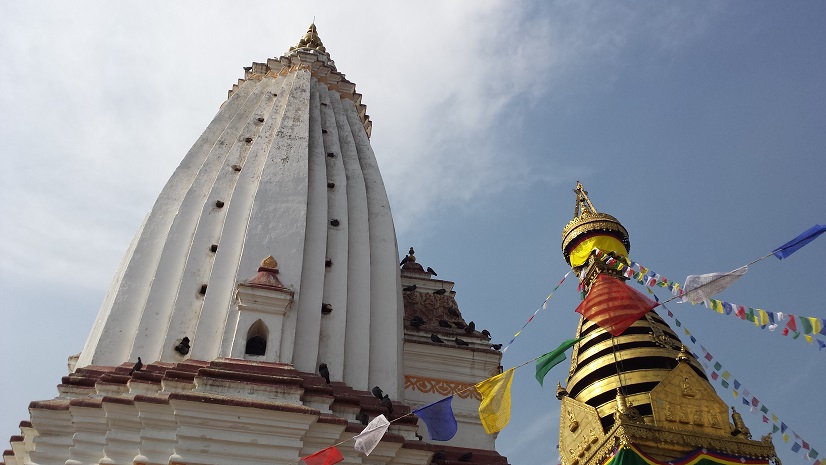
Meng’s erotic encounter took place in June of 1994 when he and two other workers at the Red Flag Logging Camp noticed something unusual in the sky over Phoenix Mountain. In 2003, he met with Zhang JingPing, a UFO researcher based out of Beijing, and agreed to hypnosis and a lie detector test to be administered by police psychologists in Beijing. The results were that Meng was telling the truth. Zhang also noted Meng’s scars, which he said were not indicative of any normal injuries or surgeries. Obviously, they could only have been caused by getting freaky with a ten-foot-tall alien with six fingers (allegedly).

Meng had very little formal education, despite having spent most of his life in the Wuchang province. Wuchang was one of three cities that merged into modern-day Wuhan, the capitol of the Hubei province of China. He says he had never heard of UFOs or anything related to that sort of tale prior to his own experience.

After his encounter, Meng claimed that the oversized aliens continued to harass him (apparently word had gotten out in the Big ‘n’ Tall Lady Alien circles that Meng was a love machine). He also claimed that on the 17th of July of the same year, the aliens abducted him again and took him to Jupiter, which they claimed was their home world. Although most UFO buffs in China believe the initial encounter may have actually happened, no one believed Meng’s subsequent stories, choosing instead to believe that he was just milking it for publicity.

In other accounts, Meng is said to have claimed that his alien copulation took place while “floating above his sleeping wife and daughter.” Freaky. The scar he suffered is said to be on his thigh. When the aliens returned to abduct him again, he is said to have claimed that he levitated through a wall to board the alien spaceship. He was told he could not see his alien mistress again, but that on a distant planet, his alien love child would be born in 60 years.

Today in China, there is a growing interest in UFOs, and many Western tourists have reported that Chinese citizens will approach them and ask them if they have seen any UFOs in their countries. Sadly, despite the Meng case being the most famous account of an alleged alien abduction in China, not many other details have been released. Perhaps now, however, the aliens have learned that Wuchang Clans ain’t nothin’ to f*** with. (Sorry, I could not resist).

3. Russia: Hill 611.

Most Americans are familiar with the story of the alleged Roswell UFO crash of 1945. Similarly, in Russia, a few privileged people are aware of a similar event that occurred on the romantically Russian-named Hill 611, located in the extreme east of Vladivostok. This crash was reported to have involved a “flying sphere” that crashed into the hill in 1986. Although most of the object disintegrated on impact, specialists from the Academy of Sciences were able to recover some debris.

On January 29th, at around 8:00 p.m., residents of the small town of Dalnegorsk reported seeing a red ball about half the size of the full moon. It flew silently and slowly (around 15 meters per second, or 34 mph) over the ground. As it approached Hill 611, it tried to ascend but crashed into the hill. Eyewitness accounts of the crash differ, with some saying the sphere vanished after a brilliant flash, and others saying that it yawed unsteadily, emitting an array of bright lights before it finally hit the earth. Three days after the crash, a team of ufologists led by Valery Dvuzhilny climbed the hill and found a crash site a few meters in diameter. The area looked as though it had been exposed to high levels of heat, with the rocks baked to a shiny black, and there were the remnants of a burnt tree in the center of the site. Strange beads and bits of tear-drop-shaped metal were found scattered around the site, along with a strange mesh-like material. The beads and drops were analyzed, and said to contain mostly lead, silicon, and iron, although some of the drops also contained bismuth and rare earth elements. Some of the rocks at the crash site were covered with drops of silvery lead which was determined to be of a different variety than the local lead. The radiation levels of the grounds around the site were normal, although when the team took pictures using two different cameras, all of the pictures developed blank.

Years later, a TV special on the incident concluded through “scientific testimony” that the materials found at the crash site were not of man-made origin but were from “somewhere else.”

Since this account is even shorter than the Meng case and doesn’t have all the exciting trappings of alien erotica, I will also relate a famous mystery that occurred in Russia which many have attributed to possible alien involvement. The now-famous and creepy story is known as the Dyatlov Pass incident. It took place in January of 1959, when nine young students and a ski instructor from the Ural Polytechnic Institute went on a skiing expedition in the Ural Mountains. None of them ever returned. Their bodies were recovered a month later, and some of them showed very unusual injuries. Five of them were found frozen to death outside the tattered remains of their tent. The others were found buried in the snow in a clearing further from the camp. One had a crushed skull, and another was missing her tongue. The evidence at the scene indicated that they had fled in sudden terror, leaving key survival equipment – including coats and boots – behind. The official cause of death was a “compelling unknown force.” Strangely, soon after, the entire case was filed away as ‘Top Secret.’

The ski team was scheduled to arrive in Vizhai on February 11th and send telegrams home to their families to let them know their trek had been a success. By February 19th, when no telegrams arrived, concerned families demanded the Ural Polytechnic Institute send out a search party, which they did. Soon concern was at such a heightened state that the Soviet military got involved, combing the Ural region with helicopters and foot soldiers. It was these soldiers that eventually made the grim discoveries.

Ïàëàòêà Äÿòëîâöåâ

The tent had been ripped in half, and all of the camper’s gear had been left behind. Around the tent, the footprints of eight people could be seen—some bare, some in socks, and one wearing only one shoe. About 1,500 feet from the tent, the footprints were covered in snow. Nearby, however, the soldiers found the frozen, half-naked bodies of two of the men near an extinguished campfire beneath an old pine tree. Why had they not gone back to the tent to retrieve their clothes? Even weirder, the soldiers noted that the branches of the tree had been broken off up to fifteen feet above. My first guess, as I am sure yours would be, was that the men had been breaking off the branches for firewood. The soldiers, however, claim that they broke the branches off in a frenzy, shredding their hands to bloody pulps. 900 feet away, the bodies of the others were found, one clutching a birch tree branch in one hand and holding up another frozen hand as if warding off some unknown attacker. A girl was found with her tongue missing, although accounts vary as to whether it had been cut or bitten out.

Even stranger, later analysis of the tent material indicated that it had been ripped from the inside. Damage to the bodies was said to be equivalent to that suffered in a car crash. The crushed-in skull had been hit with a heavy object, and other victims had crushed ribs. No animal tracks were found nearby… in fact, no tracks other than those of the campers were anywhere to be found. There is one cryptic phrase that was found written in one of the camper’s journals: “We now know the snowmen exist.” Of course, this could have been written as a joke, as at the time, a popular activity among students was to create their own newspapers as a rebellious act against the state-run media. To this day no one knows what really happened out there in the Russian wilderness. Theories include hostile local tribes, a top-secret military exercise, and –

284374f558f572ff33

2. Malaysia: Mini-Alien Invasion

After that creepy Russian account, you may welcome a tale of the more… campy variety of alien encounters, what with the multi-colored tunics and ray-guns and little green men. Well, we need look no further than Malaysia! And the little green men were really little – no more than six inches (15.2 cm) high. “Why heck” you might be thinking, “That’s not scary! I’d like to capture one of those and put it in a mayonnaise jar! He’d be great for show-and-tell!” Yes, he would be – if it weren’t for the fully-functioning ray-gun he toted. Let’s look at the “facts.”

From the 1970s up into the mid-80s, reports of tiny alien invaders were popping up all over the little South-East Asian country. They arrived in tiny little spaceships, no more than 3 feet (91.4 cm) wide. Aside from the larger eye-to-head size proportion common to most aliens, some of these little doo-dads also sported two antennae atop their heads! Adorable. So adorable, in fact, that no one seemed to mind that their favorite places to explore seemed to be children’s playgrounds. No one minded, that is, until the devious little suckers brought out their ray guns.

mini_merc_by_the_xenomafia-d6zhxwb

One case occurred on school grounds in Johor Bahru in 1969. A group of schoolboys ran into their headmaster’s office to report seeing a small flying saucer in a small wooded area near the playground. They claimed they saw six little beings, all wearing red suits, milling around on the forest floor. As soon as they spotted the boys observing their activities, they scrambled and hid in a hollow beneath a tree root and their “spaceship” vanished into thin air. A search of the area in question turned up nothing unusual – except for a small burn mark about the size of a dinner plate where the spaceship had allegedly landed to recover its crew.

A similar sighting occurred near a middle school in Bukit Mertajam, where a group of children reported seeing a small spaceship land and a tiny ramp emerge. Then five 3-inch tall humanoids marched in “military fashion” down the plank. Four wore matching blue uniforms while the fifth, who seemed to be the leader, wore a yellow tunic and a helmet with spikes on top. They ignored the children and proceeded to climb a nearby tree to erect some sort of aerial device. One of the children apparently decided the little buggers would make cool pets and went to capture the leader. The little aliens had other plans, however, and opened fire with their tiny ray-guns, the beams from which stung and burned the children, who promptly ran away. One of the boys exhibited small burns on his thigh, presumably a result from the tiny laser blasts. Remarkably, very few details such as specific names, are available. Chroniclers of these occurrences claim that this is due to the lack of accurate record keeping by Malaysian authorities at the time.

1. Australia: Aliens from another dimension?

The Dandenong foothills, near Belgrave, Victoria, were the scene of one of the strangest UFO encounters on the books. It involved a woman by the name of Kelly Cahill and her family, and she would later describe her alien tormentor as one with no color… and no soul.

It was August, 1993, when Mrs. Cahill was returning from a visit to a family friend, along with her husband and three children. Her husband was driving, and the kids were nodding off in the back seat. It was soon after midnight when the Cahills noticed a circular craft hovering over the road. It had multicolored lights glowing underneath, and windows all around it. Kelly told her husband that she thought she could see people moving around inside the object through the windows. Then she noticed that they weren’t people. She started to scream, telling her husband to drive around the object and get them out of there. Suddenly, the craft disappeared in an intensely bright flash, and they found themselves alone once again on the deserted road. Kelley later said she kept asking her husband, “What are you going to do?” and “What happened? Did I black out?” Her husband remained silent and quietly drove the family home.

Soon after, Kelly kept smelling an obnoxious odor “like vomit” but could not locate the source. She soon pieced together on her own recollection that they had somehow lost nearly two hours of time on their drive home that night. Two hours, as any ufologist will tell you, is the standard amount of missing time associated with most alien abduction scenarios. She also noticed a tiny, triangular mark above her naval. In the weeks that followed, Kelly suffered from minor health problems, including a urinary tract infection. She also reported frequent stomach pain.

Over the next two days, she gradually remembered the harrowing details of the family’s experience. She said that they had encountered the UFO again after it had disappeared that night. Further down the road, they had seen it hovering in a gully. In a “trance-like state” she sat quietly as her husband drove over to the area and stopped the car. They each got out of the vehicle and began walking toward the craft, which she described as being very large – around 150 feet (46 m) in diameter. As they got closer, they could make out something moving in the field around the craft. She could see several dark creatures, humanoid in shape, about seven feet (2 m) tall. And when she said they were dark, she meant dark. She said they were completely devoid of color, except for a large pair of glowing red eyes. Other than those eyes, it was as though light did not exist in them. She described them as having “no soul.”

cahillufo2tc

She got a sense from them that they were evil. As they watched the aliens move about the ground, she was aware that they were not the only witnesses there. Another car was parked on the other side of the craft. She could see the aliens were moving in groups, and one group floated over to the other car. Another group soon surrounded her and her husband and led them into the craft. Then she blacked out and awoke back in the car. Later, she would claim to recall one of the dark entities hovering over her nude body like it was kissing her naval, and she would say that she got a distinct feeling from them that they were “intruding on our dimension.” They were taking up space, but reflecting no light.

Soon after her story was made public, people claiming to be the witnesses from the other car came forward and described the same details – including details like the nude examination that were not made public. Coincidence? Probably. More likely, however, I would suggest that the Cahill’s story is actually very similar to many alien abduction accounts, including the famous Betty and Barney Hill story referred to earlier. It is therefore possible that the other witnesses simply filled in the missing information with common traits of other such encounters. Either that, or….

284374f558f572ff33

While these stories may be interesting, they are a mere speck of the entire canon of ufological accounts of bizarre encounters with strange beings. There are stories about aliens of all shapes and sizes, from little hairy trolls to large, blonde Nordics. There are spooky “black-eyed children” and reptilian lizard people, and even an account of aliens that made pancakes for a Wisconsin chicken farmer. And – of course – there are the ever-popular “grays.” Are all of these stories fake? Some of them do offer some compelling physical evidence, while others just make us laugh. Some scare the crap out of us (like that Russian story… sure, it may not have been aliens, but really – WTF?!) All told, they represent an interesting reflection of human psychology and culture. And who knows? Maybe some of them even offer a glimpse into one of humankind’s greatest questions: Are we alone? I, for one, sure hope not. If we are, then we have some serious psychological problems.