Showing posts with label Korea on the Edge. Show all posts

Tuesday, April 8, 2014

Christmas... in Korea?

http://www.youtube.com/watch?v=d6oy8IucCMg

Ho ho ho!


Santa and his trusty reindeer land on rooftops, and he shimmies down the chimney to deliver Christmas presents for those on his ‘Nice List.’ Sound familiar?

This is what some of you inevitably expected of Christmas when you were younger and still held onto the notion of a mystical figure who brought gifts on one magical winter holiday of the year. Although you grew up and eventually learned that (SPOILER ALERT!) Santa Claus did not actually exist, you still probably promoted the idea to future generations. Even minus a jolly red-cheeked fat man with gifts, Christmas is still a joyous holiday the world over, all about spreading holiday cheer to family and friends---even as far as Korea!

Yep, you read that correctly. Christmas is celebrated in Korea as well as in many Western countries. Indeed, the Korean notion of Christmas are pretty similar to that found in the West, but with a few tweaks.

Santa Claus exists in the hearts of most young children in Korea as in many other countries. Parents tell their children to behave and be nice if they want Santa, often called Santa haraboji (할아버지; Grandpa Santa) to bring them presents. However, as the children grow older, they discontinue their belief in Santa, and as such, they stop receiving presents. Most children stop getting presents once they become middle school students. In Korea, no strict custom exists for family or friends to give and receive Christmas gifts. No Christmas presents, you ask? Then what about the food? Surely, there shall be a feast to celebrate with the family!

Nope, the only food that is especially popular on Korean Christmas is Christmas cake. Christmas is, after all, the birth of Jesus Christ, and what better way to celebrate his birthday than with a cake? Thus, every year, bakeries try to outdo one another with extravagant cakes. Stroll into any bakery near the holidays and you’ll find the store brimming with Christmas cakes.

[caption id="attachment_1516" align="aligncenter" width="500" class=" "]Korean Christmas cake Korean Christmas cake[/caption]

Most, if not all, churches in Korea welcome anyone and serve food (don’t expect anything too special) and sometimes small gifts around Christmas. Because 25 percent of the Korean population is Christian, many churchgoers, as well as non-Christians, attend Christmas service in church. For those that prefer not to spend the holiday in church, there are other options.

Many people choose to spend Christmas with their family, regardless of how bland the holiday may be. For others, it’s a day to go out drinking and partying with friends. On Christmas Eve and Christmas day, you’ll find most pubs and bars filled to the brim with patrons looking for some holiday ‘spirit.’ In parts of Seoul like Gangnam or Hongdae, you’ll see groups of men and women mixing together, trying to see if they can find love. There’s even a huge event called "solo daecheop (솔로대첩; victory for singles)" on Christmas where single folk come out to find partners. However, for those who already have a significant other, the day is dedicated to enjoying a romantic date. On Christmas Eve and Christmas day, you’ll see many couples walking hand in hand, taking in the sights. Visit any restaurant and most of the tables are occupied with couples. Who knows? You might find a relationship too.

[caption id="attachment_1514" align="aligncenter" width="500" class=" "]Matching singles in Korea during the holidays Matching singles in Korea during the holidays[/caption]

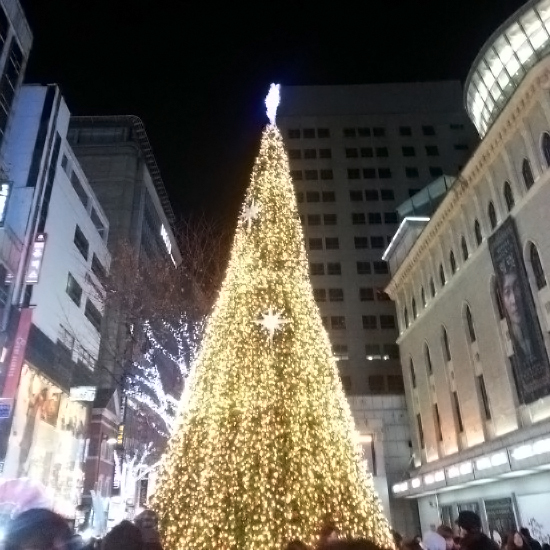
Those who live in or frequent downtown Seoul know certain districts light up with bright Christmas decorations during December. Most decorations are put up in big shopping districts, or Korea’s many cafes. So if you’re feeling homesick, try hanging out in the booming shopping district 명동 (Myeongdong, Line 4) or Times Square in 영등포 (Yeongdeungpo, Line 1).

[caption id="attachment_3392" align="aligncenter" width="500"]Christmas in Myeongdong Christmas in Myeongdong[/caption]

There are many ways to spend the Christmas holidays. So if you happen to be an expat in Korea during them, don’t shut yourself in your home, thinking about your past holiday experiences. Go out and take in the sights, meet new people, grab a few (or more) drinks with friends, or if you have family, spend a warm and cheerful holiday with them. Christmas isn’t about where you are; it’s about those with whom you choose to spend it. Merry Christmas!

Thursday, March 27, 2014

Boryeong Mud Festival: Here's mud in your eye

There really isn’t much to say for this event that you can’t already imagine: Just a bunch of people getting down and dirty, writhing around in a whole lot of mud. Why? Because it’s FUN, dammit. When you were a kid, did you ever see a bunch of mud after a rain storm and get a sudden urge to take a running slide into it, head first? But that ol’ kill-joy Mom wouldn’t allow it? Just think of what it would do to your school pants! Well, chances are, Mom isn’t in Boryeong and you have long outgrown your school pants, so get in there and wallow!

mud_festival02

The Boryeong Mud Festival is a week-long event that takes place every July in the little town of Boryeong, South Korea, about 140 km (87 mi.) south of Seoul. Boryeong is commonly called Daecheon because that is where beautiful Daecheon Beach is located on the Western (or Yellow) Sea. You can get there from Seoul by bus or by train on the Gyeongbu Line. Which bus? Here is a helpful tip for any foreigner in Korea, if you don’t know it already: Just dial 1330 on your cell phone and ask! And that goes for anything – buses, subways, restaurant locations, movie times…

What was I talking about? Ah, yes – the Mud Festival! It’s a lot of fun. What’s that? Rolling around in big pools of mud with a bunch of strangers aggravates your OCD? Well, consider this: The mud of Boryeong is famous for having wonderfully therapeutic properties. Cosmetics have been produced that use the mud due to its high mineral content. It also contains bentonite, an absorbent aluminum phyllosilicate, and Germanium, a grayish-white metalloid. What does that mean? I have no idea, but it sure is fun to slide around in. The mud is moved from the Boryeong Flats by truck and dumped on Daecheon Beach every year just for this event. There are slides, pools, and various wallows, along with body-painting (using multi-colored mud), volley ball, mud-skiing… well, pretty much anything you can imagine you could do in a big pile of mud. And when you have had your fill of the muddy goodness, just take a stroll into the cleansing surf to wash away every trace of it.

APTOPIX South Korea Mud Festival

The mud itself is recognizable due to its unique grayish color (must be that Germanium) and when it dries all over your body, well, you just look freaky and it makes for a great Facebook profile picture. Put on a pair of wrap-around shades and you could abduct people in your spaceship – if you are one of the fortunate ones to have a spaceship. Keep in mind, pretty much anything goes at Boryeong, but probing is a no-no, so keep those muddy hands to yourself, or you’ll be put in the mud prison (yes, they have one, but it is purely for amusement purposes). All the while, you can enjoy live music from the stage, which hosts a line-up of bands from Seoul and other places.

The Boryeong Mud Festival – the name says it all. And in case you are more of a visual learner, check out the video from the IDC Crew down below. Mud, mud, mud, mud, mud. What more can I say? Enjoy it. It’s a good time that is good for your skin. And Mom never has to find out.
 

Focus: Boryeong Mud Festival (Korea on the Edge)


[embed]http://www.youtube.com/watch?v=b_qTSuLpl8g[/embed]

A popular attraction in the summer months following the rainy season, the Boryeong Mud Festival has been a yearly tradition since 1998. If you want to attend this incredibly filthy-fun event, don't let the name fool you. The mud is taken from the Boryeong Mud Flats and transported to Daecheon beach, where celebrants roll, dance, slide, sling, and frolic in the therapeutic beauty-enhancing mineral-rich muds. The reputation for the mud's therapeutic effects started in 1996 when cosmetics made from the mud were marketed as being full of minerals that occur naturally in the mud at Boryeong. And then someone got the great idea, "Wouldn't it be nice if we could just roll around in this stuff?" And a legend was born. Now the festival includes all sorts of fun mud-based activities, from mud fights to colored-mud body painting to mudslides and mud- Well, you get the idea: Mud, mud, mud. And when you've had enough, you can just jump into the nearby surf for a quick wash and you're ready to head back to your normal life as a non-mud creature. The festival usually occurs over a two-week period, but the climactic finale is usually held on the second weekend of July and it is a huge draw for the Korean expat population. There are usually several groups of people heading into the Daecheon region at this time, so hitching a ride should be no problem. Or you can just catch a bus at Seoul Express Bus Terminal, or take a direct bus from Incheon to Daecheon Beach. If you want to see more check out the official website. mud's therapeutic effects started in 1996 when cosmetics made from the mud were marketed as being full of minerals that occur naturally in the mud at Boryeong. And then someone got the great idea, "Wouldn't it be nice if we could just roll around in this stuff?" And a legend was born. Now the festival includes all sorts of fun mud-based activities, from mud fights to colored-mud body painting to mudslides and mud ? well, you get the idea: Mud, mud, mud. And when you've had enough, you can just jump into the nearby surf for a quick wash and you're ready to head back to your normal life as a non-mud creature. The festival usually occurs over a two-week period, but the climactic finale is usually held on the second weekend of July and it is a huge draw for the Korean expat population. There are usually several groups of people heading into the Daecheon region at this time, so hitching a ride should be no problem. Or you can just catch a bus at Seoul Express Bus Terminal, or take a direct bus from Incheon to Daecheon Beach.

There will be mud! The Pop-culture quizz


http://www.youtube.com/watch?v=aVnkDkYP9jE

Join Kris as he walks around and asks foreigners living in Korea what they know about Korean culture. If they get the question right, they get a fresh cold beer but if they get it wrong...

Friday, January 3, 2014

Drinking in Korea: Soju and Makgeolli

http://www.youtube.com/watch?v=PksPNM0GzHA

One can hardly presume to understand much about Korean culture without knowing at least a little about its alcohol. And one can hardly proclaim an understanding of Korean alcohol without knowing some about the basic characteristics, history, and uses of its two staples: soju (燒酒/소주) and makgeolli (막걸리).

Though these two alcohols are radically different in taste and use, they do present some important similarities. Perhaps the most obvious of these is that they are both traditionally made from rice, like many—but, of course, not all—alcohols found across East and Southeast Asia: míjiŭ (米酒) and sometimes báijiŭ (白酒) in southern China, tapuy in the Philippines, sato in Thailand, sake or shōchū (the latter of which shares the characters 燒酒 with Korean soju) in Japan. A less obvious similarity is that despite their traditional origins in rice, both liquors are also sometimes made with other grains: Soju with barley, wheat, or even corn [1], and makgeolli with wheat or a mix of unidentified or “other” grains [2], though “100% rice” is still trumpeted by some producers of these liquors as a sign of their quality. Third, both beverages can be purchased very cheaply, for around 3000 won (about $2.60) for a 750 mL bottle at most convenience stores.

Soju, a dry, clear alcohol that was traditionally up to 35% alcohol by volume (ABV) but is now generally sold as much weaker 15-20% ABV drinks [3], is popular. Incredibly popular. So popular, in fact, that Jinro Soju (진로 소주) is the top-selling alcohol in the entire world[4]. Yes, top. As in number one. On the entire planet Earth. Not bad for something produced in a country of 50 million, eh?

Perhaps soju’s wild popularity the world over is due in part to that fact that it is well suited to enjoyment in company. Less shocking than some varieties of Western liquor or Chinese baijiu, it can be weak enough to drink in greater quantities than other hard-liquor equivalents (thereby showing off one’s prized 酒量/주량, or alcohol tolerance), but it is cheap and, er, effective enough to serve in a casual setting where one might loosen up with coworkers after—or, more often than not, during—a grueling eighty-five-hour work week.

So how did this versatile social drink work its way into the Korean, and then global, consciousness? The sixteenth-century Ming dynasty text Běncǎo Gāngmù  本草綱目 refers to a soju-like beverage cooked, as its modern character name 烧酒 ”burned liquor” implies, above a fire to refine and strengthen the taste; in this source it is accorded a number of different  names, most notably “Yàcìjī” 亞刺吉, which suggests origins in the Middle Eastern liquor arak [5]. Mentions of 亞刺吉 similarly abound in other texts across a wide swath of history and geography, including the fourteenth-century Yuan dynasty Yĭn Shàn Zhēng Yào 飮膳正要,  the sixteenth-century Ming dynasty Shìwù Gànzhū事物紺珠, and even the seventeenth-century Tokugawa Japanese 吾吟我集 (loosely supporting, perhaps, the common origins of Korean soju and Japanese shōchū). According to the Korean Alcohol and Liquor Industry Association, soju does indeed trace its roots to western Asian and Middle Eastern liquors, as do, also, the brandies first distilled in Europe after the return of the Crusaders from the same region in the twelfth century [1]. Its entry into Korea as the arak-linked 亞刺吉 was facilitated by the invasion of Mongol forces during the Yuan dynasty under the name “araki” (아라키) [6]. The exact origins of the connection between araki and its modern character name soju 烧酒 are unclear [7].

Compared with its dry and relatively serious cousin soju, makgeolli is sweeter, thicker, and weaker, generally weighing in at less than 10% ABV [2]. It is a favorite party drink among college students, who sometimes mix it, like soju, with clear soda like Sprite or the local equivalent Chilsung Cider (칠성 사이더), as well as a beloved comfort drink for calmer settings, served warm and accompanied by onion pancakes (파전/pajeon) during rainstorms. According to the website “Mister Makgeolli” (which offers wonderfully detailed instructions for making your own makgeolli at home), this thick rice beverage has been associated with the earthy, unrefined stereotypes of farmers due to its connection to the similar but stronger dongdongju (동동주), and has thus traditionally been considered an alcohol that one does not want to be caught drinking in public [8]. Even so, like soju, its range includes not only uber-cheap chemical cocktails drunk from plastic bottles or even cans but also more upscale, and generally stronger, products sold in gracile frosted glass, like the line sold at the upscale Jahihyang (자이향) makgeolli bar in Seoul’s Seodaemun district [9].

Unlike soju, the origins of makgeolli are considered to be wholly Korean, beginning sometime during the Three Kingdoms period from 57 to 668 A.D. when the peninsula was divided into the Goguryeo (高句麗/고구려), Silla (新羅/신라), and Baekje (百濟/백제) kingdoms, as a fermented rice drink that would later evolve into yakju (藥酒/약주) and takju (濁酒/탁주), the precursor (some say equivalent [8]) of makgeolli, sprang up in households across the country [10]. In accordance with its abundance of unclear local origins, makgeolli has gone by several different names according to time and region, including moju (母酒/모주), wangdaepo (왕대포), takbaegi (탁배기) on Jeju Island,  takjubaegi (탁주배기) in Busan, and the already-mentioned takju (濁酒/탁주) in Kyeongbuk [11].

So the next time you meet a Soju on the street or a Makgeolli in the checkout line, you’ll know a bit more about what it’s all about. Not simply generic “rice wine,” these two Korean alcohols have distinct personalities, origins, and functions within a shared—and expanding—cultural ecosystem.

Tuesday, May 14, 2013

The Han River: Witness to the Best and Worst of Korea

Join Melissa as she gives the grand tour of the Han River.

http://www.youtube.com/watch?v=laQ8q0zvtJs

Within a bustling city like Seoul, the few places untouched by the pernicious hand of human activity seem to be those rendered inaccessible by accident of their geography: mountains, lakes, and rivers. And it is ironic, though reasonable, that those places relatively unaffected by collective human development are often the preferred locales of community gatherings.

It is perhaps no wonder, then, that a city with enough mountains to warrant their own Wikipedia page [1] is also one with a high density of parks (also with their own equally long Wiki page [2]), nature trails, and other scenic meeting points, as well as a population that consistently names hiking as its favorite leisure activity [3]. Likewise, it is not surprising that, according to a 2009 survey of Seoul residents, the most beautiful such gathering place (second only to Namsan Tower, incidentally built atop a forested mountain) is considered to be the Han River (漢江/한강) [4], a long stretch of water relatively uninterrupted by the city structures that have largely chased away the flora elsewhere in Seoul.

No surprise indeed for anyone who has visited this river, a bustling but beautiful activity center that stretches 500 kilometers from Taebaek (太白/태백) in central Korea to the Yellow Sea in the west [5] and features banks in Seoul dotted with parks, athletic fields, walking and bike paths, and, as Melissa happily discovered in our video, bike rental hubs. Narrated ferry tours can be taken from a few spots along the river during the day and into the night [6]. Sports teams, including Seoul’s international Ultimate Frisbee league [7], hold practices and events along various points of the river, and organized swims, such as the annual “Handicapped Hangang Swim Festival” [8] and the “Hangang Crossing Festival” [9] are also common.

By serving as the site for so many different community activities, the Han embodies the possibility of connection among the otherwise separate individuals who share it. With its twin sources from the South Han River (南漢江/남한강) and North Han River  (北漢江/북한강) and a locked-off estuary located between the two warring Koreas [10], however, it might also stand as a tragic reminder of the arbitrary divisions that can drive otherwise connected people apart.

Just as the Han River’s geography serves as a reminder of the historical ties between North and South Korea, its character-based name also represents the historical links between South Korea and China, though perhaps not in the way that some may assume. The Han 漢 (汉)  of “Han River” is a Chinese character of multiple meanings, one of which refers to the ethnic Chinese nation “Han” as seen in the names Hànzú 汉族 (Han people) and even Hànyŭ  汉语 (synonym for spoken Mandarin Chinese). The name Hangang may thus be misinterpreted to imply that the Han River, as well as its associated 漢城(Hànchéng, a name Seoul used until the Korean government officially changed its characters to Shóuĕr 首尔 to avoid this confusion [11]), somehow belongs to, or once belonged to, China. An older reading of the character—and more likely the one intended when it was first applied—is the meaning “large,” which is generally rendered in modern Chinese as 大and, correspondingly, in Korean as 대 (dae). A connection between these two interpretations may also be seen in the old name of the Korean city Daejeon [12], which can also be called 漢밭 (“Hanbat”  for “big field”), a name equivalent to the currently more common 大田 (the modern “Daejeon,” which also means “big field”) [13].

The Hangang might serve as a powerful reminder not only of the important relationships among different peoples—the various residents of Seoul, North and South Koreans, Koreans and Chinese—but also of that between people and the environment. In the seventies and eighties, blighted by South Korea’s rapid and reckless economic development, the Seoul leg of the river was apparently so dirty that it was impossible to catch the fish that had once thrived in its waters. A cleanup operation in time for the 1988 Olympics apparently ameliorated the condition enough to justify such events as the aforementioned swim festivals [14], but the river still shows signs of pollution, with toxic chemical concentrations that increase along its westward flow. Correspondingly, pictures of dead fish littered the front page of a Donga Ilbo published in 1988 following a flurry of waterfront construction in Singok and Jamsil even after the supposed cleanup in the eighties [15], and visual and numerical evidence of pollution continues to surface in the media even today, much to the chagrin of naturally concerned residents [16].

The Han at once links one people and divides two nations, symbolizes shared regional origins and epitomizes our undeniable association with a common natural habitat. Within this ever-shifting body of water lie ten thousand thousands of contradictions, histories, and possibilities, the surfacing coalescence of which is ultimately determined by the perspective of the individual observer. Though we might all peer into the same body of water, we each see different reflections of a common landscape, just as Melissa created a singular personal experience that can be perceived only indirectly, retrospectively, and ultimately individually through its reflection in film.

Should you follow in her footsteps and look into this paradoxically tranquil yet busy, conjoining yet divisive, Korean river, what would you find?