Showing posts with label The Silk Road. Show all posts

Monday, April 21, 2014

5 Things to know about Koreans

What comes to mind when you think of Koreans? Kimchi? Soju? Or the Youtube sensation, Psy? Those are pretty famous staples of Korea, but what about the Korean people? Here are a few traits of Koreans you should know if you plan to interact with them.

  1. Hasty
    Whatever you’re doing – work, studying, or even drinking – do it fast. That’s the general rule for Koreans.  If you had a Korean mother like me, the words, “빨리 빨리 (Pfali Pfali; quickly, quickly)” should be stuck in your head. No matter the task, Koreans (especially the older generation) want things done fast. Of course, doing things correctly is also important, but in Korea, it’s do it fast, do it right. That’s why you see commuters rush onto the subway train or bus while disregarding everyone else. If you’re waiting for the bus or metro during the morning or evening rush, please stay away from the doors. Even the Almighty himself could not save you if you come between a Korean and an empty seat on the metro. There’s an old expression often used in the military: “hurry up and wait.” Soldiers mutter the phrase when they’re trying to point out the irony behind the statement. However, in Korea, the irony is lost on its people.

    [caption id="attachment_1542" align="aligncenter" width="682"]Many taxis race through the streets of Korea Many taxis race through the streets of Korea[/caption]

    If a shop is crowded or jam packed with customers lined outside, the rationale of Koreans is to hurry up and wait. Once in line, the complaining begins. If you’ve ever been in line with a Korean 아줌마 (ahjuma; elder lady), I’m sure you’ll have noticed how much they fidget, hoping to get a glimpse at how much longer they have to wait. Koreans need to get to places quickly, which is why you’ll often see reckless driving.
    Get into a taxi, I dare you. Taxi drivers pay no heed to speed signs or even traffic lights. For many Korean drivers, green means go, yellow means go faster, and red means stop – maybe. As Koreans are always in a hurry, their emotions run high as well.

  2. 2.      Hot-tempered
    Koreans flare up easily. If they feel offended, their first reaction is to get angry. Never mind who wronged whom. Both parties yell at one another, and there appears to be no end to it. Then just as suddenly, it’s over. It’s one of the most distinguished characteristics of Koreans. In Korean, it is called 냄비근성 (naembi geunsung; quick to heat up but quick to lose steam).

    [caption id="attachment_1543" align="aligncenter" width="399"]People protest against the North Korean regime. People protest against the North Korean regime.[/caption]

    When a controversy erupts in Korea, the majority of people don’t waste time criticizing the parties involved. Korean netizens assiduously point blame at this and that. However, after about a week or two, no one cares. Someone in the government took bribes from someone? Criticism pours in throughout the nation about how corrupt Korean political officials are. After a brief period of time, Koreans will move onto a different issue. Thus, the popular saying, 냄비근성.


  3. Competitive
    At a very early age, parents raise their children to be the best. This is more true in Korea, where parents enroll their young toddlers in academies and institutions to learn English, math, and other various academic subjects. They are pitted against one another to try and outdo the other. Once they get into college, the real competition begins.

    [caption id="attachment_1544" align="aligncenter" width="450"]Job seekers prepare for an exam at a cram school. Korea Times Photo by Kim Ju-young Job seekers prepare for an exam at a cram school.
    Korea Times Photo by Kim Ju-young[/caption]

    The courses are set so that only a certain percentage of the students get A’s, B’s, C’s, etc. Nowadays, most Korean college students focus so much on raising their GPAs. On top of that, they study relentlessly to achieve other qualifications or certifications that will help their resume stand out more. Why you ask? They want to work for big corporations like Samsung. Even if they aren’t recruited right after graduation, they will wait another year or so to get into places they set their eyes on. Thus, there’s a labor shortage for SMEs (small-medium enterprises) at the moment. Success is everything for Koreans, and the most commonly thought of success is money. With the power of money, they can buy luxury goods and other valuables they can show off to other people. Koreans like to show-off, which is why they are so concerned with…

  4. Appearance
    Korea is the place to go for cosmetic surgery. According to International Society of Aesthetic Plastic Surgery, South Korea had the highest rate of cosmetic plastic surgery. Many Korean women, along with some men, go under the knife to improve their facial features. So many people do it that it has become the norm to have double eyelid surgery or rhinoplasty (nose job). Appearance is crucial in Korea, and I’m not talking about just physical traits.

    [caption id="attachment_1545" align="aligncenter" width="600"]Cosmetic surgery clinics advertise through before-and-after pictures. Cosmetic surgery clinics advertise through before-and-after pictures.[/caption]

    Unfortunately, Koreans are quick to judge. They form opinions on others based on their jobs and occupations. Hence, many people will hold you in high regard if you attend a prestigious university or work for a large corporation. That’s not to say they will look down on you if you don’t have a fancy job or degree. It just means they’ll most likely choose not to associate with you. However, there is one thing that brings all Koreans together. That would be…


  5. Rice
    Rice is the basis of most Korean food. It’s hard to find any Korean food without those white sticky grains grouped together in a bowl. Sure, there are some who don’t eat rice, but for Koreans, it’s a necessity. In most, if not all, restaurants that serve meat such as 삼겹살 (samgeubsal; pork) or 갈비 (galbi; marinated pork or beef), customers have an option of fried rice after their entrée. One food Koreans really enjoy is the spicy ricecakes, or 떡볶이 (tteokboki). Some restaurants cook the ricecakes right in front of you. After the meal, most customers choose to mix rice with the leftover ricecake sauce. This goes to show how much Koreans adore rice. Even outside Korea, most Koreans can’t live without rice.

    [caption id="attachment_1546" align="aligncenter" width="640"]Fried rice with leftover ricecake sauce Fried rice with leftover ricecake sauce[/caption]

    I remember when my sister and I would leap in joy when our family would go to McDonalds or Burger King. For us, it was a rare treat, and we savored every bite. However, my parents would go home and have rice instead. From the many accounts of Koreans who had lived abroad, they could not go long without rice. For Koreans, rice is not simply food. Rice runs in their blood.


There are more characteristics of the Korean people, but these are just the basic five you should know. Despite how they may look on the surface, always remember they are a proud race and it would be in your best interest to keep that in mind. You just may learn a thing or two from them.

Sunday, March 16, 2014

Five Techniques that Make Learning A Foreign Language Significantly Less Impressive

http://www.youtube.com/watch?v=Up6VuAbykos

“What did you eat for breakfast as a child?” asked a wide-eyed woman from across the conference table.

My friend had just introduced me to her clinical research group as “Kelley from Korea who speaks Chinese, Korean, and French” because she loves nothing more than to engineer awkward moments with strangers just to watch me sweat. The scientists, whom I had expected to react to the unnecessary boast with polite but detached smiles and nods, instead seemed to be more impressed by my various language experiences than by the admission that a white girl named Kelley was a friend “from Korea.”

While this anecdote admittedly tiptoes into dangerous humblebrag territory, it also illustrates what I think is a sorrowfully inaccurate popular perspective that learning a language is a harrowing undertaking reserved for people with oddly wired brains fortified with supervitamins. I certainly won’t knock the necessity of nutrition for proper cognitive function, but I will stress that this cognitive function is something that the grand majority of us possess. Developing proficiency in a foreign tongue, even at a relatively mature age, should not be intimidating for either the learner or those who might praise her: Critical periods of pronunciation development aside, we are “wired” from the start to learn language—which is, after all, a creation entirely of the human brain, and one that most of us have mastered in at least one form already.

While I have been immersed for over a decade and a half in developing and maintaining proficiency in three foreign languages that I began learning relatively late in life—French at eleven, Chinese at seventeen, and Korean at twenty-four—I am not a teacher and thus have no authority to claim any well developed theories on what language-learning strategies might work for most or even many people. I can only look back with limited retrospection and report on what I think has been effective for me, in the hope that my advice might enable or embolden some others to succeed at their own linguistic pursuits.


  • Fabricate need: Like any pursuit, learning a language is a lot easier given the proper motivation. Unfortuately, unless you have an immediate need to develop spoken and written proficiency in another tongue, it’s difficult to justify putting in not just the time but also the consistent energy and attention it requires. Spend some time in a country where that language is spoken, even if just a semester or a short vacation. Set a deadline to take—and pass—a proficency test. Join a weekend discussion group or set up regular meetings with a language partner for some stimulating social pressure. In short, find out what motivates you and establish a study system that takes advantage of those tendencies.


  • Prepare to feel stupid: Learning a language requires assimilating a lot of new information—countless vocabulary words composed of phonemes you may never have heard before, various arbitrary rules about how they can and cannot be combined, cultural context behind the potentially strange new concepts they might be used to express. And it’s often difficult to appreciate the subtleties of foreign diction and logic of syntax until you’ve blindly learned, botched, corrected, and re-learned multiple instances of it. So if you’re doing your learning job right and processing your rich inputs with a sizeable number of corresponding outputs, you’re going to make mistakes.And if you spend any part of your language-learning experiences interacting with native speakers (as you should!), your powers of understanding and expression will also inevitably be both over-and underestimated at awkward turns. Be prepared to swallow your pride, both to ask questions when you don’t understand something that your interlocutor assumed you did, as well as to avoid distracting frustration when they repeat or water down a concept that you grasped sufficiently from the start.


  • Have fun: Have fun, that is, while feeling stupid (see our previous article on drinking in Korea for some ways to practice this art). Deciding to devote the resources needed to master a new language requires passion, and passion is not distilled from punishing goals and strict schedules. Developing passion for a subject means not taking yourself too seriously and not feeling guilty about turning studying into a game. It means spending hours playing classic game ROMs in your target language and staying up later than you should binging on dubbed Pixar movies and foreign dramas. It means reading cheap fiction and comics that you might not normally allow yourself to waste an afternoon on were they in your mother tongue. Because the point is maximizing exposure, and isn’t being able to effortlessly integrate your desired language into the activities you love one of the ultimate goals of learning it in the first place?


  • Be patient: According to one widely cited but unfortunately apocryphal statistic, “research shows” that mastery of foreign pronunciation alone---one tiny and sometimes even slightly disposable aspect of the multifaceted undertaking of language learning---depends in part on the purely physical development of tiny orofacial muscles that can take months of daily practice to reshape themselves. Even in the event that this particular factoid is just an Internet rumor, it stands to reason that going from mute to conversational, conversational to proficient, proficient to eloquent, and unlettered to literate doesn’t happen overnight. Indeed, the more you begin to parse and understand, the more poignantly you become aware of how far you have to go, making the uphill climb toward a satisfactory skill level a painfully Sisyphean process. Be patient.


  • But also… don’t wait: Don’t wait to “learn” the language before you start forcing yourself to “use” it; the best way to learn is to use, and developing proficiency only promotes rather than deprecates the learning process.

    It’s a little-applied fact that one does not need a large vocabulary to speak a new language with confidence; you just have to learn to creatively apply what you have. Focusing from the start on the most commonly used words is also important for developing efficiency, and one of the best ways to determine what words you need the most is to force yourself to speak and listen to only your target language for an extended period. It wasn’t until I moved to Beijing after two years of college-level Mandarin study that I realized how absurd it was that I could expound with some confidence on the advantages brought by China’s socialist history for the status of women in society but didn’t know the word for “hairbrush.”

    You should dive into listening with the same confidence, as you’ll find that the human brain can understand quite a bit even with weak knowledge of verbal components and structure. In the words of social psychologist and Harvard Business School professor Amy Cuddy, “Fake it until you make it”—don’t write off a conversation as incomprehensible simply because it’s in a language you just started to learn or even haven’t learned at all; throw yourself into it with full attention and take note of every scrap of recognizable data—tone, expression, hand signals, loan words—that might be useful to you. At the very least, you’ll find yourself passively absorbing information on intonation and accent that could be useful for later adventures in proper expression.

    I decided to take a short vacation in Tokyo following college graduation and use the opportunity to practice Japanese. This was a slightly problematic decision because I did not know Japanese, and even after a few halfhearted glances through survival language books between final exams, I had a paltry vocabulary of fewer than twenty words. I assumed (naturally) that I was just setting myself up for failure.

    And yet, feeling the full brunt of Point 2 above, I pressed on anyway, finding to my pleasant surprise that when I challenged myself to use my scant knowledge to ask passerby for directions or order from a menu, I could generally pick up on the interlocutors’ responses: By focusing on gestures and the very few words that I knew (mostly verb particles and place or food names), I could fake a conversation in Japanese—without knowing Japanese.


So manipulate yourself into desperation, have fun feeling stupid, and be patient about the inevitably unsatisfactory results of precipitously challenging yourself to use the language you wish to learn. It might sound like a tall order, but just remember that what you’re seeking to master is something that’s already known by countless others, something that the brain is primed to acquire–indeed, something that has been suggested to be important, if not necessary, for some forms of thought itself. So eat whatever you want for breakfast. What's the big deal?

Wednesday, March 12, 2014

How I (Almost) Became a Korean Pottery Fiend---and Why You Should, Too

This is supposed to be an article about Korean pottery. To be honest, my closest association with traditional Korean pottery was posing for pictures next to the infamous kimchi pots at the entranceway to Haebangcheon, known simply as HBC to the widely diverse expat community that lives there.

pottery1

In recent times, and largely due to the foreign influence of that tiny area beneath the shadow of Seoul Tower, this neighborhood has become known as the HBC Arts Village to the Korean tourism bureau. Although I frequently encountered these familiar stacks of pots, which have become a landmark to expats in Seoul, I was fortunate enough to visit several of Korea’s museums to see the more elaborate representations of this impressive creative process.

Of all of Korea’s wonderfully innovative artistic endeavors, there is none with a richer history than pottery. It really is exceptional, and if you watch the video, you will see that it is not so easy to create. It’s not like two guys sat down at a pottery wheel and just threw some clay together. Look at that shape; the contours; the edges; the balance. Look at the design and the emotion that… well, OK, maybe not in this video. But the tradition of Korean pottery goes back for centuries, and it is a skill that has been handed down in many forms, and these forms are loosely classified into the styles of the three Korean kingdoms: Goguryeo, Baekje, and Silla.

As far back as 57 BC, the people of Korea were forming various types of ceramics in numerous kilns. Mostly they consisted of common-use houseware items, but they also included artistic pieces featuring royal figures, horses, and Haetae.

During the Silla period, pottery was simple in its design, but over the years the potters developed new styles along with new types of glazes. They also developed better types of clay to be used on their potter’s wheels and in their hand-sculpted pieces. Celadon glazes gave a greenish hue to some of the pottery that was greatly prized in many Asian cultures, largely because of the demand by Buddhist traditions. This style of ware is created by adding a bit of iron to the pottery before glazing. During the firing process, the iron interacts with the glaze, giving the finished products a wide range of green-tinted finishes. This color made this type of ceramic one of value because it not only resembled jade, but traditional beliefs held that the ceramic would change color if poison foods touched it, so there was a safety feature involved.

Over the years, different artistic styles developed, new shapes evolved such as the popular gourd-shape, and elaborate motifs featuring animals such as birds, deer, horses, or fish often adorned the pottery. Celadon versions of this style are called cheongja, while pottery made from high-grade white clays, glazed with feldspar, are called Baekja. The popularity of Baekja peaked just before the rise of the Joseon Dynasty.

pottery2

Goryeo porcelain was usually used for smaller, more stylized ceramic items, such as incense burners or tea cups, and ran the gamut of colors that included shades of brown to almost black. Celadon glazes were used to highlight various changes in the shading of these items, which were often modeled after birds, insects, flowers, and geometric shapes. The influence of Confucianism, however, lent a more simplistic style to Korean ceramics, including a rise in the amount of white porcelain produced.

The Joseon Dynasty produced some of the more spectacular works of pottery and ceramics, and the styles became much more elaborate and colorful, not only in the design but also in the decoration. These were considered the height of the culture, and many art historians today refer to this period as the “Golden Age” of Korean pottery. This is thought to be due to the use of chambered climbing kilns, a few of which can still be seen throughout Korea in traditional folk villages. As a result of new styles, glazes, clays, and kilns, Korean pottery became famous and highly sought-after, particularly in the Busan region. Many quality ceramics found their way to Japan, either through trade or outright theft. Korean pottery was so valued, in fact, that the Japanese were known to actually abduct entire families of potters in order to get their hands on these wares. Who would have guessed the Japanese were such pot-fiends?

pottery3

Several beautiful examples of the original, traditional Korean-style ceramics are on public display in Korea’s many museums. If you happen to be in town, we highly recommend taking a day or two to visit some of these places to see the many products of this amazing hand-craft for yourself. If your travels will miss the Land of the Morning Calm, you may yet have a chance to view some of these stunning works as the museums often arrange international tours of many of Korea’s cultural artifacts. But take my advice – see them in Korea. It is a place not to be missed.

Friday, March 7, 2014

Sore Throat and Sniffles? No Problem! Try These Korean Cold Remedies

http://www.youtube.com/watch?v=ZM-QLZciJzI

After a year of research and instruction on integrative modern and Korean medicine, two years of mealtime conversations with some very health-conscious Korean friends and acquaintances, and six years of ginseng jelly care packages, if I were asked to summarize my take on the Korean folk remedy approach to colds, my answer would probably be: “Don’t get one.”

No, I’m not confessing a lack of faith in Korean traditional medical perspectives on rhinitis (though that wouldn’t be quite so chauvinistic given that modern medicine is similarly deficient in this department) nor my own ignorance of the subject (which I nonetheless readily admit). Instead, I am attempting to emphasize that indigenous Korean medicine holds dear the traditional Chinese notion that “上医医未病之病, 中医医欲病之病,下医医已病之病,” or “top-rate doctors treat illness as it has yet to occur, middling doctors treat illness as it is about to occur, and low-quality doctors treat illness after it occurs.”

As I described in a previous post on the medical mystique of Korean bathhouses, the various Korean traditional medical theories that have been syncretized from domestic and Chinese sources and passed down through several works of national literature (including the Yibang Yuchui 의방유취/醫方類聚  [1443-1445], one of the most comprehensive syntheses of otherwise unrecorded Chinese medical theory to date; Dongyui Bogam, 동의보감/東醫寶鑑 [1596-1610], a collection of disease symptoms arranged by affected organ system, and 동의수세보원/東醫壽世保元 [1901], the underpinning of Korea’s own four constitution medical theory, which develops a more systematic approach to patient-centered treatment than most lines of TCM) describe the human anatomy as multi-layered fields of energy—not only the well known qi or ki (기/氣) but also essence jeong (정/精), spirit shin (신/紳), and blood (혈/血)—in constant flux among various organs and the external environment. And while not even the most hard-line of Korean medical traditionalists would argue that a cold is induced by energy field imbalance in the absence of a little something called germs, Korean medical tradition does seem to contain some lines of thought that one’s daily habits have a large hand in whether external insults like rhinovirus—which fall within the traditional concept of bad qi (사기/邪氣)—will be handled properly by the body’s natural defenses—also called proper qi (정기/正氣)—or allowed to bloom into nasal waterfalls and scorching throats. For example, it is thought that weakened defenses might be precipitated by a sudden drop in temperature, either due to change to a colder season or even rapid jump in indoor air conditioning use from spring to summer; the chronic stress of an academic lifestyle; or being a small child whose immune system is yet to be fully developed [1].

Okay, right. So in an ideal world the Korean traditional medical establishment (and the continuously changing streams of loosely related folk remedies that serve as both source and outlet) successfully collaborates with 100% compliant patients to develop personalized strategies for halting all manner of infectious disease in its tracks faster than you can say “H1N1.” But no amount of pontification over a meridian map will console the poor sniveling sap who doesn’t finish her dinnertime kimchi and insists on galloping around polar vortex Gangnam in a miniskirt. What, then, to those less-than-vigilant patients for whom a conscious diet, frequent spa visits, daily morning qigong, and a commitment to a stable inner life is already too late?

  • Stewed pear (배찜): A favorite dish in both northern China and Korea for cold prevention as summer turns to autumn, this simple stew is made by boiling a clean Nashi pear (also known as “Asian pear” or just “pear,” depending on who you ask) with some honey and red dates until the solid ingredients are soft and the water reduces into a thick nectar. The honey provides some relief for a sore throat, and the pear, considered in traditional medicine to be of slightly wet constitution, is thought to supplement fluids lost to illness.

  • Honey water (꿀물): A remedy similar to one with which many non-Koreans may also be familiar if they’ve ever coated a painful throat with a spoonful of honey. This is also a nice snack found in the hot beverage counter at many convenience stores.

  • Spicy bean sprout soup (매운 콩나물국): Perhaps not the first choice of those suffering from a sensitive larynx, the red pepper powder in this soup is nonetheless great for providing temporary relief from congested sinuses.

  • Ginger tea (생강차): This sweet and slightly spicy tea is a much more appealing way than straight water to maintain much-needed fluid intake to loosen annoying mucus deposits, and the ginger provides a nice kick to the nasal passages.

  • Toxin release by sweating: Dip your feet into some warm water, take a long shower, engage in light exercise, and support your immune system by stimulating circulation and sweating out the poison. Just don’t be rude and take your viruses to a public jjimjilbang.

  • Appetite stimulation: In some cases, a cold is accompanied by a loss of appetite, under which condition it is thought that replenishing the body’s heat with foods of “warm” constitution—ginseng (인삼/人蔘), huanggi (황기/黃芪), and changchul (창출/창출) root—will enhance digestive function. [1]


Armed with a taste of some folk Korean medical knowledge, dear readers, you are now equipped to tackle the final frigid days of winter, endless examinations of spring semester, and sudden onslaught of summer air conditioning with some time-tested weapons of battle with rhinitis. Feel free to add to the armamentarium by posting your own personal remedies in the comments below!


Friday, January 31, 2014

Five Traditional Characteristics of Modern Korean Apartments

[embed]http://www.youtube.com/watch?v=KC_ok04NqDQ[/embed]

Korean architectural tradition is dead, a fact to which any modern Korean city like Seoul will attest. Homogeneous growths of board-approved steel and concrete stretch high into the urban smog over a landscape where once-widespread wooden temples, pavilions, and courtyard dwellings have either been razed completely or herded into museum-like national parks and restored under the veneer of cultural tourism. The hanok (한옥), a century ago the mainstay of Korean private architecture and primary form of multi-generational family home structure, has been relegated to the dusty pages of history, its versatile multi-structure, open-air design; attractive tiled roofs; and economical insulation systems never to venture again beyond the walls of publicly funded educational attractions and UNESCO World Heritage sites.

Or has it?

Not so fast. Here are just five ways that Korean traditional architecture, despite being beleaguered on all sides by international engagement and the design influences that inevitably follow, has not yet gone gently into that good night.

1. The Vestibule 


In my experience, the entrance of most (I’d say “all” if the term didn’t make my science bone hurt) Korean residences (as well as many restaurants, private schoolrooms, and some offices) begin with a depressed vestibule in which one is expected to remove her or his shoes before stepping up about ten centimeters to the main floor. While not quite the 기단 (基壇) that kept rainwater out of a traditional Korean house [1], the slight difference in intent behind this unique design feature might be forgiven in a twenty-sixth-floor apartment.

2. The Veranda


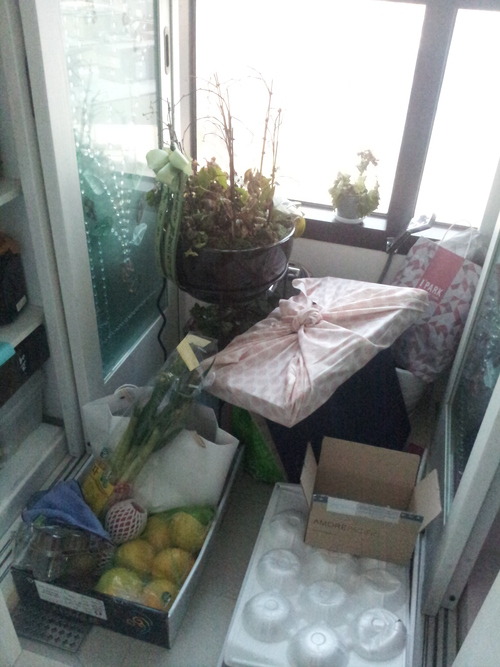
Most Korean apartments have one or more screened-in verandas, usually attached to or near the kitchen. A characteristic not seen so consistently in their foreign counterparts, they are generally too large and built in to be considered a balcony, but also not large enough to be considered a proper room. As they tend to be more well lit and exposed to external temperatures than the rest of the house, they provide a handy place for storing foods in the winter—-apples, onions, sweet potatoes—-or drying them in the summer—-persimmons, peppers. They also serve as a favored spot for hanging laundry or even keeping the washing machine, which might otherwise be in the kitchen or bathroom. In a traditional house, these purposes of the veranda might be better served by one of the many porch-like maru (마루) surrounding the traditional hanok, or just the outdoor courtyard itself.

3. The Anbang


What many English speakers might call the “master bedroom” is still called the “anbang (안방),” or “inner room,” in Korean apartments today. The holdover of this traditional term to describe a home’s largest bedroom—usually for a couple—is somewhat perplexing, as used in the context of a hanok it refers to an often separate structure used exclusively by the woman (alpha female, if you will) of the house.

4. The Underfloor Ondol System


Ah, my favorite aspect of Korean apartment life. The typical Korean ondol (heating) system is a glorious setup in which steam-generated heat radiates from the floor in a soft glow of delicious warmth that layers a new dimension of luxury onto the winter afternoon catnap. Despite providing seemingly more advanced results than the American approach of pumping dry, smelly air into the house until it’s sweltering hot, this form of temperature control can be traced back to the Goryeo (고려) period (932-1392) [2]. Historically, however, the concept of heated floors hasn’t been limited to Korean architecture, as a similar “hypocaust” (literally, “under burnt”) system was also used by the ancient Romans [3] [4]. Western comrades, where did we go wrong?

5. Layered Sliding Windows and Doors


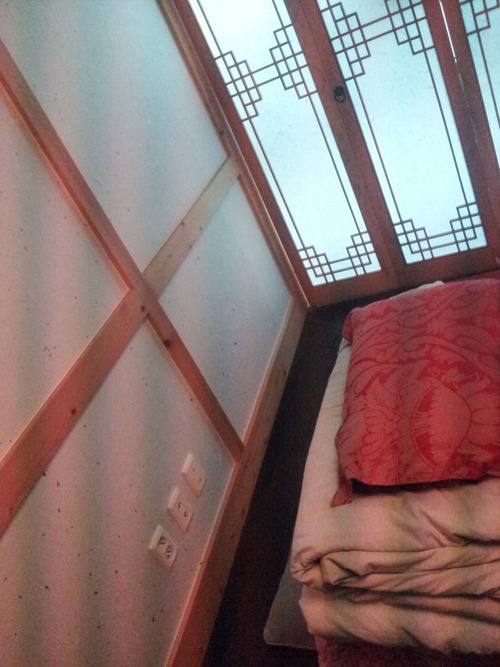
One thing that I haven’t been able to get used to in the Korean apartment is the ubiquity of sliding, often floor-length, windows and doors, which harken back to the days when entire walls were made of paper and could slide away to open a house to good weather. Where many American windows open on hinges, most Korean ones seem to be on sliders. And where American houses might use blinds or drapes to obscure the inside from out, some Korean apartments use an extra layer—sometimes even two—of frosted windows or doors, something that I have never seen anywhere else. Add that to another layer of just screens, and you can see why opening up a room for some fresh air might sometimes be a challenge of almost comical brain-teaser proportions.

Despite this scattering of features that make even the modern apartments here uniquely Korean, it is an undeniable fact that the traditional architecture is on the way out as people increasingly make their homes in densely packed cities (see our feature on Korean apartment life for a taste of just how packed they get). Luckily, Korea has some great resources for keeping its history alive. To read more about Korean traditional architecture, check out the excellent introduction on Korea’s official tourism website here [5]. And to explore some structures yourself, take a trip to one of Korea’s many traditional villages, including Bukchon Hanok Village [6], Namsangol Hanok Village [7], and the Korean Folk Village in Yongin [8] outside of Seoul, or Hahoe and Yangdong Villages in Andong and Gyeongju, respectively [9].

Wednesday, January 8, 2014

Fermented Plums, Pine Needles, and Mugwort: Strange and Innovative Korean Teas

http://youtu.be/LreK41UmxaM

“Don’t you want to see what’s inside?”

I reluctantly tore my eyes from my problem set and glanced over at my boyfriend. He was looming in the doorway of our dormitory over a cardboard shipping box that came up to his knees. “My mom sent it to me today.”

“From California?”

“Korea.”

I pushed my chair back and swiveled toward him. This promised to be more interesting than debugging my seg-faulting homework. My boyfriend’s mother, whom I had met but once earlier that year in 2008 while she tore about in a whirlwind of plastic furniture and yellowed school papers helping pack up her son's room at the end of the last semester, tended to spare no effort when it came to her care packages. She had once sent us an entire box of Korea’s famed red ginseng (홍삼/紅蔘): red ginseng jellies, ginseng hard lozenges, ginseng tea, honeyed ginseng root, red ginseng pills and powders for digestion. And some green tea. Our room had smelled like a corner pharmacy in Flushing for weeks afterward.

“Cookies. Rice cakes. Mmm, laver. Oh! Instant rice. You should try it with the laver; it’s very nice.“ He had already torn open the box and begun stacking its contents around him. “Here, open this tea.” He tossed me an expensive-looking paper box decorated with hangeul script over a delicate patterned background. I opened it to see a plastic bag of what looked like shriveled juniper berries inside.

I had been to China a few times, arguing pennies over paper bags of chrysanthemum buds and jasmine leaves from alleyway huts in Shanghai. “This isn’t tea.” My voice glowed with the authority of Real Experience. “It’s just a box of dried-up… what is it?”

Hongsuk stared at me, the freckled Midwestern suburbanite whose first sixteen years of travel experience had been limited to cheese factories in Wisconsin and Mennonite colonies in southern Indiana. I averted my eyes into the ten-pound pile of dried laver, yakgwa, and rice cookies at his feet. It was possible that he might know more about Korean food than I.

“It’s… mmm…” he thought for a moment and glanced at the label. “Oh yeah, it’s gugijacha. Like… berries.”

“Berries? You people,” I said in mock contempt, “turn everything into tea.”

“Yep,” he said happily, diving back into the goodies.

“Turning everything into tea” is hardly a characteristic special to Korean culture—South African Rooibos tea, Alaskan spruce-tip tea, Spanish garlic tea, and more all stand as testament to human ingenuity and versatility the world over—but it is hard not to get overwhelmed by the sheer variety of the teas traditionally made by Koreans. Just to give a taste (har har), here’s a brief list of some of the different delicious edibles one might find peeking out from traditional Korean tea:

  • Mulberry leaf tea (뽕잎차): I drank this nearly every day for a whole summer while preparing graduate school applications and found it to be a quite worthy substitute for coffee as, when brewed strong, it has a dark, woodsy taste with an almost chocolate finish.

  • Brown rice tea (현미차)

  • Barley tea (보리차): Incidentally served at nearly every Korean restaurant I’ve visited in China. Strangely not as ubiquitous in Seoul.

  • Corn tea (옥수수차): The corn used in this tea is roasted first, which would explain why it tastes more like barley tea than the starchy on-the-cob stuff to which many might be habituated.

  • Solomon’s seal tea (둥굴레차): Dried root of Solomon’s seal, a flowering plant found across Asia. Tastes slightly less exotic than it sounds—or at least it does when brewed from the free teabags in my lab. I liken it to a somewhat more pungent brown rice tea.

  • Buckwheat tea (메밀차)

  • Pine needle tea (솔잎차): YES. Except… just don’t try making it from your neighbor’s discarded Christmas tree. Not speaking from experience. I swear.

  • Chrysanthemum tea (국화차): Also popular in China, where it is sometimes served with rock sugar.

  • Persimmon leaf tea (감잎차): I once ordered this at a teahouse in Insadong somehow expecting that because it was made with persimmon leaves it would be sweet. It was, of course, not. The person with me had somewhat more intelligently ordered a steaming cup of fragrant red date tea. Do not make my mistake.

  • Goji berry tea (구기자차/枸杞子茶): Boiled goji berries, sometimes with honey or sugar.

  • Job’s tears tea (율무차): More like a thick porridge than a tea; made with the grounds of the grain Job’s tears mixed with milk, honey, and sometimes other ingredients like walnuts, almonds, and pine nuts.

  • Ginger tea (생각차/生薑茶): Ginger root boiled with brown sugar or honey.

  • Citron tea (유자차/柚子茶): Citron peels boiled with honey. Don’t try to apply this principle to grapefruits. Citrons are not grapefruits. Citrons boiled with honey turn into delicious citron tea. Grapefruits boiled with honey turn into citrusy vomit.

  • Plum tea (매실차/梅實茶): Fermented plums and lots of sugar. Not to be confused with plum wine.

  • Chinese bitter orange tea (탱자차/橙子茶): Fermented trifoliate orange with sugar.

  • Quince tea (모과차/木瓜茶): Fermented quinces and sugar.

  • Omija tea (오미자차/五味子茶): Fermented omija (“five taste berries”) and lots of sugar. One of the most delicious tastes (or five) that will ever grace your tongue. Waiting endless months for this stuff to ferment is unadulterated anguish, but store-bought omija tea is no comparison to the homemade deal.

  • Sungnyung (숭늉): After-dinner drink made by pouring boiling water over nurungji (누룽지), the crisp rice that sticks to the bottom of the pot after a meal.

  • Sujeonggwa (수정과): Cinnamon, ginger, persimmons, and pine nuts served cold with sugar or honey.


For a more complete and pretty awesome list of Korean teas, see [1].

The above enumeration is staggering, but it doesn’t even mention the so-called medicinal teas brewed to putatively treat various ailments rather than just tickle the tastebuds. This list exhibits some overlap with the above but also includes:

  • Danggui tea (당귀차/當歸茶): A ubiquitous herbal brew made from the dried root of Angelica sinensis. Contains a number of phytochemicals that have supposedly inhibited the growth and proliferation of various cancer cells in culture. I don’t know about its anti-cancer properties, but at least one of its components (decursinol) has consistently demonstrated a marked sedative effect in mice [2].

  • Ginseng tea (인삼차/人蔘茶): Another ubiquitous herbal tea that supposedly treats a wide range of ailments from to insulin intolerance and impotence and, of course, (reportedly) slows aging and reduces cancer risk. Support for such claims by high-quality clinical trials is inconsistent [3] but perhaps bear further research. Can be purchased in pouches as a bitter extract or made oneself by boiling ginseng with honey or sugar. Yum.

  • Mugwort tea (쑥꽃차): Limited evidence that it may stall growth and proliferation of cancer cells, at least in vitro. Has some cool effects on hippocampal slice culture electrophysiology in chronically treated rats. Tastes bitter. But as the Chinese say, 苦药利病: Bitter medicine is good for (treating) sickness. Or just making you feel less bad about the six cups of sujeonggwa you just drank.


…and more. Far, far more.

If it’s a particularly lucky day, a visitor to Korea might also get a taste of some very special tea handed out by local church ajumma attempting to entice new visitors into their services, as they tend to do at odd hours outside my apartment complex. Brewed with cinnamon, ginger, red dates, and a lot of guilt, this uniquely Korean tea, like many of the others mentioned here, is difficult to find anywhere but here.

Unless, of course, you ask a nice Korean mother to send you a care package.

Non-Linked References

[2] Swanberg, K. (2013). Unpublished data. I’ve always wanted to say that.

Saturday, January 4, 2014

Illegal Tutoring, Millionaire Instructors, and Bad Reputations: The Real Cost of Korean Hagwons

http://www.youtube.com/watch?v=1KrY0LZGN2s

Whether you’re a domestic or foreign resident of Korea, chances are the word “hagwon (학원/學院)” carries with it some emotionally laden connotations. According to the “Laws Regarding the Institution and Management of Hagwon and Extracurricular Education in the Republic of Korea (대한민국 학원의 설립·운영 및 과외교습에 관한 법률),” a hagwon is any private organization offering courses that run on a schedule longer than thirty days [1]. Sounds innocuous, right? Perhaps its common English moniker “cram school,” then, might be a better indication of the terrors that lie curled up and waiting in the deep recesses of the concept.

Hagwons offer a wide range of courses for both children and adults, though nearly half of them reportedly constitute prep classes for the fearsome national school entrance exams [2]. At a hagwon one might study ahead in standard public education subjects like math, science, history, or literature; get an edge or just enrich one’s intellectual life with subjects like foreign languages, Chinese characters (한자/漢字/hanja), studio art, and both Korean and foreign musical instruments; or even learn practical skills like dance, martial arts, investing, cooking, Microsoft office, computer operating systems, driving, and more. This variety of classes may seem staggering, but it is hardly surprising given that there exist an estimated 70,000 hagwons in the country today [1].

Many hagwon courses are structured around one or more standardized tests, lending the classes both an urgency and legitimacy sometimes not found in such extracurricular pursuits. Perhaps because of the high value placed on test scores as a component of one’s specifications or “스팩 (spec),” studying for a test appears to be considered by many young Korean adults as a valid lifestyle alternative to enrolling in graduate school or getting a job, at least temporarily. Indeed, in the last two years I have witnessed at least five Korean friends, sick of the thankless overwork and complicated social dramas of Korean workaday life, all but retire themselves from society save for attendance at one or two hagwon courses under the perfectly legitimate guise of “preparing for a test” (one of them ultimately fled to Europe once even the social cachet of this front had been expended after the proverbial test had been taken).

The modern prevalance of private academies has not been a constant staple across even twentieth-century South Korean history. Private academies have been around since at least the late 1800s, but commercialized education has, since then, not been without some social and governmental backlash. In the nineteen-eighties, for example, President Chun Doo Hwan (전두환/全斗煥) made efforts to outlaw private extracurricular academics entirely, a policy that held into the nineties [3]. But even after the subsequent comeback of hagwons, making headlines into the twenty-first century Lee Myung-bak (이명박/李明博) administration were lobbying attempts to level the playing field by introducing policies curbing the academic market’s rapidly bifurcating price brackets, marked by a polarization that 76% of survey respondents called “too extreme” [4]. And even now the Park Geun-hye (박근혜/朴槿惠) administration is enforcing private education policies like strict evening curfews that, to hagwons and their proponents, too closely resemble the wholesale crackdowns of the eighties [5].

But maybe the government should not worry so much about the hagwon-induced effect of economic inequality on student advancement—after all, even in the absence of hagwon wealthy families would still presumably hire the services of elite tutors—but, rather, the economic inequality created by the commodification of a good as vital as education. Hagwon instructor Kim Kihoon, for example, who has been teaching for more than twenty years, apparently brings in an annual income of more than $4 million, mostly through online sales of curricular materials [6]. While Mr. Kim is obviously a highly visible exception to the less-than-stellar hourly wages earned by most Korean and foreign hagwon instructors, his existence does raise the question of how much private individuals or firms should be able to profit from providing a service traditionally considered to be within the purview of calculated governmental wisdom rather than market-based competition.

The pragmatic answer to this question might hinge on whether competition for profit leads to higher-quality instruction than that which might be offered at schools established through more traditional community-based means. Judging from student reports of hagwon instructors being more engaged, more interesting, and all-around more admirable than public school teachers (not surprising given that 10% of these instructors are reportedly fired any given year) [6], the system seems to work, at least for those willing and able to sift out the top-quality schools—and then pay for them. Bringing us back to the original concern that hagwons contribute to the pernicious translation of economic inequality to inequality of social opportunity.

Native Koreans aren’t the only ones to have raised concerns about the hagwon system, which has also, to some degree, received a bad reputation among foreign teachers for its poorly regulated employment conditions. One quick look at Dave’s ESL cafe [7] is enough to suggest that at least some private academies can and do short-change their teachers by controlling—and altering without notice—their housing and roommate conditions, firing them early just to avoid bonus payments, working them overtime without extra pay (anecdotally, this practice seems neither limited to hagwons nor foreign employees), withholding their passports for “safekeeping,” and generally treating them like second-class citizens. I’m sure that at least some of our readers can pipe in with some juicy stories.

But, dear readers, what do you think? Should education be a public good provided solely by tax-funded government institutions or private semi-charitable non-profit bodies, as in research universities? Or should for-profit companies be able to compete within the same market–as long as they are restrained by a certain degree of regulation? And, if so, what sort of regulation? Is the Korean system living up to this ideal? We’re interested in your thoughts.

Friday, January 3, 2014

Putting the “Pa” in “Pajeon”: Korea’s Onion Pancakes

http://www.youtube.com/watch?v=_33u8KZ--oI

My first brush with Korean food was in 2007, at a small restaurant on the outskirts of Harvard Square, sandwiched between an Indian buffet and a boba tea shop. The restaurant was infamous for being expensive and not extraordinarily tasty for the price (a criticism that could admittedly be applied to many dining establishments in the area), but I was pleasantly surprised by both the variety and amount of food that was served.

I don’t recall everything that I ate that night, but two dishes stand out against the rest like onions over a pancake. Both were banchan (飯饌/반찬) appetizers served before the actual meal: The first was kongjaban (콩자반), salty, smoky soybeans in sauce that I continue to encounter at less than ideal frequency even in Seoul; the second, slices of steaming pajeon (파煎/파전).

To those familiar with Chinese food (or its Cantonese-American variant), a pajeon may be likened to a scallion pancake (cóng yóu bĭng 葱油饼): large slices of green onions cooked into a soft, thin cake of doughy rice flour, though rendered into a product perhaps not quite as thick or greasy (the Chinese version is, after all, called “onion oil cake,” while the Korean version is simply “onion cake”) and often with more and larger onion pieces than the Chinese variety. But unlike the Chinese scallion pancake, which is, as its name implies, made with the scallions (대파/daepa) of leekspin fame [1], the Korean jeon is generally cooked with smaller, thinner green onions (실파/silpa; English speakers might call them spring onions or chives) [2]. And, unlike a scallion pancake, a pajeon often prominently features ingredients besides onions: peppers, carrots, kimchi, ham (or spam), mushrooms, beef, or, in the case of a seafood pajeon (海物파煎/해물파전), squid, shrimp, mussels, oysters, clams, and other seafoods [2, 3].

Dissimilar to a pancake as it may be envisioned in some regions of Europe and the United States, the dough of a pajeon is simply a light crust meant to bind the various vegetables and proteins together instead of the main focus merely to be decorated by blueberries, walnuts, or a pat of butter. This often results in a thinner and more organically shaped cake than the monster carbohydrate frisbees to which some may be accustomed when they hear the word “pancake.” In this way it might be likened more to a latke or hash brown patty than a dough hotcake destined for being drowned in sauces and toppings less boring than itself.

As mentioned in our post about soju and makgeolli [4], pajeon are sometimes eaten on rainy days with a bowl of makgeolli. There doesn’t seem to be an obvious link between rain and green onions except that both might be sketched with long and skinny lines, and there certainly seems to be little relationship between rain and makgeolli over that with any other potable liquid, so an examination into the origin of this tradition promises an interesting story.

The word on Naver street seems to be that the putative link between rain and pajeon is not visual but, rather, auditory, as the sound of pajeon frying in oil resembles (or should resemble—-all you novice Korean cookers take note) the sound of rain pattering down on a roof [5]. Where the makgeolli comes in is still unclear. But hey, I’ll take it.

So the next time someone asks you, “What’s round, yellow, and green (and sometimes red, brown, orange, and pink) all over?” you will now know that the obvious answer is “a pajeon rolling down a hill.” And the next time you chance across a pajeon rolling down a hill, you will now know a little bit about the culture that makes it more special than just a gyrating lump of dough with some onions hiding inside. But with great knowledge comes great responsibility: So go, now, and use your newfound awareness to make friends with onion pancakes and their creators across the world.